


H.775 is an innovative housing bill designed to stimulate housing development in Vermont through financial tools, pilot programs, and planning reforms. The legislation authorizes municipalities to issue revenue bonds backed by special assessments, expands the State Treasurer's credit facility, broadens VEDA financing authority for certain multiunit housing developments, adds new municipal housing-planning requirements, codifies the Rental Housing Revolving Loan Program, and (in the Senate version) adds a new Service-Supported Housing Advisory Council focused on housing for individuals with developmental disabilities.
The Details:
The legislation proposes a multi-pronged approach to addressing housing needs, focusing on financing tools, off-site construction, and municipal planning supports:
-
A Service-Supported Housing Advisory Council is created, overseen by the Department of Disabilities, Aging, and Independent Living. The Council is composed of representatives from the Vermont Housing and Conservation Board, the Agency of Human Services, the State Treasurer's office, the Commissioner of Housing and Community Development, the Developmental Disabilities Housing Initiative, the Vermont Developmental Disabilities Council, Green Mountain Self-Advocates, and Vermont Care Partners.
The Council shall meet at least monthly and is charged with identifying opportunities for increased alignment between human services programs and housing capital and support services programs, particularly for individuals who receive Medicaid-funded Developmental Disability Services.
The Council must report annually (by November 15) to relevant House and Senate committees on reforms, housing needs assessments for this population, activities undertaken, and recommendations for future legislative action and funding sources.
-
Municipal Plans For Housing: a new requirement is added for municipalities to include a housing element in their plans that identifies current and projected housing needs, including needs for people with disabilities. If a municipality cannot meet regional housing targets, it must analyze regulatory and physical constraints and report impediments to the Department of Housing and Community Development, including potential actions to address those constraints.
-
Duplexes shall be a permitted use (upgraded from "allowed" in the House version) in any district allowing year-round residential development, with dimensional standards no more restrictive than those for a single-unit dwelling.
-
Multiunit dwellings with four or fewer units shall be a permitted use on the same size lot as a single-unit dwelling in any district served by municipal sewer and water infrastructure that allows residential development, unless that district specifically requires structures with more than four units.
-
-
Special Assessment Bonds:
-
Municipalities may issue revenue bonds to finance a public improvement that benefits a limited area of the municipality.
-
These bonds are repaid only from special assessments on the properties served by the improvement and are not backed by the municipality’s general taxing power.
-
-
State Treasurer Credit Facility & Housing Fund:
The bill increases the State Treasurer’s authority to establish a credit facility from 10 percent to 12.5 percent of the State’s average cash balance. It also authorizes a separate credit facility of up to one percent of the State’s average cash balance for bulk purchasing of off-site constructed housing, though any amount used there reduces the larger facility by the same amount. The bill also preserves the Treasurer’s separate authority for a climate infrastructure and resilience credit facility of up to 2.5 percent. -
Mobile Home Park Infrastructure: the Treasurer may continue using amounts available under the credit facility to provide financing for infrastructure projects in Vermont mobile home parks and may modify financing terms as needed to promote housing availability and protect the interests of the State.
-
Off-Site Construction Accelerator:
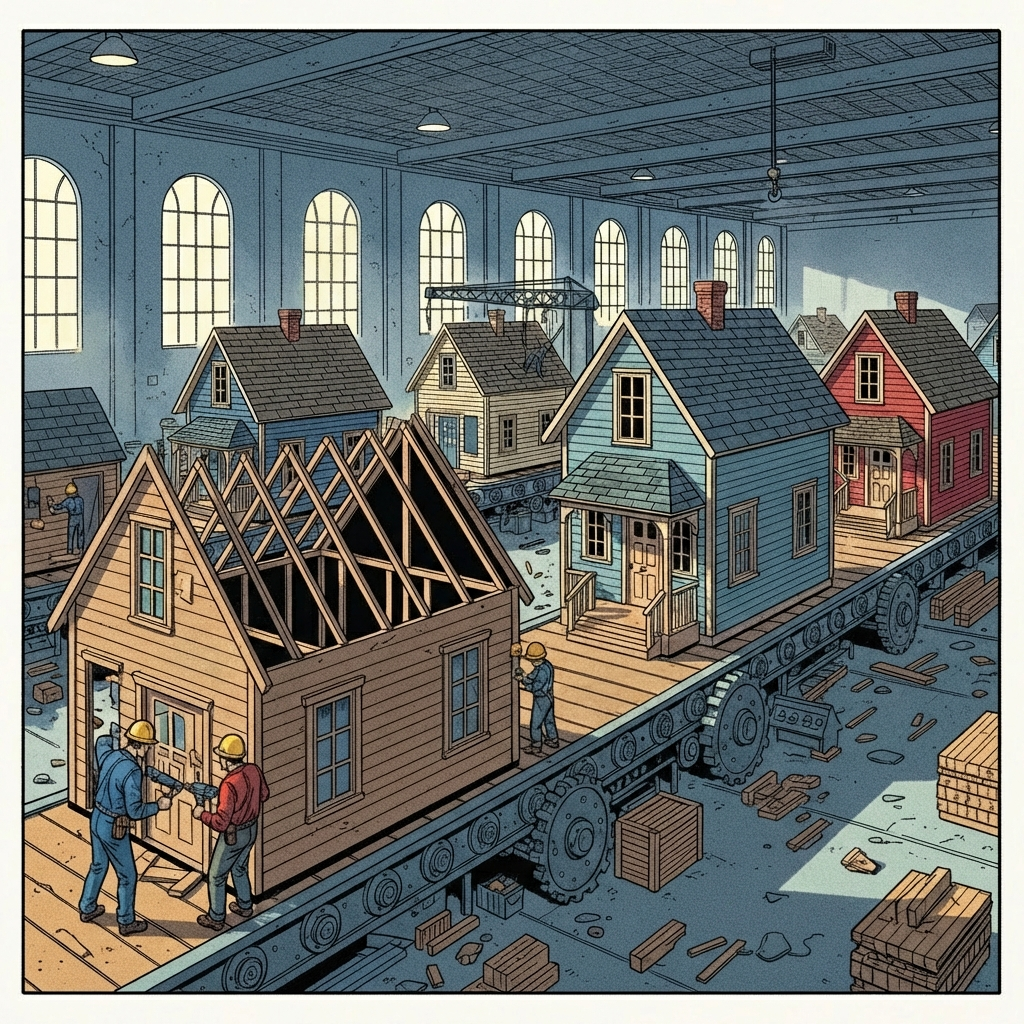
The Agency of Commerce and Community Development is directed to develop a pilot demonstration project and study exploring whether modular and other off-site construction methods can reduce housing development costs. The pilot will examine bulk purchasing, preapproved designs, loan loss reserves, statewide procurement, permitting alignment, and possible off-site building codes.
-
VHIP Reporting: A new annual reporting requirement is added for the existing Vermont Rental Housing Improvement Program (VHIP), requiring the Department to report to the Legislature by November 15 each year on units funded, rehabilitation outcomes, rent levels relative to HUD fair market rents, and tenant turnover rates.
- VEDA’s Expansion: The Vermont Economic Development Authority (VEDA) expands financing scope to include housing-related projects and certain multiunit housing developments of five or more units, when requested by and jointly financed with a financing lender, subject to consultation with and deference to the VHFA where both entities could finance the project.
-
The Senate version codifies in statute the Rental Housing Revolving Loan Program, originally enacted in 2023 and administered by the Vermont Housing Finance Agency. Key features of the Program include:
-
Eligibility: Projects must create two or more new rental units, with at least 25% of units affordable to households earning up to 150% of area median income (AMI). Eligible project types include new construction, substantial rehabilitation, and preservation of naturally occurring affordable housing.
-
Loan limits: The lesser of 35% of costs allocable to affordable units, or $150,000/unit (up to 80% AMI) or $100,000/unit (81–150% AMI); these amounts are adjusted at least annually for inflation.
-
Enhanced subsidies may be available for projects with employer investment, municipal/community investment, tax-exempt bond funding or LIHTC participation, or small-scale infill development within historic settlement patterns.
-
Affordability requirements: Subsidized units must remain affordable for the longer of seven years or full loan repayment plus three years; annual rent increases are capped at 3%.
-
The Agency must design the Program with a streamlined application process and equitable statewide distribution, with priority given to communities with the greatest economic and employment needs.
-
The Good:
|
The Bad:
|
Analysis:
This bill represents a shift towards owner-occupied housing assistance that has often been neglected over the past 20 years. The programs proposed in the bill recognize that traditional market forces and state subsidies are failing to produce affordable owner-occupied housing, particularly in rural parts of the state.
The focus on off-site construction (modular housing) addresses the acute labor shortage in the construction sector as well as the exploding cost of site-built construction. Research indicates that modular construction can reduce project timelines by 20–50% and lower costs by up to 20%, offering a viable solution for Vermont's high building costs. However, financing modular projects is often difficult because lenders are hesitant to release funds for off-site materials; the State Treasurer's involvement here attempts to bridge that financing gap.
The introduction of "Special Assessment Bonds" aligns Vermont with other states that use special districts to localize the cost of infrastructure. This ensures that the costs of new sidewalks or sewers fall on the specific properties benefiting from them, rather than the general taxpayer base. This mechanism helps protect the general credit rating and taxing authority of the municipality.
The codification of the Rental Housing Revolving Loan Program represents a meaningful step toward stabilizing middle-income rental housing production, with built-in incentives for employer and community investment and a clear affordability framework. The addition of a Service-Supported Housing Advisory Council reflects an important, if overdue, recognition that housing policy must account for Vermonters with developmental disabilities.
Overall, this bill creates benefits for several stakeholders:
-
Municipalities gain a new financing tool for infrastructure and a framework for identifying local housing constraints.
-
Developers and lenders gain access to additional financing pathways, including VEDA participation in some multiunit housing projects.
-
Homebuyers and residents could benefit if off-site construction and infrastructure financing reduce development costs and increase housing supply.
-
Vermonters with developmental disabilities gain a dedicated advisory structure to align housing capital with support services.
-
State agencies take on a more active coordinating role in housing finance and modular-construction policy.
This legislation signals a recognition that regulatory reform alone is insufficient, requiring direct financial intervention and supply-chain management to increase housing stock and decrease cost of construction and time to market.
Current Status:
The bill was passed by the House on 3/19/2026 and was considered by the Senate Economic Development and the Senate Natural Resources Committees before the Senate Appropriations Committee failed to advance the bill before adjournment on May 29th. The bill is now dead and will need to be re-introduced.
Last updated: 06/04/2026
DISCLAIMER: Generative AI used to assist in the production of this report.
News coverage on H.775 |
Read the Bill |
More bill summaries |