


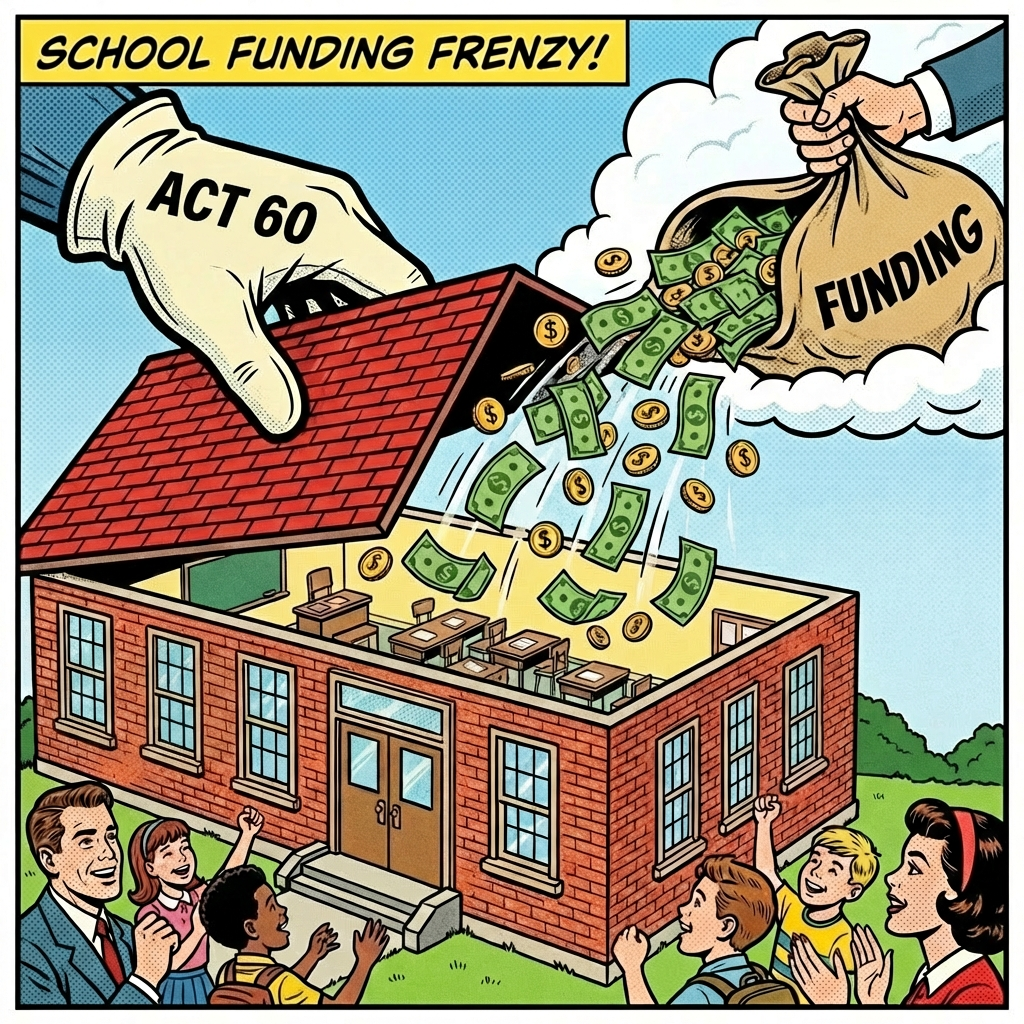
S.220, seeks to curb the growth of property taxes by placing temporary limits on school district budget increases.
The Details:
-
Lowers the excess spending threshold: Amends the definition of "excess spending" to be any amount greater than 112% of the statewide average per-pupil spending. This is a reduction from the current 118% threshold, which means the penalty will apply to a wider range of districts.
-
Exempts voter-approved bonds: Removes all voter-approved bond payments (both principal and interest) from being counted as education spending when calculating the excess spending penalty.
-
Establishes a "good cause" appeal process: Allows a school district to avoid the excess spending penalty if the Secretary of Education determines an increase was for "good cause" or was beyond the district's control. Examples include emergency capital expenditures or a substantial loss of students or revenue.
The Good:
|
The Bad:
|
Analysis:
It is important to note that this bill was significantly altered by the Senate Finance Committee. The original version of S.220 proposed a temporary cap on the growth rate of school budgets. The current version, as passed by the Senate, instead changes the formula for the state's existing excess spending penalty, lowering the threshold from 118% to 112% of the statewide average per-pupil spending.
A primary trade-off in this legislation is the tension between local democratic control and state-level accountability. While Vermont has a long tradition of voters deciding their school budgets at town meetings, this bill creates a strong financial disincentive to approve budgets that exceed the state’s threshold. This may improve short-term economic security for taxpayers, but it raises questions about the ability of local communities to address unique student needs that the state’s funding formula might not fully capture.
Furthermore, the "good cause" appeal process introduces a layer of bureaucracy that depends heavily on the discretion of the Secretary of Education and an advisory panel. It is possible that a significant number of districts will try to take advantage of this appeals process.
Unfortunately, it is unclear if lowering the threshold to 112% of the statewide average will be sufficient to constrain spending. One of the main reasons for the current property tax crisis is that spending growth has consistently outpaced organic revenue growth. To be effective, any mechanism must rein in overall spending growth to a level that aligns with available revenue in order to prevent further property tax rate increases.
Current Status:
The bill was introduced by the Senate Finance Committee and passed by the Senate on 3/24/2026 but the House declined to advance the bill. However, a version of this mechanism was included in the yield bill, H.949.
Last updated: 6/6/2026
DISCLAIMER: Generative AI used to assist in the production of this report.
News coverage on S.220 |
Read the Bill |
More bill summaries |