


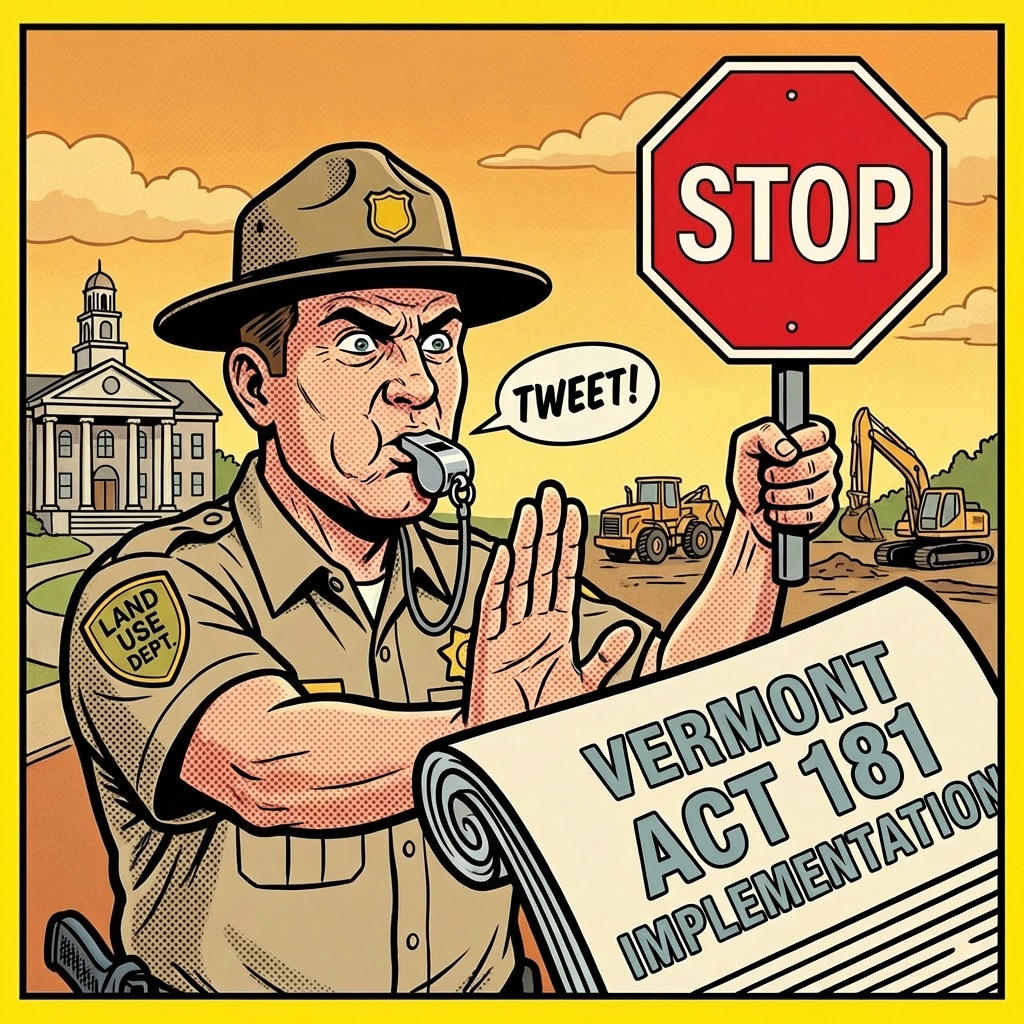
Act 152 makes technical, transitional, and policy changes to Vermont’s land use and regional planning laws to recalibrate implementation of Act 181. In the House proposal of amendment, the bill repeals Act 181’s road-jurisdiction and Tier 3 jurisdiction provisions, delays certain related implementation dates, extends several housing-related exemptions through 2028, and clarifies how Tier 1A and Tier 1B review will work under the new land use planning framework. It also makes changes to regional planning procedures, creates new reporting and oversight requirements, and adds a public engagement process on working lands and natural resource protections.
The Details:
-
Extended timelines:
-
Act 181’s road-jurisdiction provision is repealed. (The original Senate version delayed rollout of the revised “road rule”)
-
Act 181’s Tier 3 jurisdiction provisions are repealed. (The Senate version delayed implementation; the House version deletes those sections instead.)
-
The temporary exemption for certain priority housing projects in and around designated centers is extended from 2027 to 2028, while keeping limits related to floodplains, river corridors, and wastewater or utility service. (Added by the House)
-
Regional and municipal plans set to expire in 2026 or 2027 are extended until December 31, 2027.
-
Environmental justice implementation deadlines are pushed back, including the public release of the mapping tool and certain rulemaking deadlines.
-
-
Clarifications & Exemptions:
-
Municipalities in Tier 1A areas continue to have a process for carrying forward relevant conditions from prior Act 250 permits into local permits, with findings, notice, hearing, and land-recording requirements.
-
Municipal panels in Tier 1A areas are required to enforce existing Act 250 permit conditions when those conditions have not yet been transferred into a municipal permit.
- Projects in approved Tier 1B areas remain eligible for exemption from Act 250 review for certain housing and mixed-use projects with 50 or fewer housing units on 10 acres or less.
-
Accessory on-farm business exemptions are revised so that Act 250 exemption language expressly covers improvements for storage or sale of qualifying products, preparation or processing of qualifying products under existing sales thresholds, and certain educational, recreational, or social events featuring agricultural practices or qualifying products. (The House version broadened and reorganized on-farm business exemption language.)
-
-
State responsibilities:
-
Regional planning procedures are adjusted by requiring draft regional plans to be submitted to the Land Use Review Board before hearings, setting review timelines, requiring clearer notice to municipalities about future land use map changes and Tier options, and creating distinct processes for minor and nonminor future land use map amendments.
-
The bill removes references to Tier 3 area status from the regional future land use framework.
-
-
Other items:
-
The bill creates a Joint Legislative Environmental Oversight Committee to oversee Land Use Review Board and Agency of Natural Resources permitting processes through July 1, 2029. (Added in the House version)
-
The bill requires a public engagement plan to gather statewide input on protection of working lands and critical natural resources. (Added in the House version)
-
The Land Use Review Board must prepare reports on commercial activities on farms, mitigation on primary agricultural soils, and the effects of jurisdictional triggers and Criterion 9(L) on retail and service development outside village centers.
-
The bill requires an annual report on the Community Investment Program and a separate report on municipal appeals, discretionary review of housing, Act 250-exempt housing production, and the 802 Homes pilot program.
-
The statute providing formal review of regional planning commission decisions is repealed.
-
The Good:
|
The Bad:
|
Analysis:
Act 152 remains essentially an implementation and calibration bill rather than a broad new policy departure, but the House proposal makes more substantive changes than the earlier version. The bill no longer simply slows rollout of selected Act 181 tools. Instead, it repeals Act 181’s road-jurisdiction section and its Tier 2 and Tier 3 jurisdiction sections, while preserving and extending several housing exemptions and continuing the transition toward the revised planning framework. In that sense, the House version is still trying to stabilize a major land use reform, but it does so by pulling back parts of Act 181 that lawmakers may now view as premature, unclear, or too difficult to administer on the original timeline.
The main trade-off is still between urgency and readiness. Vermont’s housing shortage creates pressure to reduce delays and allow more homes in downtowns, village areas, and other places with infrastructure. S.325 responds by extending exemptions for housing in designated centers and nearby eligible areas through 2028. Those provisions may improve housing access for Vermont students, families, workers, and older residents who want to stay in their communities. At the same time, the House version goes further than the earlier bill by repealing, rather than merely delaying, the road-jurisdiction and Tier 2/Tier 3 provisions. That reflects concern that the State is not yet ready to apply those tools consistently, that they may be difficult to explain or administer, or that they could have unintended consequences for rural parts of the state.
The bill also continues to highlight a trade-off between streamlining and accountability. Supporters of the transition language argued that towns should not be discouraged from opting into Tier 1A by fear of instantly taking over every preexisting Act 250 permit. This bill preserves that basic approach by clarifying that municipalities primarily enforce their own permits as projects come forward for amendment, while still preserving continuity for older permit conditions. That may make local administration more practical. But it also puts more weight on municipal capacity, which varies across the state. If some communities have stronger bylaws, staff, and enforcement tools than others, then similar projects may receive different levels of scrutiny and follow-up.
Another important tension is between concentrated development and environmental caution. The bill continues to direct growth toward mapped centers, planned growth areas, village areas, and other existing settlement patterns consistent with smart growth principles. That may strengthen local economies, improve access to services, and reduce the pattern of scattered development that can raise infrastructure and transportation costs. At the same time, the House proposal adds a public engagement process focused on working lands and natural resources, creates a legislative oversight committee, and delays some environmental justice implementation deadlines. Those choices suggest lawmakers are still working through how best to balance housing production, rural land use, environmental protection, and public trust.
On balance, the legislation appears designed to buy more time, preserve housing momentum, and make the new framework more workable, while leaving several harder questions about cost, environmental boundaries, rural land use, and the permanent permitting structure for future legislative sessions.
Current Status:
The bill passed the Senate on 3/27/2026 and was subsequently amended by the House on 5/7/2026 and sent back to the Senate. The bill was negotiated in conference committee between the two chambers and then signed by the Governor on June 16, 2026. The bill will now become law.
Last updated: 6/20/2026
DISCLAIMER: Generative AI used to assist in the production of this report.
News coverage on S.325 |
Read the Act |
More bill summaries |