


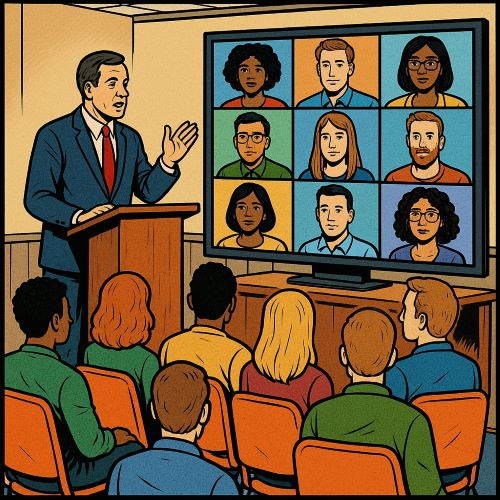
The bill amends the state's Open Meeting Law to enhance transparency, accessibility, and accountability in public meetings; requiring hybrid meetings and clarifying policies and procedures for various meeting functions.
The Details:
-
Right to Attend Meetings
- Declares all public body meetings open to the public, except as allowed under executive session provisions.
- Mandates hybrid meetings (physical and electronic platforms) for state public bodies, excluding advisory bodies, with audiovisual recordings retained for 30 days post-meeting.
- Exempts site inspections and field visits from hybrid meeting requirements.
- Requires municipal public bodies to record meetings and post recordings for 30 days after official minutes are approved.
- Mandates electronic platforms for hybrid meetings to allow public access, including by telephone, with access details in meeting agendas.
- Requires clear designation of meeting times and places, with public notice for special meetings at least 24 hours in advance.
- Mandates detailed meeting agendas posted 48 hours before regular meetings and 24 hours before special meetings, with executive session details specified.
- Requires annual training on Open Meeting Law procedures for municipal chairs, town managers, mayors, state public body chairs, and state advisory body members.
-
Executive Sessions
- Requires a two-thirds vote for state public bodies or a majority for municipal bodies to enter executive sessions, with the motion specifying the business to be discussed.
- Limits executive sessions to specific matters, including security, cybersecurity, emergency response, and confidential business information for state public body loans.
- Prohibits formal actions in executive sessions, except for real estate options, and exempts minutes from public inspection.
-
Disorderly Conduct
- Amends the definition of "disturbs any lawful assembly or meeting" to align with constitutional requirements from State v. Colby (2009), specifying conduct that substantially impairs meetings, such as causing premature termination or sustained disruptions after warnings.
- Amends the definition of "disturbs any lawful assembly or meeting" to align with constitutional requirements from State v. Colby (2009), specifying conduct that substantially impairs meetings, such as causing premature termination or sustained disruptions after warnings.
-
Effective Date:
- The act takes effect upon passage.
The Good:
|
The Bad:
|
Analysis:
While there is give and take, this bill generally allows better access to public bodies through electronic and a-synchronous means. The legislature has had hybrid meeting options for several years now and it has improved access, understanding, and engagement.
The most controversial portions of the bill deal with disruptive meeting attendees and how to appropriately handle situations where meeting procedures are interrupted by such individuals. This is a delicate balance between protecting the public interest in terms of the work the public body is conducting while also ensuring the free speech rights of the individual.
The balance struck in this bill is based on prior legal precedent, which seems reasonable.
Current Status:
The bill has been passed by both the House and the Senate and was singed by the Governor on June 9, 2025.
News coverage on S.59 |
Read the Bill |
More bill summaries |
Last updated: 6/21/2025
DISCLAIMER: Generative AI used to assist in the production of this report.