


Let’s pause for a second and look at 50 years of Act 250 from the perspective of a Vermont professional civil engineer, and Act 250 Land Use Consultant. I did my first land use project in 1973.
The first question, what went wrong in the first 50 years? My opinion, Act 250 killed housing and precluded most of Vermont from having a chance for a vibrant economy.
Here’s why…
First Example:
Act 250 is inherently flawed from the perspective of an applicant, landowner, and developer; the process is un-predicable and cannot assure a permit will be issued; cannot assure what conditions may be attached to that permit; cannot assure on what timeline a permit may be issued; and is devastatingly risky to the applicant.
Over my greater than 50 years helping landowners and developers negotiate the Act 250 process, the first question out of any developer considering applying for a permit is most often, “Can you assure me I will receive an Act 250 approval?”
The only honest answer is, while most permits are eventually approved, I cannot assure you will receive an Act 250 permit, nor what conditions may be imposed.
“Well then, can you tell me how long it will take to negotiate the Act 250 process?”
The duration is controlled by two regulatory regimes, the Act 250 permitting process, itself; but perhaps even more so by the Agency of Natural Resource (ANR) and the Department of Environmental Conservation (DEC). DEC administers a myriad of permit programs that may or may not apply to your proposed land use. The real duration is closely linked to the number of DEC permits on which Act 250 relies before rendering a decision.
Once all ANR/DEC permit applications are submitted for review to each individual DEC feifdom, you may submit the Act 250 Land Use Permit Application. But Act 250 will not determine the application ready for review until every DEC permit is issued and on file with the Act 250 office. This same process also is also required if an Agency of Transportation (AOT) approval applies.
In addition, you may need an architect, mechanical and electrical engineers to assist with this array of permits. Those application fees and professional fees are independent of our project engineering fees.
“Well, if I move forward with Act 250 and all the relevant permit applications, can you at least provide a probable budget for the whole processes?”
I’ll be blunt, there is no way to even begin to estimate any budget, there are simply too many variables. Act 250 is so unpredictable, untimely, and expensive there is no ability to provide any applicant with any assurances.
I cannot tell you how many times I, as an Act 250 consultant, have participated in this dialog. Many, if not most, will have walked away before this conversation is concluded. A few will stay long enough to inquire, “what are my options to make this predictable and timely to the point where I can get a reasonable estimate of the cost?”
The answer is simple and straight forward. Scale back the size and scope of your development project so as to be smaller than the Act 250 definition of development. This is why so much of rural Vermont suffers from inadequate housing and economic stagnation, it is less risky and more economical to reduce the scope to avoid Act 250.
Second Example:
The housing threshold. The threshold for Act 250 housing jurisdiction varies; based on a municipality having adopted and approved, subdivision and zoning ordinances.
Towns with approved subdivision and zoning, were deemed exempt from Act 250 jurisdiction, provided the subdivision was for 10 or fewer lots. Projects involving ten lots or more required an applicant to apply for and receive both Act 250 approval and all applicable ANR, DEC, and AOT permits. In essence, if a subdivision, multifamily housing project, motel/hotel/B&B were for greater than ten units, Act 250 was mandatory, statewide.
For municipalities without approved subdivision or zoning, this exemption was provided if the subdivision was for six or fewer; subdivision lots, multifamily housing, motel/hotel/B&B.
The reader must stop and pause to digest this; Act 250 was so strict, it automatically triggered for any development activity that envisioned 10 or more dwelling units. This could apply in many communities for as few as six dwelling units.
And Vermonters have been left to wonder why there is a housing shortage.
Let’s dissect Rutland County; 27 total municipalities; 11 municipalities were designated as 10-acre towns, and 16 were designated as one-acre towns. While 11 municipalities had adopted approved subdivision and zoning ordinances, the plurality, 16 towns, mostly rural, did not meet the exemption threshold, they were limited to five lots without requiring an Act 250 permit.
This was largely replicated throughout the state of Vermont. While several rural communities did adopt subdivision and zoning ordinances, the larger majority of rural Vermont lacked the wherewithal and impetus to comply with the mandates of Act 250 (limited to five lots if avoiding Act 250).
For a developer and/or landowner seeking to subdivide, entering the Act 250 processes became perceived as a significant burden for all the reasons outlined above. Act 250 was, for many, a non-starter.
The simple answer became to avoid act 250, reduce the number of housing units to below the threshold, and Act 250 disappeared.
Mind you, the cost of negotiating Act 250 is wholly at the expense of the landowner or developer. Banks will not loan money to a developer until all permits are in hand, including Act 250 permits, and the 30-day appeal period has expired. For any large subdivision of land tens of thousands of dollars were put at risk for this bargain.
In my experience, only the most well-financed developers were able to engage in the Act 250 process.
Third Example:
The business threshold. The same Act 250 jurisdictions for housing, are applicable for commerce and businesses. The same 10 acre and 1-acre triggers applied to commercial development for towns with/without zoning.
From a practical perspective, a one-acre town was precluded from most new commerce because no business wanted to risk an Act 250 process for a project or build in less than a 1-acre footprint. Ten-acre towns were much more attractive.
Returning to Rutland County, only 11 communities had approved subdivision and zoning ordinances, 16 were one acre and required a permit for nearly all businesses.
At this point, it is worth a look at Chittenden County. Only Buel’s Gore is a one-acre community, all 18 other municipalities are 10-acre towns, providing them with the opportunity for economic growth and housing. Of note, only Franklin, Washington, Grand Isle, Addison and Bennington counties have more 10-acre towns than one-acre municipalities. However, many of these municipalities, if not most, have permanent zoning administrators facilitating a much smoother transition. Many smaller and more rural communities that lack on-site staff have foregone the process of permanent subdivision and zoning ordinances.
For one-acre rural Vermont, development for commerce (small businesses, mom and pop shops, manufacturing, retail, any small business) on a parcel of land greater than one-acre triggered Act 250 jurisdiction. For a mom-and-pop grocery store in rural Vermont, a 20x20ft addition or a change in parking automatically triggered Act 250. Small businesses had to weigh the cost of that process vs how many cans of beans needed to be sold to break even.
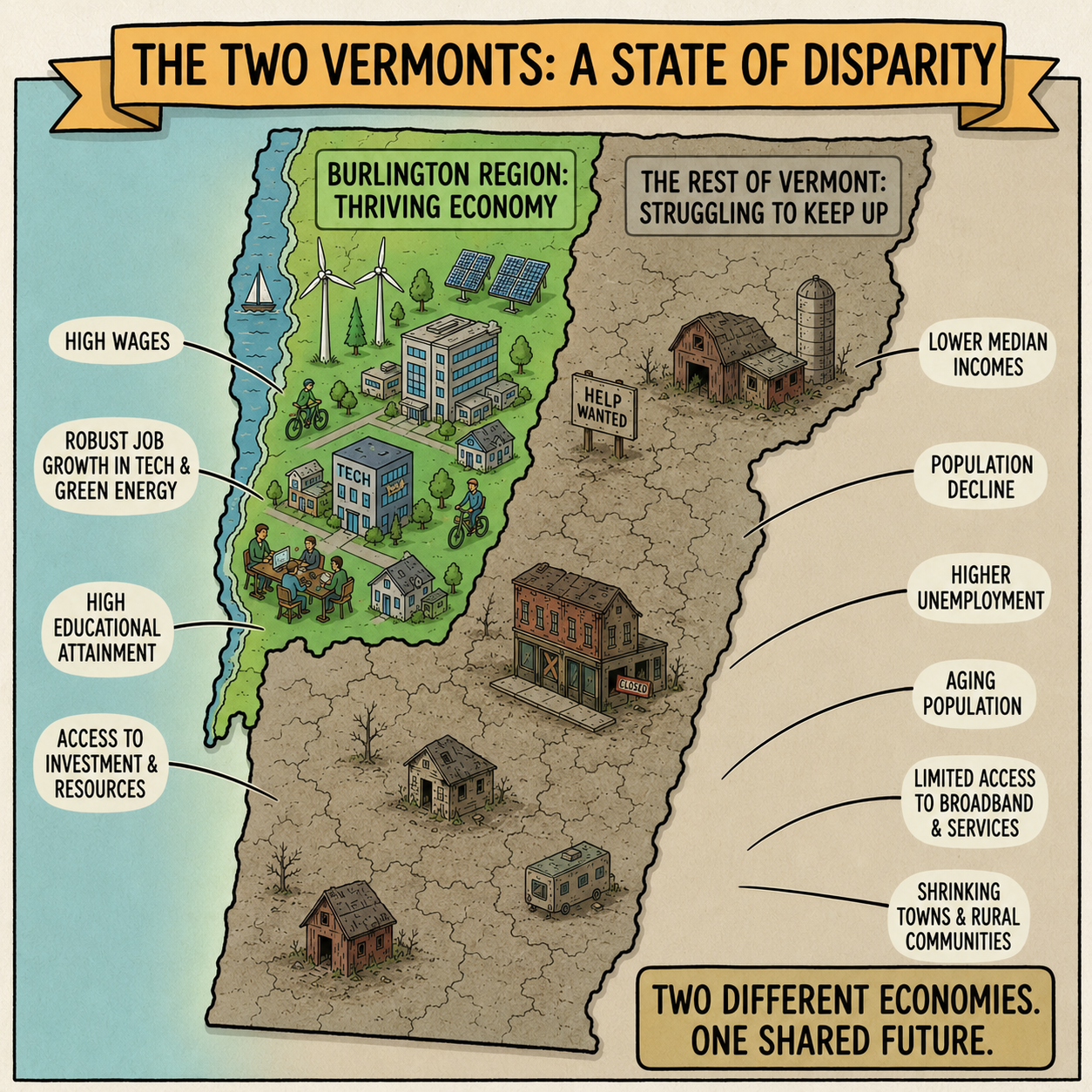
In my opinion, Act 250 has furthered the divide between the two Vermont’s, urban vs rural.
Fourth Example:
The road rule. First let’s explore a “rule” and a “statute.” A rule is an LCAR approved procedure granted to a state agency for the adoption of a rule. In a rule, an agency may propose and LCAR may eliminate, reduce, or expand the jurisdiction in the proposed rule. Originally, Act 250 had an 800 ft “road rule” trigger. In other words, if a project included a road of 800 ft or more (driveways not included), Act 250 was triggered.
The problem with a rule was, and remains, that it is an arbitrary permitting trigger threshold. A road of 799 ft is below the jurisdictional threshold, no permit required. If the road is just a few feet longer, at 802 ft for example, a permit is required. So, many engineers, myself included, would develop plans with roads 799 ft or less. No triggering Act 250 jurisdiction.
The Act 181 proposal for an 800 ft roadway, including driveways, remains an arbitrary trigger, wholly unjustified by environmental standards. This is being proposed as a statutory change, meaning that this is no longer an LCAR jurisdiction. A statute is approved by the Legislature and signed by the Governor. Once in law, the procedures for changes are not at all simple. It would require another law to be passed.
In my opinion, and 800 ft road rule statute, is a non-negotiable permit killer. A two-lot subdivision with a road greater than 800 ft would mandate the developer and/or landowner to obtain an Act 250 permit, thereby facing the un-predictability of the process, the opportunity of undue conditions, the untimeliness of the process, and the expense of consultants and application fees. To most this is a no-can-do.
Second truth, if the developer manages to construct a driveway just under 799 ft, and a future landowner extends their driveway by ten feet, perhaps an innocent error, an Act 250 permit is now immediately required, and the landowner is in violation of the law. Now what?
This 800 ft statute limit denies a landowner or developer the implied ‘right to defend use of their personal property.’ This gives no opportunity to present evidence that extending the road completely meets all the environmental regulations imposed by ANR/DEC. Does that extra 10 feet impose so much risk of environmental damage that it necessitates the full Act 250 process? This is a question we should be asking ourselves.
What’s Act 181 really going to do for housing and the economy of Vermont?
This is my opinion of how the next 50 years may play out under Act 181 based on the past 50 years under Act 250. I am not a sociologist; I am a retired Vermont registered professional engineer that has 50+ years of experience in Act 250.
In 2024, the Vermont legislature passed Act 181 to update many aspects of Act 250. Act 181 creates new statutory tiers where housing is encouraged, while severely restricting development in other areas of the state.
Let’s call this what it really is; Act 181 does not protect the environment. Act 181 is creating opportunity zones and punishment zones, classifying rural Vermont where dwelling and economic survival will be forever more difficult.
The environmental rules and regulations administered by ANR/DEC will remain largely the same. Act 181 is not making sweeping changes to the rules that protect the environment (water, wastewater, stormwater, agriculture, wetlands, river corridors, shoreland protection), I could go on, they remain applicable regardless.
These tiers will be in statute, forever. These tiers presently are unvetted by the citizens of Vermont; they have been vetted in the halls of the legislature, based on “recommendations” from Vermont’s “regional planning commissions.” Tier 1A and B, apply minimally to 2% to 2.5% of Vermont’s total land area. These are the areas that would be largely exempt from Act 250 going forward.
By their own numbers then, an estimated 95% plus of Vermont will forever remain rural, in statute.
Notwithstanding, Vermont has the lowest birthrate in the nation, an aging population, and a reported lack of affordable housing. Vermont is rated as one of the slowest growing economies in the nation, estimated 1.9% to 2.5% annual growth. Wage rates for similar employment opportunities vary widely between populous Chittenden County and more rural parts of Vermont.
The legislative intent of Act 181 Tier 2 is to largely leave the current regulatory framework in place, while the goal of Tier 3 is to substantially increase the Act 250 burden on applicants, substantially increase the cost of regulatory compliance. For those creating housing and commerce in our state, I fear this will forever increase the burden on rural Vermont.
A few demographics:
City of Rutland (US Census)
-
- 1880 Rutland was Vermont’s largest city
- 1970 Rutland reached its peak population, 19,293
- 1990 modern peak before a steadier decline, 18,230
- 2020 census, 15,807
Chittenden County (Wikipedia)
-
- 1970 population 99,131
- 2022 population 169,301
- 1970-2010 27% increase
- 2010-2020 7.5% increase
- 2020 – present more modest, 8%
While one is city and the other a county, they represent the two Vermont’s: urban growth in northern Vermont and rural decline in the rest of the state.
I turned to AI to list examples of consequences for communities losing population. I selected five. The opinions on the probable consequences of population decline in Vermont are mine.
- Vermont is already witnessing population decline. It is in the news almost daily. The student population has plummeted from 105,000 (1998) to 73,000 (2025) students.
- Vermont has the lowest birth rate in the nation, an aging population, and a reported lack of affordable housing.
- For a rural Vermonter, it is impossible to ignore the economic power of Williston; and its surrounding areas near Burlington; and the economic blight of rural Vermont.
- By statute, the legislature is forever creating a northern powerhouse, Tiers 1A and 1B; at the expense of forever rural Vermont, Tiers 2 and 3.
In my opinion, I expect rural Vermont will see increased labor shortages, slower economic growth, closure of businesses, decrease in tax revenue, and declining value in real estate.
Labor shortages
Vermont is already suffering from labor shortages. The blame is continually placed upon the lack of housing; that is certainly not my opinion. After watching 50 years of vilification of housing and commerce in rural Vermont under Act 250. It’s clear to me, this is the basis of Vermont’s near stagnant economy.
Economic growth comes from jobs and increased employment opportunities, entrepreneurial spirit, the growth of the bottom line for all businesses. This economic growth allows employers to raise wages, hire more employees, increase job responsibilities, build more retail, produce more manufacturing, and increase warehousing.
If Vermont as a whole is growing at 1.9 to 2.5%, businesses in Vermont are not keeping up with inflation. And if Burlington and the surrounding communities are growing faster, then rural Vermont is growing even slower, and that trend is accelerating.
Vermont’s legislature must immediately address the stagnation of rural Vermont by reducing regulations so as to inspire housing and commercial development in all corners of the state.
Slower economic growth & loss of local businesses
With an inability to maintain the economic health of a community, economic health will deteriorate. Farms, once vibrant, will shutter, as will gas stations, mom-and-pop stores, pharmacies, grocery stores. More will follow suit.
A tipping point will occur when there is simply a lack of population, and retail and local commerce will lack patrons and storefronts will shutter.
Decrease in tax revenue
With failing economic health of rural communities, revenue sources for taxes (both state and local) will decrease. With a falling population, there will be fewer taxable bodies to cover the cost of government. This will result in a more rapid departure of rural population. And home values will begin to fall.
The tipping point
There is a tipping point where values of existing rural homes will begin to fall.
There are approximately 335,000 total housing units in Vermont. By 2050 Vermont needs an estimated additional 172,000 housing units, the operative word is “additional.” This would bring the total number of housing units to 507,000. At what point do existing housing values fall from saturation?
If growth is concentrated in northern Vermont, what will happen to rural Vermont? It is unlikely that deteriorated houses in rural Vermont will be replaced, and with them economic growth will rot away.
With no growth in local population, storefronts on Main Street will shutter. The economic return for businesses located out of state (grocery stores, retail chains, etc.) will drop and they will pull back, not invest in the upkeep, and eventually close. Some communities are likely to turn to blight.
Final Thoughts
Vermont’s legislature is about to forever establish in statute, two Vermont’s, urban and rural. Vermont is not two states, we are one; but by statute, we will become two, perhaps forever.
The legislature, through sweeping Act 250 revisions, is engaging in a horrible social experiment. By all rights the first 50-year experiment has left Vermont woefully short of housing and perhaps forever economically damaged. Our state’s economic growth does not exceed the nation’s rate of inflation. That means our economy is slowly drowning. This should concern every citizen and every taxpayer in Vermont.
The growth of taxes exceeds the ability of Vermonters to pay. Vermont must grow the economy of the entire state, not a select few counties in northern Vermont. The powers that be in the Legislature must accept that every Vermonter, every voter, deserves a shot at economic opportunity; a home of their ambition, employment that will allow their family to aspire, and to retire in Vermont comfortably.
The legislature must look at unification of the entire state, not further division. I have traveled all over Vermont, observed how Vermont’s environmental regulations have been disproportionally applied and seen them furthering the divide. Rutland County was once the largest, it is now fifth or sixth. Rural Vermont is losing.
We’ve had 50 years of top-down Act 250, let’s make the next 50 years bottom up.
Respectfully,
Blair Enman
Professional Engineer, Retired
Rutland, VT