

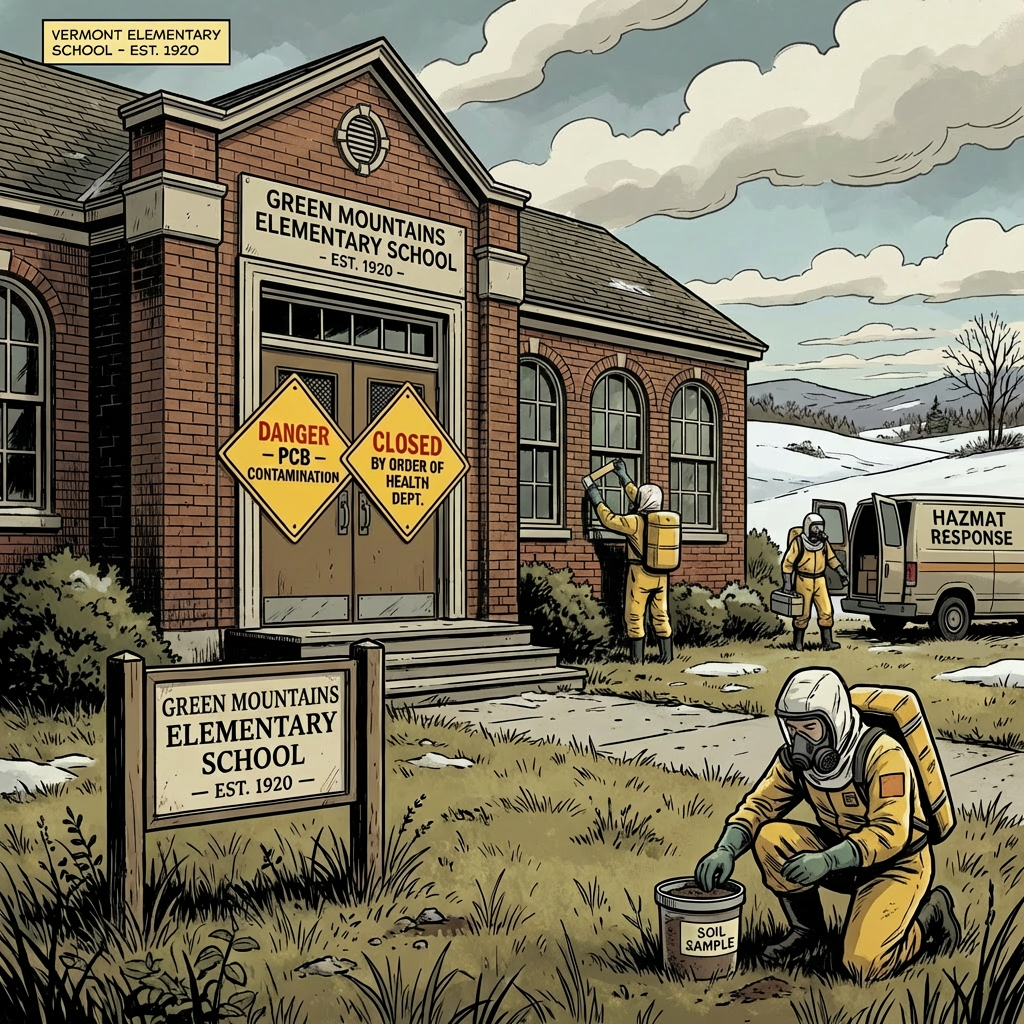
As amended and passed by the legislature, Act 130 updates Vermont’s approach to polychlorinated biphenyls (PCBs) in schools by extending the statewide indoor air testing deadline, creating a dedicated School PCB Program Fund to support investigation and remediation, linking PCB evaluation to school construction planning, and requiring a statewide cost estimate and funding plan.
The Details:
-
Extends the statewide PCB testing deadline (rather than ending the program)
The bill amends existing law to require public schools and approved and recognized independent schools constructed or renovated before 1980 to complete indoor air quality PCB testing, but it pushes the deadline from July 1, 2027 to August 1, 2035. -
Creates a School PCB Program Fund to finance investigation and remediation
H.542 establishes a new “School Polychlorinated Biphenyl Program Fund” administered by the Secretary of Natural Resources. The Fund is designed to support the investigation, mitigation, and remediation of PCBs at schools in Vermont. The Fund consists of:-
Reimbursements from schools for work covered by a State PCB grant when the school recovers money from litigation or other awards (limited to the lesser of the grant amount or the recovery).
-
Litigation recoveries by the State for costs of addressing PCB contamination in schools (less attorney’s fees and costs).
-
Monies transferred by the General Assembly.
-
Other gifts, donations, or monies dedicated for deposit into the Fund and approved by the Secretary of Administration.
-
-
Establishes a grant program with prioritized PCB-related activities
The Secretary of Natural Resources administers a grant program to school districts, to the extent funds are available, for PCB-related work in priority order:-
(A) PCB investigations that are part of a facilities master plan; or voluntary indoor air quality testing initiated by a school district, if the district notified the Secretary and conducted testing according to the Department of Environmental Conservation (DEC) standards.
-
(B) Development of PCB management plans.
-
(C) Costs of mitigation when test results exceed the immediate action level.
-
(D) Costs of implementing an approved corrective action plan when concentrations remain above the immediate action level after mitigation.
-
(E) Costs of implementing a corrective action plan as part of a school construction project.
-
-
Provides 100% State coverage for certain ANR-required PCB work when funds are available
To the extent funds are available, grants for school districts required to conduct investigation, mitigation, or remediation after ANR testing must be sufficient to pay 100% of the costs at the school for investigation, remediation, or removal required by the Agency of Natural Resources Investigation and Remediation of Contaminated Properties Rule. -
Requires reimbursement to the State if litigation awards overlap with State-funded work
If a school district recovers money from litigation or other awards for work covered by a grant under the program, the district must reimburse the State the amount of the recovery or the grant amount—whichever is less. -
Authorizes the State to seek cost recovery from PCB manufacturers
In addition to other remedies, the State may recover from PCB manufacturers monies expended or awarded by the State for PCB investigation, testing, assessment, remediation, or removal of PCBs in schools above the relevant action level. -
Links PCB evaluation to eligibility for school construction aid for older buildings
The bill amends Vermont’s school construction approval statute so that, if a school district is applying for construction aid for a school building constructed or renovated before 1980, the district must have completed DEC-standard indoor air quality testing for PCBs. This requirement is included among other facilities master planning and construction-approval criteria already used in the school construction process. -
Requires a statewide cost estimate and funding plan
On or before January 15, 2027, the Agency of Natural Resources must report to the Senate Committee on Education and the House Committee on Education:-
An estimate of the additional cost to the State to complete PCB testing, mitigation, and remediation at qualifying schools; and
-
A proposed plan to fund the costs estimated as necessary.
-
-
Repeals a separate 2023 PCB grant funding provision
H.542 repeals the previous statute governing State funding of grants for investigation, remediation, and removal of PCB contamination at schools. This effectively consolidates school PCB funding policy under the new School PCB Program Fund. -
Sets effective dates
The act takes effect on passage, except that the school construction-related provisions take effect on July 2, 2026.
The Good:
|
The Bad:
|
Analysis:
This Act attempts to reconcile two competing realities: a genuine concern about PCB exposure in aging school buildings, and a lack of dedicated, long-term funding to complete statewide testing and fully remediate every potential problem discovered. The Legislature has already invested roughly $44 million in this effort, yet legislative hearings have highlighted that remaining funds are insufficient to fulfill the existing 2027 testing mandate and the remediation obligations that widespread testing would likely generate.
Instead of terminating the statewide school PCB testing mandate, Act 130 now extends the testing deadline to 2035 and creates a dedicated Program Fund and grant structure to support investigation and cleanup. The Legislature is acknowledging that the original 2027 deadline was not realistically funded, while also recognizing that simply ending testing would have left significant health and equity questions unresolved. The new approach attempts to manage PCB risks over a longer timeline, with a clearer (though still limited) financing framework.
From an educational quality and access standpoint, the amended bill may better align with equity goals than a hard stop to testing. Districts with older buildings are still expected to test for PCBs, and tying PCB evaluation into facilities master planning and school construction aid encourages more holistic thinking about where students learn, how safe those environments are, and how capital dollars are prioritized. However, because funding remains contingent (“to the extent funds are available”) and the bill itself does not appropriate the full estimated cost of statewide remediation, there is still a risk that more affluent or better-resourced districts will be able to move faster on testing and building upgrades than smaller or fiscally constrained communities.
Economically, the new Fund and cost-recovery structure are attempts to protect the Education Fund and the State budget from completely open-ended liabilities while not leaving districts on their own. Grants that can cover 100% of required cleanup costs at ANR-directed sites, combined with the ability to reclaim funds from lawsuit recoveries or manufacturer settlements, are intended to stretch public dollars further. Yet, without substantial appropriations, the extended testing requirement could still strain local capital budgets and, over time, influence property tax rates and the overall cost of school construction and renovation—especially as PCB work becomes a more routine part of facilities planning.
On transparency and accountability, the Senate version trades the original bill’s long-term remediation plan and annual reporting structure for a nearer-term requirement: by 2027, ANR and the Agency of Education must quantify statewide PCB costs and propose a funding plan. This may sharpen the fiscal conversation and give lawmakers clearer numbers to work with, but it also reduces the explicit, ongoing reporting mechanisms that were in the earlier version. Reasonable people may still disagree on whether the extended timeline and new Fund adequately address the underlying health concerns: some will see this as a more responsible, phased approach that acknowledges both risk and fiscal limits, while others may worry that, absent robust appropriations, vulnerable students and staff could remain in buildings with unremediated contamination for too long.
Current Status:
The bill was passed by the House and and Senate and was signed by the Governor's on June 15, 2026.
Last updated: 6/24/2026
DISCLAIMER: Generative AI used to assist in the production of this report.
News coverage on H.542 |
Read the Bill |
More bill summaries |