


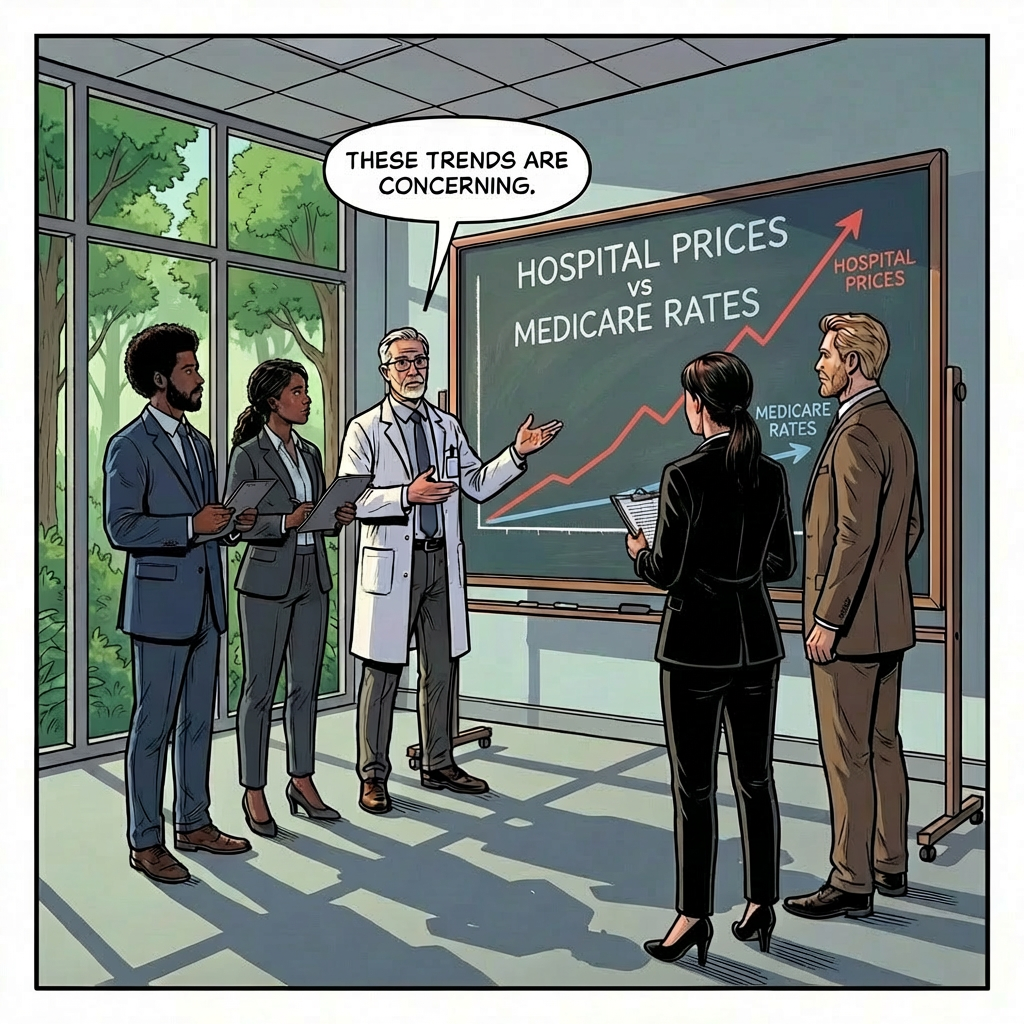
S.190 seeks to enhance state oversight of healthcare costs and improve financial transparency within Vermont’s hospital system, healthcare reform, hospital budget regulation, and consumer protection.
The Details:
- Mandates the Green Mountain Care Board (GMCB) to implement reference-based pricing by hospital fiscal year 2027, setting maximum amounts hospitals can accept as payment.
-
Benchmark Alignment: Hospitals and health insurers are required to transition their reimbursement rates to a transparent scale, typically expressed as a percentage of Medicare rates or another benchmark approved by the Green Mountain Care Board (GMCB).
-
Mandatory Payment Caps: The GMCB is tasked with setting the maximum amounts Vermont hospitals can accept as payment in full for specific items and services, effectively creating a state-mandated "ceiling" on healthcare prices.
- Premium Suppression Oversight: To ensure these savings reach Vermonters, the GMCB and the Department of Financial Regulation must monitor the system to confirm that decreases in payments to hospitals result in a corresponding decrease in health insurance premiums.
-
National Price Target: The bill directs the GMCB to use reference-based pricing to reduce hospital prices incrementally until they are equal to national median prices by hospital type by calendar year 2030, using high-quality data showing hospital prices as a percentage of Medicare to measure progress.
-
-
Requires hospitals to include in their federal hospital price transparency machine-readable files pricing information shown both as a percentage of Medicare rates and in dollars and cents, disaggregated by payer and by plan.
-
Authorizes the GMCB, for hospital fiscal year 2027, to order hospitals to reduce their commercial reimbursement rates for qualified health benefit plans and for health benefit plans offered to school employees based on a percentage of the Medicare adjusted base rate determined by the Board.
-
Prohibits a registered carrier or health benefit association from reimbursing a hospital above the percentage of the Medicare adjusted base rate specified by the GMCB for hospital fiscal year 2027, and protects patients from being billed beyond normal plan cost-sharing when a hospital is paid under those limits.
-
Requires that if a hospital is ordered to reduce commercial reimbursement rates beyond those initial reductions, it must first reduce rates that exceed 500 percent of the Medicare adjusted base rate, or if none exceed that threshold, then reduce the rates that are highest relative to Medicare.
-
Requires hospitals to use unique National Provider Identifiers (NPI) for off-campus departments to ensure site-specific billing transparency.
-
Establishes regulatory oversight for "outsourced services" by requiring hospitals to report information on clinical services outsourced to external entities and directing the GMCB to study the impact of outsourcing on access, quality, availability of care, and provider tax revenue.
-
Authorizes the Department of Vermont Health Access, in consultation with the Department of Financial Regulation, to pursue a federal Section 1332 waiver to establish a reinsurance program and seek federal pass-through funding tied to premium tax credits.
-
Clarifies that the GMCB is not required to negotiate with health care provider bargaining groups or engage in nonbinding arbitration when establishing reference-based prices.
-
Directs the creation of an interactive health system performance tool to display information regarding quality, access, and affordability.
-
Essentially this is a broader health system transparency tool, while the bill also updates the State’s interactive price transparency dashboard using VHCURES claims data.
-
This provision is contingent on securing external funding.
-
-
Addresses the problem of high Medicare outpatient cost-sharing at critical access hospitals by requiring each critical access hospital to identify outpatient services where charges are at least five times the Medicare allowed amount and to post consumer disclosures about the federal cost-sharing rule and lower-cost alternatives that may be available elsewhere.
The Good:
|
The Bad:
|
Analysis:
S.190 represents a significant shift toward a more interventionist approach to healthcare cost containment in Vermont. By centering the state’s strategy on reference-based pricing, essentially using Medicare as the "gold standard" for what a service should cost, the bill aims to stabilize the volatile growth of healthcare premiums. This creates a clear trade-off: while it offers the potential for lower costs for Vermont families and employers, it limits the flexibility hospitals have to negotiate private contracts that often subsidize underfunded essential services.
The bill still focuses heavily on transparency and accountability. Requiring certain hospital rates to be expressed as a percentage of Medicare, requiring machine-readable pricing files to include those Medicare-based comparisons, and requiring unique NPIs for off-campus departments should make it easier for patients, employers, and policymakers to see where care is being delivered and how much it costs. From a data-driven perspective, that kind of standardization is necessary if Vermont wants to measure whether its healthcare system is becoming more efficient over time.
The hospital outsourcing provisions are more limited than a full regulatory restructuring, but they still address a growing trend where hospitals contract out departments or services to third-party entities. Requiring hospitals to disclose more information about those arrangements and directing the GMCB to report on the effects on access, quality, availability of care, and provider tax revenue is a reasonable first step toward understanding whether important parts of the system are moving outside the State’s traditional oversight structure.
At the same time, the bill has changed in meaningful ways as it moved through the legislative process. Compared with earlier versions, the final bill no longer includes the more expansive study of a Public Employee Health Benefit Authority or the separate analysis of applying reference-based pricing to State employee and VEHI plans. Instead, it narrows the reimbursement-limitation section to hospital fiscal year 2027 and applies it to qualified health benefit plans and school employee plans only to the extent the GMCB orders those reductions. It also adds authorization for the State to pursue a Section 1332 waiver for a reinsurance program and replaces an earlier critical access hospital working-group approach with direct disclosure requirements aimed at helping Medicare beneficiaries understand potentially high outpatient cost-sharing.
However, the efficacy of this bill still hinges on the Green Mountain Care Board’s ability to execute these complex new duties related to reference-based pricing. The transition to site-specific billing, Medicare-based pricing disclosures, premium oversight, and annual reference-price review requires a robust data infrastructure that Vermont currently lacks. Reasonable people may disagree on whether this level of intervention is justified.
Because Vermont has created monopolies in our health care system, it seems reasonable to start regulating them like monopolies instead of a hybrid regulatory/market approach. This bill is a step in that direction.
Current Status:
The bill was passed by the House and Senate, but vetoed by the Governor on June 16, 2026. The legislature may still consider a veto override attempt, otherwise the bill will fail to become law and need to be re-introduced in the next legislative session.
Last updated: 6/18/2026
DISCLAIMER: Generative AI used to assist in the production of this report.
News coverage on S.190 |
Read the Bill |
More bill summaries |