

This week tensions boiled over between Governor Scott and the Legislature over the mid-year budget adjustment for FY2025. The Legislature's version of the bill faced significant opposition from Governor Scott, who criticized it as "irresponsible" spending. At the heart of the dispute is the motel voucher program, which is set to expire in April for the summer (the FY2025 budget only funded the program for families most in need through the winter months). Legislative leaders, lacking the votes to override Governor Scott’s veto, shifted focus earlier this week; they pressed the Governor to extend the motel shelter program for a subset of unhoused persons, reflecting a narrower approach to address the "immediate needs" amid budget disputes.
| This is a truncated version of our weekly legislative update. To receive the full version, please sign up for our legislative updates (it's free!). |
The Governor's proposal is to take some of the funds that might have been spent on the motel voucher program going forward and re-allocate them to municipalities so each community can choose how to respond to their own needs. The program has an annual budget of $44 million and serves roughly 1300 households. On a per-household-basis, this program costs ~$33,846 per year if funds are evenly distributed (they’re not, due to varying stay lengths).
With roughly 300,000 tax filers in the state, this program costs around $147 annually, per taxpayer. Because the primary source of revenue for the state's General Fund is income taxes, this amount will vary based on household income.
Education
The Legislature seems to have hit a dead end with education reform. Much like Act 46, the House Education Committee has decided they want to consolidate school districts, but don't want to draw the new district lines themselves. Instead they will punt to an unelected working group, likely made up of the educrats that got us into the current mess to begin with.
We have called every member on the Education Committee in the last 10 days and some of them are interested in our education proposal, but not enough; we will likely be issuing an action alert in the coming days urging this committee to not punt on education reform and to avoid the traps that Act 46 fell into.
The House's version of "Education Transformation" looks a lot like Act 46 2.0. Positively, however, the House is discussing including minimum class size standards in their bill, which is something our report from December found beneficial from both a cost- and outcome-standpoint.
On the Senate side, there is a competing proposal that draws a new map and seems to take education reform seriously. The current draft would put forward 9 school districts across the state. We plan to do a summary & analysis on this proposal in the next week or so.
The annual property tax "yield" bill emerged in the House this week. The Ways & Means Committee chose to accept Governor Scott's $77M buy-down of property taxes with a one-time General Fund transfer. This is on the heels of a $68M "one time" buy-down last year. The Committee also chose to add $41M in surplus to the pot, resulting in an expected average increase in property tax bills of 1.1%. Voters on town meeting day approved a nearly 6% increase in education spending. The Committee vote was 9-2 in favor of the yield bill; members who opposed the draft cited concerns over the long-term implications of using surplus funds.
Housing
There are currently housing bills in both the House (H.479) and the Senate (S.127). The House bill contains $71.8M in spending for FY2026, primarily for new and existing housing programs. The first-generation homebuyer program, which provides grants to assist low-income individuals in purchasing homes, is a primary recipient of these funds. The project-based tax-increment financing (TIF) provision also has a foregone revenue component to it. Because TIFs freeze current property values during a project, both the state and municipality "lose out" on potential tax revenues that could have been collected based on the increased property value. For FY2026 these are estimated at $250k and will increase annually going forward.
The Senate Economic Development Committee largely focused on off-site (manufactured) housing construction this week as they pushed to get their bill to the floor. The Vermont Housing Finance Agency (VHFA) and others have pointed to off-site construction as a potential solution to Vermont's housing crisis. Testimony highlighted that manufactured housing could offer significant savings, but not all off-site construction is inherently cheaper.
The Committee discussed the potential for bulk purchasing of manufactured homes to achieve economies of scale, although concerns about financing and market demand were raised. A proposal for statewide building codes was suggested to streamline the process and reduce costs associated with local code compliance. One challenge that has been noted to achieving scale in manufactured housing today is that zoning codes and building requirements vary across municipalities which requires redesigning housing products for each new order. The Committee seems to be leaning towards requiring a comprehensive study to address questions related to this approach, raising concerns about rushing into a program without adequate planning.
Workforce
Former Representative Dave Sharpe (the author of Act 46) has been in the Legislature this week advocating for career and technical education (CTE). He is pushing for shared governance (something our education proposal does) of CTE centers and traditional high schools. He believes (and we agree) that this would eliminate financial competition between academic schools and CTE centers, encouraging more students to pursue technical education. There was some consensus that CTE governance should not be treated in isolation but integrated within the broader educational system.
He also envisions creating comprehensive high schools that integrate both academic and technical education, allowing students to take advanced courses alongside vocational training. The need for accessible adult education programs was discussed, emphasizing the importance of retraining individuals for new careers. The House Commerce & Economic Development Committee's commitment to addressing these issues reflects a broader goal of enhancing workforce development and ensuring that Vermont's students are well-prepared for the demands of the job market.
Economic Development
A bill in the House, H.398, aims to enhance the Vermont Economic Development Authority's (VEDA's) operational capabilities. The bill proposes to broaden the definitions of eligible VEDA projects to include: capital improvements, purchasing of receivables, and insurance programs. The bill would also expand the terms of the loans that VEDA can offer from 10 years to 20. Other provisions address liability, disaster recovery, and alignment with the state' "Sustainable Jobs Strategy."
On behalf of Vermonters,
|
|
||
|

| Sign Up for Legislative Updates |
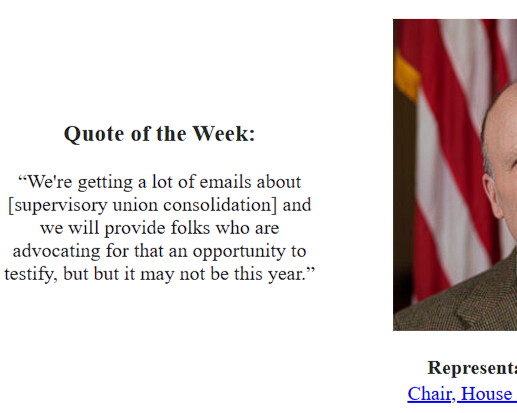
Quote of the Week:“We're getting a lot of emails about [supervisory union consolidation] and we will provide folks who are advocating for that an opportunity to testify, but but it may not be this year.” |
|

| Representative Peter Conlon |
| Chair, House Education Committee |
| To continue reading, please sign up for our legislative updates (it's free!). |