

I testified this week in the Senate Government Operations Committee, urging them not to close the door on independent oversight for the Legislative and Judicial branches of State government. As I am sure you are aware, the House passed a bill that would remove a requirement that these two branches consult with the statewide Ethics Commission; this is a concerning step backwards in the progress we have made in the last decade around Vermont ethics reform.
| This is a truncated version of our weekly legislative update. To receive the full version, please sign up for our legislative updates (it's free!). |
We are still ranked as one of the worst states for government ethics, largely because we do not have an effective independent oversight authority with the power to enforce the statewide code of ethics. H.1 would close the door on independent oversight ever happening, by saying that the Legislative and Judicial branches of State government are required to police their own.
To their credit, Senators listened and appear to be taking those concerns seriously. A new draft of the bill would push implementation of the consultation requirements out two years in order to allow for more time to reconcile the various perspectives on the bill and, hopefully, provide the Ethics Commission with the funding they need to serve an expanded role. While delayed implementation is not the ideal outcome, it is better than the House version of the bill, and is a positive step forward. A big THANK YOU to all of you who wrote the Committee in response to our action alert; we couldn't have done it without you.
Housing
The Committee is concerned that the inclusion of Tier 2 could face significant opposition, particularly from environmental advocates. Some committee members suggested a phased approach, where Tier 2 could be revisited after the initial implementation of the CHIP program.
Another hotly-debated topic was how to prevent damage to the Education Fund (EF) due to the freeze on property values for properties that are part of CHIP/TIF. The Committee recognizes the need for a mechanism to ensure that excess tax revenue flows back into the EF. So far, a mechanism has not presented itself, although there is a suggestion to allow the value of the property to continue increasing at an inflationary rate for education tax purposes. There may be some mechanism that would allow this to work.
New language around the CHIP program was introduced on Thursday, emphasizing housing development by requiring at least 40% of the floor space of a project be dedicated to housing. This allows for mixed use developments but still ensures housing is being built. An alternative process allows for discretionary approval if this threshold cannot be met. The definitions of what CHIP funding can be used for were also updated to clarify that utilities, transportation infrastructure, and site preparation all qualify. It was also suggested that energy code improvements should be considered as infrastructure.
A new board will also oversee the program to assess whether proposed housing developments meaningfully contribute to community needs, providing an additional layer of evaluation beyond the existing process. However, the Vermont Economic Progress Council (VEPC), the current overseer of TIF projects, pushed back on this; they are concerned that the proposed CHIP board could complicate the approval process.
VEPC also believes that local municipalities should determine what qualifies as housing, rather than imposing statewide measurements. They claim that municipalities are better-suited to determine local affordability needs, so statewide definitions of affordability should also be avoided (legislators seemed receptive to this).
Other testimony from affordable housing advocates raised concerns about the complexity of the application process for smaller developers, who may struggle to meet the affordability criteria. The committee discussed the potential need for exemptions in this space. The average cost of newly-built homes in Vermont reached $615K in 2023, making homeownership increasingly unattainable for many Vermonters. The goal of the new criteria is to create mixed-use and mixed-income communities, as seen in the Cambrian Rise project in Burlington. That project will include over 250 affordable units when it is completed.
Economic Development & Infrastructure
Last week we talked about the impact of federal tariffs on Vermont and the 17K jobs Canadian trade supports in the state; this week, the conversation expanded. Regional Planning Commissions (RPCs) pleaded their case in the House Appropriations Committee as they have faced challenges due to recent federal funding cuts. RPCs serve as vital support resources for towns in the absence of county governments in Vermont. They operate under a governance model where municipalities appoint representatives to their boards; however, RPCs do not have the authority to levy taxes. Their funding relies heavily on grant monies, of which 40-70% are federally-sourced.
RPCs across the state have started to see federal grants getting cut, including:
- A $875K EPA grant aimed at developing bike and pedestrian facilities was terminated, impacting rural towns' ability to innovate in transportation.
- $150K in grant monies that supported health equity initiatives across several communities was canceled.
- Each county had received $75K for energy projects, which has now been paused.
- The FEMA Building Resilient Infrastructure and Communities (BRIC) Grants, crucial for local hazard mitigation plans, have been canceled. This affects small communities' disaster preparedness.
- Grants for emergency management by RPCs are potentially on the chopping block and could severely limit disaster response capabilities.
The state Department of Tourism and Marketing is also concerned about their ability to address the decline in Canadian visitors due to various factors, including federal rhetoric and exchange rates. The prospect of losing federal grant monies to support tourism would further complicate this situation.
To this end, the Senate is working on a resolution (S.R. 11) calling on the federal government to refrain from imposing tariffs on Canadian imports. They are also hoping to encourage Congress to reassert its legislative authority over trade policy, emphasizing the need for a balanced approach to tariffs.
The House Energy & Digital Infrastructure Committee took additional testimony on H.121 from a California advocate this week. The bill aims to address affordable and high-quality broadband access for low-income households, but careful consideration of pricing, service quality, and the impact on smaller providers is essential for its successful implementation. The Committee's ongoing discussions and potential adjustments to the bill will play a significant role in shaping the future of broadband accessibility in the state, which we view as a critical economic development tool in the 21st century economy.
The current proposal would cap services charges at $15/mo for providing 25 Mbps download speeds and $20/mo for 200 Mbps to qualified households. Research on California's program showed that low-income broadband programs would reduce provider revenues by less than 1% due to economies of scale.
Health Care
The House Health Care Committee continued testimony this week on H.126, specifically hearing from experts about the proposed statewide healthcare delivery plan. It is clear that primary care in Vermont is struggling, which is seen as a foundational issue for the healthcare system. The need for effective guidance for administrative agencies, particularly the Green Mountain Care Board, in making resource allocation decisions is critical, as is monitoring the healthcare system and establishing performance goals. The Committee is focused on the need for a comprehensive approach that balances cost, access, and quality as the state navigates its healthcare challenges.
To support the work on reference-based pricing in the bill, the Green Mountain Care Board had originally asked for five new positions but the Senate Appropriations Committee cut the budget down to three. As a result the Board requested to reconfigure the titles and responsibilities of those positions in the bill to meet the new budget realities.
Meanwhile, the Senate is still working on H.96, but they are making progress. The bill seeks to raise the monetary threshold for obtaining a Certificate of Need (CON), which is required for building healthcare facilities. The existing thresholds have not been updated for years, leading to concerns about their relevance in today's economic climate. The increase in threshold for healthcare projects from $1.5M to $10M would be more in line with other states. It also aligns the thresholds for hospitals and other healthcare facilities.
Senators discussed the potential for increased competition in the healthcare market, which could lead to lower costs (research backs this up, see our review of H.96). There is a call for further examination of the CON process and its impact on healthcare innovation and accessibility.
Tax Policy
The House Ways & Means Committee reviewed H.483 on Wednesday, which would exempt military retirement from the state income tax. Testimony underscored the need for Vermont to remain competitive in attracting and retaining military talent. However, reactions were mixed. While the discussion highlighted the need for Vermont to enhance its support for veterans and military families, considering the unique sacrifices they make, some representatives expressed concerns about the potential loss of tax revenue from the proposed exemptions.
The Department of Defense reports that Vermont has a significant number of military retirees, with 3,594 receiving pay and an average monthly pension of $2,757. This translates to an annual economic impact of approximately $27M. The estimated local spending by military retirees in the state is around $99M annually.
The estimated cost of this exemption is $3.9M, a modest amount, advocates claim, compared to the potential economic benefits. As legislators navigate the current budgetary constraints, the potential long-term benefits of investing in our veteran population could yield significant returns, both economically and socially. Of course there are others now asking to be included, such as first responders, health care workers, teachers, and state employees.
The Senate is also taking testimony about military retirement benefits within the context of H.34. Former Brigadier General Brian Carpenter testified. One key thing he highlighted was that the average age of military retirees is around 47, and they often possess valuable skills and leadership training that can benefit Vermont's workforce. Senators were more receptive than their House counterparts, acknowledging the importance of creating a supportive environment for military retirees and their families in Vermont.
Education
Most notably this week, the Senate Education Committee previewed a new draft of H.454, the House's education "transformation" bill, which takes seriously concerns about the implications of school district consolidation and how it would affect local governance and representation... we will continue to follow this discussion as things develop and weigh in as necessary. However, we are already encouraged by the direction the Senate seems to be going.
Meanwhile, in the House Education Committee, H.54, a legislative proposal aimed at establishing phone-free environments in Vermont schools is gaining traction. The bill would require each school board to develop a policy prohibiting the use of cell phones and personal electronic devices from "Bell-to-Bell".
These policies must include:
- A complete prohibition of personal devices.
- Designated areas for device storage.
- The use of secure lockers or pouches.
The Committee made sure to allow flexibility for how schools manage the logistics, and costs, associated with storing phones during school hours. There was also discussion of the need for exceptions in cases of field trips or emergencies, suggesting that schools should have discretion to allow phone use when necessary.
While the intent to foster a distraction-free learning environment is clear, the Committee recognized the need for careful consideration of definitions, implementation strategies, and communication methods. However, there was concern about student safety during a security incident. The School Safety Program Manager for Vermont Emergency Management noted that, while immediate communication (via personal devices) can provide peace of mind to parents, they can also allow for incomplete or incorrect information to be shared at various stages of an emergency response. They encourage flexibility in policy-making to address varying threats and hazards.
A study from the University of Chicago indicated that students with phones present, even off, performed worse academically. This is believed to be because the presence of screens detracts from students' ability to focus on lessons. A CDC report also indicated that frequent social media use is linked to a 50% increase in suicidality among teenagers.
On behalf of Vermonters,
|
|
||
|

| Sign Up for Legislative Updates |
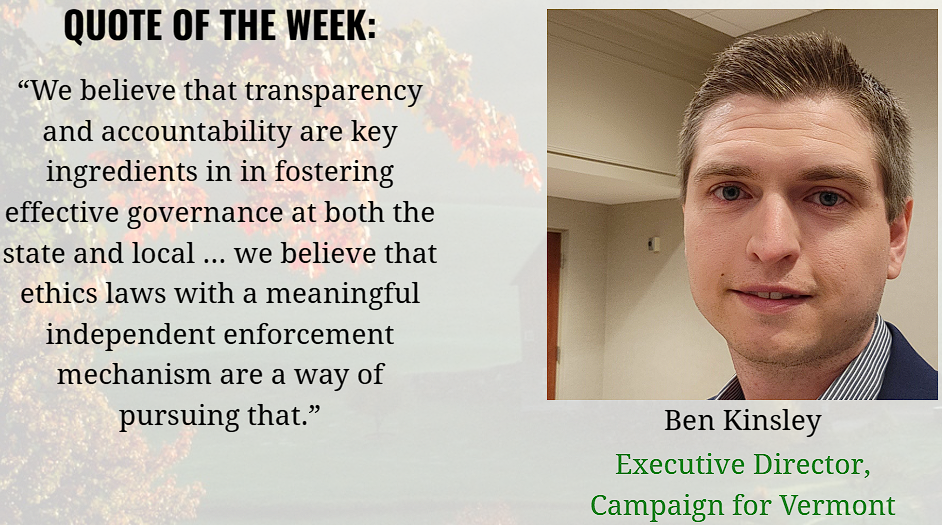
Quote of the Week:“We believe that transparency and accountability are key ingredients in in fostering effective governance at both the state and local ... we believe that ethics laws with a meaningful independent enforcement mechanism are a way of pursuing that.”
|
|

| Ben Kinsley |
| Executive Director, Campaign for Vermont |
| To continue reading, please sign up for our legislative updates (it's free!). |