

This week the Judicial branch jumped on the H.1 bandwagon, saying that if the Legislature is going to exempt anyone from ethics oversight, it should be them!
| This is a truncated version of our weekly legislative update. To receive the full version, please sign up for our legislative updates (it's free!). |
To be fair, the Judicial branch does have a robust accountability mechanism to hold lawyers and judges to a high standard. But, these are occupational licensing and professional conduct mechanisms (which are present in other professional fields as well). They are often stricter than the statewide code of ethics, which applies more broadly to all public officials. However, not everyone in the Judicial branch is subject to those occupational oversight boards (only lawyers and judges).
Further, the code of ethics is meant to set a standard of conduct for people in their capacity as public officials, not their occupational capacity as a lawyer or judge. These things will overlap for sure, but there is overlap with professional conduct rules in a number of places within state government such as for doctors, accountants, investment managers, etc. But again, those rules of conduct are specific to the occupation, not the person's capacity as a public official. This type of overlapping jurisdiction is found in many places in our government structures and shouldn't be used an excuse to get rid of independent oversight.
The real issue is that, under the current ethics framework, complaints that allege a violation of the statewide code of ethics are being forwarded to these professional conduct boards in the Judicial branch. These boards are looking at the complaints through the lens of a professional conduct violation (as is their purview). Ideally, the Ethics Commission should investigate the complaints in the context of the Statewide Code of Ethics and the person's capacity as a public official (with a possible exception for judges) in order to make a determination of validity. The Ethics Commission's purview is to review the conduct of public officials, but they will be handicapped in doing so if their oversight is limited only to the Administrative branch (as H.1 proposes).
Instead of exempting the Legislative and Judicial branches of state government from the requirement to consult with the Ethics Commission, we should be giving the Commission full oversight authority over the conduct of all public officials regardless of which branch of government they serve in and what their occupation is.
Economic Development & Infrastructure
The House Energy and Digital Infrastructure Committee met with Christine Hallquist, the Executive Director of the Vermont Community Broadband Board (VCBB), this week to discuss the status of federal Broadband Equity, Access, and Deployment (BEAD) funding. The meeting underscored the critical importance of reliable broadband access for all Vermonters, particularly in underserved and unserved areas. The VCBB is making significant strides in the BEAD funding process, but potential federal policy changes pose challenges that could impact the timeline and effectiveness of broadband deployment.
The state has already been allocated $229M, exceeding initial expectations due to "effective mapping and advocacy efforts." The Vermont Legislature has set a preference for fiber technology due to its capacity and reliability compared to cable and wireless options. However, there is concern that the federal government sets a low cap on funding per address (it costs $10k per mile to lay fiber), that could force the use of alternative technologies.
The VCBB is committed to ensuring that 100% of Vermont residents have access to reliable broadband (defined as 100 Mbps down / 20 Mbps up), with a target of 95% served by fiber (allowing for the possibility of alternatives in certain areas).
Education
The House is inching closer to passing their landmark education reform bill. While it largely punts governance reform to an unelected board made up of the same folks who designed the current system. There are some bright spots related to minimum class sizes, which our research indicates would reduce costs and potentially elevate outcomes as well.
On finance reform, however, there are some significant changes, including:
- A new foundation formula with a base funding amount set at $15,033. This would be adjusted upward for factors such as local poverty and number of english language learners.
- Districts can choose to spend above their adjusted base funding amount, but that spending will be capped at 10%
- The income sensitivity program is revamped as homestead (grand list) exemption, transitioning from a property tax credit to an income-eligible exemption. The exemption is structured with income brackets and property values to create a smooth curve without abrupt changes for taxpayers. One of the benefits of the exemption:
- It can be applied in the same year instead of having a year lag (i.e. you don't have to wait until you file your income taxes next year to receive the credit).
- The exemption reduces your property tax liability on the bill itself.
- It navigates around a loophole in the current income sensitivity system where households with high property wealth but low income (on paper) are being subsidized.
There is still hope that the Senate will take governance reform more seriously, but we are hearing that Senate leadership is now wanting to tap the brakes also.
On behalf of Vermonters,
|
|
||
|

| Sign Up for Legislative Updates |
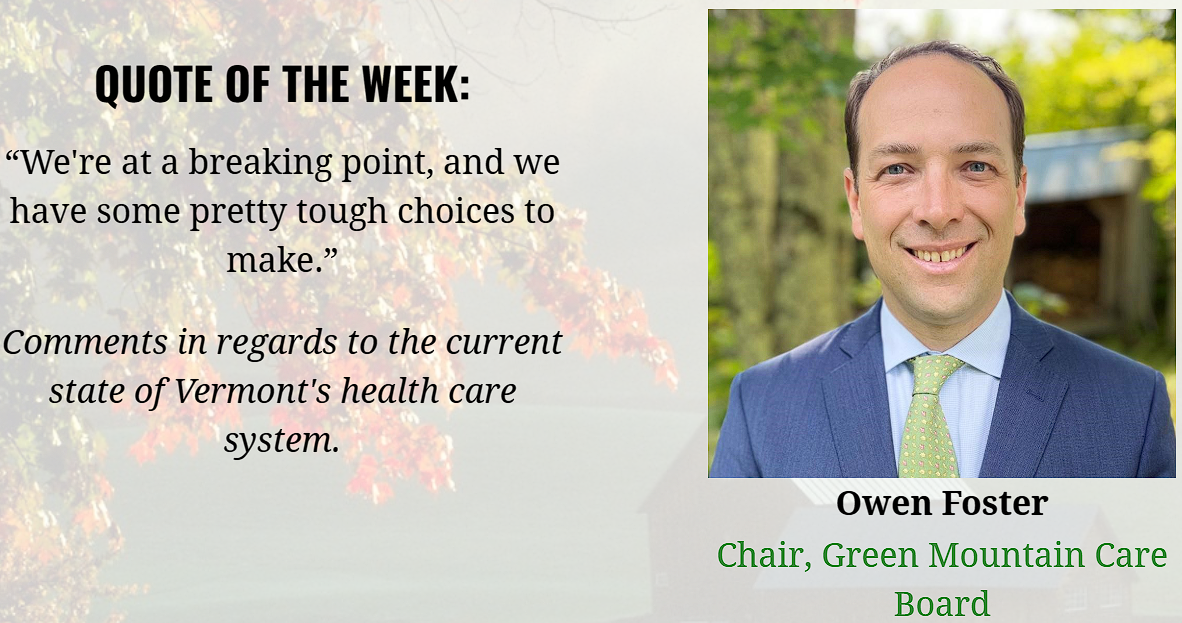
Quote of the Week:“We're at a breaking point, and we have some pretty tough choices to make.” Comments in regards to the current state of Vermont's health care system.
|
|

| Owen Foster |
| Chair, Green Mountain Care Board |
| To continue reading, please sign up for our legislative updates (it's free!). |