


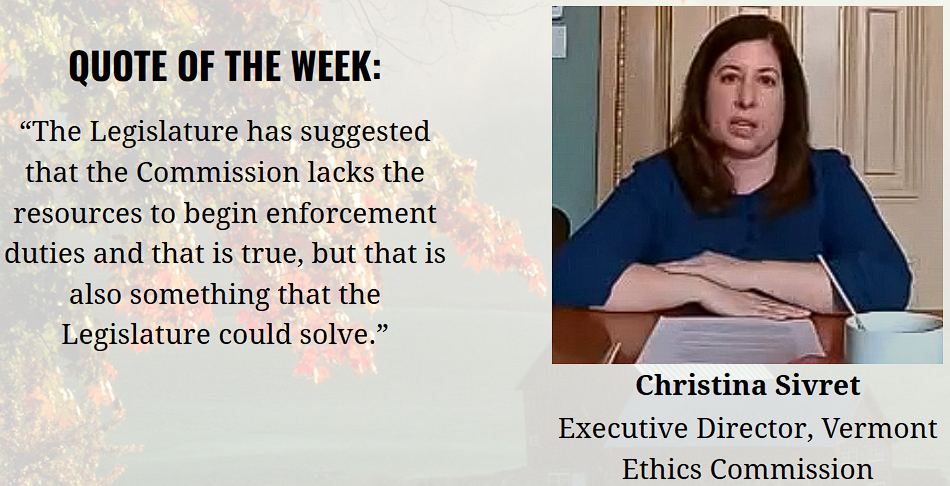
We are mixing up our format a little bit this week (let us know what you think!). But don't worry, we are still bringing you in-depth coverage on a wide range of topics.
The most important update (in our view) is that the bill dealing with the Ethics Commission's oversight authority passed a key vote in the Senate this week. The Senate's version would delay the implementation of the Ethics Commission's new powers for two years. While we are still disappointed in this outcome, it is better than the House Version which would have removed independent oversight of the Legislative and Judicial branches of state government permanently.
| This is a truncated version of our weekly legislative update. To receive the full version, please sign up for our legislative updates (it's free!). |
On the education front, the Senate is refining the education transformation bill (H.454), focusing on equitable funding, school governance consolidation, and local control, with concerns about tax rate impacts and timeline feasibility. The Senate is waiting on the House to finish work on a cell phone ban in schools (H.54) in order to incorporate it into the miscellaneous education bill (H.480) for passage this year. This addition is intended to curb distractions and protect youth mental health, with debates over policy flexibility and technology definitions.
Housing discussions continue center on H.479 and S.127, addressing accessibility, landlord regulations, and tax-increment financing (CHIP), with concerns about costs, equity, and appeal processes. The health care bills (H.482 and S.126) also continue to make headway and would expand the Green Mountain Care Board’s authority, adjust hospital reimbursement rates, and introduce reference-based pricing with a reduced target a 2.5% hospital cost reduction by 2026 (it was 5%).
The FY2026 budget (H.493) has reached conference committee negotiations, which are addressing federal funding cuts, child care, and tax relief, amid veto concerns from Governor Scott. Similarly, last minute changes to workforce bills (S.122 and H.34) were made, supporting a Baby Bonds pilot program and military retiree tax exemptions to boost workforce sectors like construction.
Environmentally, Vermont is lagging in electric vehicle sales, risking penalties under ACC2 regulations, broader vehicle market declines (up to 21% for used vehicles) are also raising economic concerns. Other bills continued to move in the House, including election transparency (H.474) and public meeting conduct (S.59), with debates over balancing accountability and practicality.
See all the details below!
On behalf of Vermonters,
|
|
||
|

| Sign Up for Legislative Updates |

Education
The House Education Committee reviewed the current state of the Senate's changes to the education reform bill (H.454). Both versions require public engagement in the process to consolidate school governance structures, but the Senate's approach is broader, allowing for maximum public input without a defined process. The Senate version also restructures of the Commission on the Future of Education and the of a Task Force responsible for the new governance framework.
The Senate Education Committee version also removed intent language related to larger school district boundaries. Indicating that more effective governance structures is the goal, not just larger ones. There were also changes to how school districts can pay tuition to independent schools, with specific criteria for eligibility.
Overall this new version focuses on balancing administrative efficiency with the needs of local communities and students.
The Senate Finance Committee now has possession of the bill, with plans to vote it out by Thursday. The path forward, however, is not without challenges. Some members of the committee are worried (justifiably) that the new funding formula and governance structure would diminish local control over educational decisions. Balancing local control with necessary state oversight will be a critical challenge moving forward.
Primary challenges with current funding system:
- The existing system creates disparities in educational offerings based on local tax rates and decisions, leading to unequal opportunities for students.
- The current governance structures complicates decision-making and accountability (really I would argue the interplay between state and local decision making in the current system is what causes this).
- Many local voters feel disconnected from the budgeting process, as their tax rates are often predetermined by statewide decisions.
Solutions proposed in the bill:
- A new funding formula was proposed, which aims to provide a more equitable distribution of resources. However, concerns were raised about the potential underfunding of this formula.
- The need for consolidation of smaller school districts was emphasized to achieve economies of scale and improve educational offerings. The committee debated whether this should be a top-down or bottom-up approach.
- Clearer accountability standards to ensure that schools are meeting educational benchmarks and that resources are being used effectively.
There is a recognition that the statewide tax rate may disproportionately affect poorer towns, leading to potential increases in their tax rates. This is because some towns may be spending well below the proposed base amount; while the increase in funding may help students it may also push local tax rates higher than current levels.
Some senators also view the timeline for implementing the new foundation formula and district consolidations as ambitious, with concerns about the feasibility of executing these changes effectively. Frustration was also expressed over the lack of a comprehensive analysis that explains the rationale behind the current weights and base amounts in the proposed foundation formula.
Senators agreed to explore various modeling scenarios to assess the impact of proposed changes to both the foundation formula, and another area of concern; the replacement of income sensitivity with a new property tax exemption.
Some changes to the tax exemption they may consider:
- Implementing a $400,000 cap on homestead exemptions.
- Adjusting the percentage of exemptions to minimize the additional costs.
One new idea offered was a proposal to implement a single tax rate for both commercial and residential properties. The idea is to create a more uniform taxation system that discourages vacancy and promotes property use. The current language in the bill moves the opposite direction, creating more categories of properties that could be taxed at different rates in the future.
There was also a suggestion that surcharge based on property vacancy could incentivize landlords to rent out vacant properties. The discussion highlighted the need to address loopholes that allow property owners to "evade" taxes.
The lack of a defined funding source for the proposed school construction aid raised concerns among committee members. The Treasurer's office indicated that the funding would rely on annual appropriations, which could vary.
While there is a consensus on the need for change, the path forward remains contentious, with differing opinions on governance, funding, and the role of local control. The committee's ongoing work will be crucial in shaping the future of education in Vermont, ensuring that all students have access to quality educational opportunities while balancing the needs of taxpayers and local communities.
AND, they have to figure all this out by Thursday.
Meanwhile, the House Education Committee continues work on the cell phone free schools bill (H.54), which is now expected to be attached to the miscellaneous education bill (H.480) so it can be passed this year. The bill would require schools to develop policies prohibiting student use of cell phones and personal electronic devices from arrival to dismissal. Exceptions would allowed for students with individualized healthcare plans, dual enrollment, and career technical education programs.
The bill would also prohibit schools from requiring students to use social media for academic work or extracurricular activities. However, the Committee debated the balance between prohibiting social media use and allowing educators discretion in its application.
Laura Marquez-Garrett (Attorney, Social Media Victims Law Center) underscored the urgent need for legislation like this to safeguard children from the detrimental effects of social media in educational settings. Garrett's testimony highlighted the profound impact of social media on youth mental health and the responsibility of schools to create a safe learning environment.
Oliver Olsen (lobbyist, Vermont Independent Schools Association) noted that practically every school had some form of cell phone prohibition in place, primarily within classroom settings. Variations exist regarding the use of cell phones outside classrooms, indicating a need for flexibility in policies.
He raised a concern that the bill's definitions may not adequately address the unique circumstances of boarding schools, which supervise students 24/7. Specific definitions related to "arrival" and "dismissal" times are crucial for these institutions.
A concern was also raised about the rapid evolution of technology that complicates the ability to define terms like "social media" and "AI" in the context of school policies. The Committee was cautioned that definitions may quickly become outdated, necessitating a flexible policy framework. Instead, Olsen suggested a goal-oriented policy that focuses on minimizing electronic device use rather than imposing strict bans. This approach is intended to allow schools to adapt policies as technology evolves while maintaining a clear direction for minimizing distractions.
An alternative suggestion was revisiting the definition annually or allowing the Agency of Education (AOE) to develop a model policy that includes a definition. However, some members voiced discomfort with leaving policy decisions solely to the AOE, fearing that the bill could lose its intended impact.
Committee discussions also touched on whether to include personal electronic devices in the policy. Members debated the implications of allowing devices like smartwatches and tablets in schools. Ultimately, the newest draft of the bill included broader language to encompass all personal electronic devices that can connect to the internet.
Representatives from AOE expressed concerns about the social media section of the bill, suggesting it be removed or simplified to avoid unintended consequences. Examples included allowing cell phone use for educational purposes or in cases of dual enrollment (which was already covered under a previous draft). The Agency suggests including broad carveouts for specific circumstances, allowing schools to adapt policies based on local needs. This is similar to what we heard last week from Connecticut about their statewide cell phone policy.
A fiscal note for the bill was recommended to assess potential costs associated with implementing the policy, and ensuring schools receive necessary support.
The Committee's ongoing discussions aim to refine the definition of social media and ensure that the legislation effectively protects students while allowing access to beneficial educational resources. The potential positive outcomes of this legislation could lead to significant improvements in the mental health and well-being of Vermont's youth.
Housing
The House's housing bill (H.479) is still residing in the Senate Economic Development Committee, which is still grappling with several key aspects of the bill.
One provision of the bill would pursue the need for accessible housing for individuals with disabilities. It was highlighted that over 80% of the homeless population in Vermont has a physical disability. Some folks are advocating for the incorporation of universal design standards into state law to ensure that all housing projects funded by the state meet accessibility requirements. Susan Aranoff (Senior Planner and Policy Analyst, Vermont Developmental Disabilities Council) echoed the need for separate study committees to address the unique challenges faced by individuals with disabilities in accessing housing.
However, the concerns were raised about the potential costs associated with implementing universal design standards. Senator Clarkson suggested that density bonuses for accessible properties could be a more effective solution than forming additional committees. The Committee expressed concern that disparate codes could raise housing costs and create barriers to building. There are multiple codes (e.g., flood, fire, energy, ADA) that often conflict, leading to confusion and increased costs in construction.
Representative Campbell joined to the Committee to suggest establishing a single office to manage various building codes and resolve conflicts. The Committee deliberated on this most of of the week, but faced challenges due to budget constraints and the capacity of the Department of Housing and Community Development (DHCD). Ultimately the decision was made to strike this section from the bill for the time being, with plans to revisit the issue in the future.
Concerns were also raised regarding landlords' ability to inquire about tenants' immigration status, with discussions revolving around how federal law might preempt state regulations. Angela Zaikowski (Director of the Vermont Landlords Association) provided insights into the bill's implications for landlords, highlighting the precarious position landlords face when screening applicants, particularly regarding immigration status and potential liabilities under federal law. Zaikowski expressed concerns that the bill could inadvertently discourage landlords from offering rental units due to increased uncertainty and risk.
Current language in the bill specifies that landlords may request social security numbers for background checks but must accept alternative forms of identification if the applicant lacks one. The goal is to prevent discrimination based on immigration status while allowing landlords to assess potential risks associated with renting to individuals without legal status. Committee members were receptive to concerns to the need for landlords to have access to information that could mitigate risks associated with renting to individuals with uncertain immigration status.
Finally, the Committee also discussed changes to the appeals process for municipal permits, focusing on the definition of "person aggrieved." The definition was modified to limit appeals to individuals who own or occupy property in the immediate neighborhood of the project in question. The Committee considered the implications of broadening the definition to include a wider range of potential appellants, which could lead to increased litigation and administrative burdens for municipalities. There was agreement on a more restrictive definition to streamline the appeals process and reduce frivolous claims.
The Senate Natural Resources Committee briefly touched on the appeals process in H.479 this week. Judge Thomas Zonay (Chief Superior Judge) provided insights into the implications of the proposed changes, emphasizing the need for clarity in defining "interested persons" in zoning appeals. He was concerned that if the definition of "person aggrieved" was expanded beyond individuals adjacent to a project, it would allow broader participation in appeals, potentially leading to increased litigation. Judge Zonay cautioned that this could lead to confusion in the courts, as the new definitions may not align with existing case law.
In the other chamber, the House Ways and Means Committee received possession of the Senate's housing bill (S.127). They are on a timeline to vote the bill out by Tuesday in order to keep in moving. However, significant questions arose around the project based tax-increment financing mechanism (known is CHIP). Members of the Committee felt a "but for" test, which assesses whether a project would occur without the proposed incentives, was necessary for this program.
It was highlighted that half of renters pay more than 30% of their income on housing, while a quarter pay over 50%. This indicates a significant rent burden affecting many Vermonters. The home ownership rate remains stagnant at 70-72%, suggesting that many individuals are unable to transition from renting to owning homes.
Also a significant topic of conversation was a proposal from the State Auditor to cap projects based on their impact to local tax rates. However, concerns about equity arise given the disparate tax bases that municipalities around the state enjoy. An alternative proposal would be to apply a cap at the statewide level, which would potentially be a more equitable approach than local or regional caps, which could restrict development opportunities in growing areas.
Neil Odell (Founding Member, Friends of Vermont Public Education) expressed concern over the proposed CHIP provisions, suggesting it could "negatively affect the Education Fund for decades." Tom Kavet (Legislative Economist) voiced similar concerns, warning that the current proposal could lead to a higher property tax rates and exacerbate existing issues rather than alleviate them.
NOTE: Regarding these debates about CHIP, tax-increment financing has always been a contentious issue under the golden dome. There has been a lack of in-depth analysis of its impact as a tool for economic growth. That being said, the theory is that municipalities (potentially) forgo short term tax revenues in exchange for long term economic growth. This generally seems like a good trade off and a number of communities have found benefit in this tradeoff. The current CHIP proposal is intended to reach smaller municipalities versus the existing program which only large towns have been able to leverage so far.
Kavet also emphasized the need for a stringent "but for" test to ensure that TIF funding is only allocated to projects that would not have occurred without government intervention.
A new draft of the bill emerged on Friday with revisions to The CHIP board's duties to address these concerns. The Board is now responsible for conducting the "but for" test for housing infrastructure agreements. A new definition of affordable housing was also included, which is now defined as housing subject to a subsidy covenant, ensuring affordability in perpetuity. At least 20% of housing units in a development must meet this definition of affordability, removing the previous minimum of five units.
There was discussion of sunsetting the existing TIF program, with suggested sunset dates in 2026 or 2027 to allow for proper evaluation of CHIP program performance.
The House Environment Committee also got into the S.127 action this week, reviewing an amendment from Rep. Kate Logan aiming to removing limits on now municipalities can emergency shelters, allowing municipalities to define conditional use regulations more freely. This seems to primarily impact Burlington, which previously allowed conditional use zoning for emergency shelters, unlike many municipalities that did not. This changed with the HOME Act which has led to the concentration of shelters in certain areas. This has created logistical issues for individuals experiencing homelessness, necessitating a broader distribution of shelters.
This amendment would enable Burlington to implement conditional use reviews for emergency shelters in various districts, including low-density residential areas. It would also clarify that municipalities can regulate operational aspects of shelters, such as hours of operation and the requirement for on-site supportive services. Committee Members raised concerns about the potential burden on emergency services and the need for wraparound services at shelters.
Health Care
Work continued on the bill (H.482) expanding the Green Mountain Care Board's (GMCB) authority in Senate Health and Welfare Committee this week. Concerns were raised regarding the new authority to adjust hospital reimbursement rates and the potential negative impact on hospitals that are currently struggling financially. However, Senators emphasized the need to trust the GMCB to make balanced decisions regarding hospital finances and insurer solvency. Discussions highlighted the need for due process in the rate reduction process, with discussions on how to ensure fair treatment for hospitals.
The House Health Care Committee reviewed a new draft of the health care reform bill (S.126) early this week. There was a shift in terminology from "reducing" to "controlling" costs, indicating a shift in confidence regarding the effectiveness of the bill in creating savings for consumers.
Significant changes were made to the language surrounding reference-based pricing, including the establishment of maximum amounts that hospitals can accept as payment. The Committee also reviewed the timeline for implementing reference-based pricing, with concerns raised about the feasibility of the proposed dates. The Green Mountain Care Board's input was noted, emphasizing the need for flexibility in the timeline with a focus on ensuring the new payment structure does not negatively impact access to care. The GMCB is required to provide an update on its implementation efforts annually, focusing on methodologies for reference-based pricing and the potential use of global hospital budgets.
The Committee discussed the importance of establishing quality of care performance metrics and accountability measures to track system-wide progress. The establishment of a new Healthcare Delivery Advisory Committee was a significant focus for addressing this goal. Members of the advisory committee would include representatives from various healthcare sectors, including physicians, nurse practitioners, and small businesses.
Appropriations were discussed for the Agency of Human Services (AHS) and the GMCB with $5M in funding over two years for transformation work, quality measures, and alternative payment models.
The Committee discussed setting a target of 5% reduction in hospital costs for the fiscal year 2026, emphasizing the need for hospitals to work together to achieve this goal. This was, however, eventually lowered to 2.5%.
Fiscal Policy
The FY2026 state budget (H.493) has moved into conference committee deliberations after both the House and Senate have passed their individual versions of the bill. As negotiations proceed, the prospect of a veto from Governor Scott looms larger than it has in recent years as legislative leaders no longer have the numbers to easily override him. As such, the meetings have focused on various budgetary concerns, including the implications of federal funding cuts, the prioritization of existing programs, and the careful allocation of resources in light of uncertain economic conditions. Members (particularly in the House) expressed unease about upcoming federal cuts and the need to prepare for potential financial shortfalls.
Here are some highlights on the conference committee's work:
- Reinstate $1M for brownfields, reflecting agreement on the importance of this funding for housing development.
- The committee proposed moving $4M for education transition to the education bill, emphasizing the need for clarity in funding allocation.
- Maintained funding for the Montreal Trade Office at $150K, emphasizing its importance despite previous reductions.
- Adjusted farm to school grants from $750K to $1M, citing the need to backfill federal funds.
- Agreement to adopt the House's proposal of $19M in child care funding along with a $5M reserve for child care, along with support for an apprenticeship program and the Child and Adult Care Food Program (CACFP).
- A compromise was reached on the infant and toddler subsidy rate, proposing a 5% increase.
- Agreement on a $13.5M allocation for a tax relief package, emphasizing the importance of maintaining this figure for the Senate Finance Committee's review.
- A reserve of $1.5M was set aside for potential extended legislative sessions.
- A $500K allocation for the Vermont Emergency Food Shelf program.
- An additional $520K was proposed for primary care funding, addressing workforce issues in healthcare.
- The initial allocation to the Climate Super Fund was reduce $700K to $350K.
- The emergency housing program was transitioned from base funding to a one-time allocation, signaling legislative intent to bring the program to an end in the near future.
Economic Development & Infrastructure
The House Commerce Committee continued work on a workforce development bill (S.122) this week. Officials from the Treasurer's Office discussed a language request for at Baby Bonds pilot program contained in the bill, which is aimed at addressing generational wealth equity gaps. The proposal includes establishing a special fund for the pilot program, separate from the existing baby bonds trust account, to facilitate philanthropic donations and expenditures.
Hans Vangu (Managing Director, Westport Hospitality) expressed support for a task force to study the feasibility of a convention center in Burlington. The tourism industry in Vermont is a $4B sector, employing approximately 30K people. He believes a convention center could attract more business and leisure travel, particularly midweek.
Jeff Lawson (VP of Tourism & Marketing, Hello Burlington) emphasized the need for a modern meeting facility to accommodate larger events, which are currently being lost to other states. They recommend the formation of a task force to explore the feasibility of a convention center in Burlington is essential for enhancing Vermont's tourism and business landscape.
The Senate Economic Development Committee also held testimony on workforce this week, within the context of a different workforce bill (H.34) that is in their possession. The focus was on provisions military retirement income exemptions, highlighting that those provisions had passed the House.
The Department of Labor (DOL) expressed strong support for the proposed legislation to eliminate income tax on military pensions. This move is seen as a way to attract retired military personnel to Vermont. As noted in our review of the bill, the average age retirement age from the military is 47. Retirees often have valuable skillsets and years left in the civilian workforce.
DOL presented data on projected job openings in the construction sector over the next decade:
- Carpenters: 4,270 openings
- Plumbers and Pipe Fitters: 930 openings
- Electrical and Telecom Line Installers: 550 openings
The financial implications of the proposed changes were examined, with estimates indicating a potential cost of $3.9M for the full exemption (compared to $99M annually in spending by military retirees). The House's proposal included a phased-out exemption based on income levels, which the Committee debated in terms of its effectiveness as an economic development tool.
Ultimately the majority favored the full exemption as a means to enhance recruitment efforts. However, some committee members expressed concerns about the implications of including certain types of military discharges in the exemption criteria, emphasizing the need for careful consideration of eligibility (for example, offering the exemption to someone dishonorably discharged).
Environment & Energy
Nationally, there was an 8% increase in new car sales in April 2025, attributed to federal tariff policies (unclear how this is the case). However, the House Transportation Committee learned this week that Vermont did not experience the same surge, with sales down 13% compared to the previous year. The used vehicle market was down even further in Vermont, seeing a 21% decline in registrations compared to the previous year, indicating broader challenges in the automotive sector.
Perhaps even more concerning is that sales of battery electric and plug-in hybrid vehicles remained flat compared to 2024, with no significant growth despite the push for EV adoption (although as a percentage of sales it might have increased). The Advanced Clean Cars II (ACC2) regulations that Vermont has adopted require that 35% of vehicles sold in Vermont be battery electric or plug-in hybrids by 2026. Current projections suggest that Vermont may only reach 12.5% by the end of 2025, raising concerns about compliance and the potential for penalties.
The introduction of tariffs on foreign vehicles is expected to increase vehicle prices significantly, potentially by $2,000 to $12,000. This uncertainty further complicates the market for dealers and consumers alike.
Good Government
The rollback to ethics oversight (H.1) was passed by the Senate Government Operations Committee on Friday in a 5-1 vote. This version of the bill diverges from the House version which would have completely rolled back the oversight authority of the Ethics Commission that were set to go into effect in September. The Senate's version, while still disappointing, would delay the implementation of those powers until 2027 to allow (hopefully) for funding to be established to support the Commission's work. This also provides time to sort out some of the constitutional questions that opponents to independent oversight have raised.
Ultimately this is preferable to the House's version, but it remains that 43 other states have figured out how to provide independent ethics oversight for public officials. Vermont is still struggling to catch up.
The Committee also heard testimony on the elections bill (H.474); specifically around the co-mingling of votes in Union and Unified Union School Districts. Some town clerks expressed a desire for transparency in how individual towns voted, arguing that co-mingling obscures this information.
Sue Ceglowski (Executive Director, Vermont School Boards Association) advocated for co-mingling as a means to foster a "unified educational community". The Vermont Superintendents Association echoed this sentiment.
In the other chamber, the House Government Operations Committee continued work on a bill (S.59) overhauling the state's open meeting laws. New language proposed to clarify that the hybrid meeting requirement applies exclusively to state public bodies, local public bodies are not subject to these requirements.
The also Committee discussed the balance between allowing public participation and maintaining order during meetings. Officials from the Town of Burke noted that the presence of law enforcement has become necessary during meetings due to some individual’s confrontational demeanor, raising concerns about safety for municipal employees. The officials expressed a desire for legal recourse to manage disruptive individuals effectively, including potential changes to existing laws to allow for temporary removal from meetings.
Suggestions were made to establish clearer guidelines for public conduct during meetings to prevent disruptions.
The Committee also touched on the election deepfakes bill (S.23) this week, removing the requirements for font size in disclaimers, simplifying the requirements to the readability standard. The current draft also explicitly excludes parody and satire from disclosure requirements, aligning with First Amendment protections.
Overall, Committee members apprehensive about moving forward with the bill amid ongoing litigation in other states. Some members suggested postponing action until the outcomes of related cases are clearer.
| To continue reading, please sign up for our legislative updates (it's free!). |