


We have a bunch of new bill reviews for you this week, including BOTH the House and Senate's versions of the housing bills and healthcare payment reform.
| This is a truncated version of our weekly legislative update. To receive the full version, please sign up for our legislative updates (it's free!). |
There is much overlap between the two versions of the housing legislation, but S.127 adds the Universal Design Study Committee and Off-Site Construction Report, broadening its focus on accessibility and innovative construction. H.479, on the other hand, includes a Positive Rental Payment Credit Reporting pilot program, which S.127 lacks, aiming to enhance tenants’ financial stability.
There are some differences in the programs that exist in both bills as well. The S.127 version of the Vermont Rental Housing Improvement Program emphasizes coordination with Homeownership Centers, potentially improving tenant access. That bill also allows the Manufactured Homes Program to fund legal fees and marketing, enhancing program reach. It also expands eligible activities in the Infrastructure Fund to include planning and design. Some reporting dates were also moved up in this bill, making it more action-oriented.
Most consequential, the CHIP program in S.127 is more structured with a dedicated board, a "but for" test, stricter municipal retention limits (85% vs 100%), and a $40M annual cap. This version also requires that construction occur within a half-mile radius of designated development centers for project eligibility. These changes can be seen as an advantage or a disadvantage, depending on your perspective, but I tend to think that the cap -- along with stricter rules -- will reduce the effectiveness of the program in reducing our housing shortage. There is also concern that the location criteria will limit the ability for small towns to participate in the program, which is the whole reason for the shift from the existing TIF program to CHIP.
The Legislature reviewed the differences between the two approaches in a joint hearing between the House General & Housing Committee and the House Commerce & Economic Development Committee this week. Ongoing concerns about the impact on rural communities and the distribution of housing developments were present. So, too, was disagreement over the cap; it was estimated that the cap could support over $1B in housing development over 20 years.
By my back-of-the-envelope math, that would mean about 2,000 units of housing over 20 years (at $500k per unit). In January, the latest housing needs assessment indicates that we would need 41k additional housing units over the next five years in order to meet demand. A CHIP program capped at 1,000 units per decade will not get us there...
H.479 also addresses the consolidation of housing appeals (covering multiple kinds of permits) to address issues with permitting delays. The language has been debated here, but ultimately, only neighboring property owners who can demonstrate harm will be allowed to appeal. This is likely to make the development of housing projects much more predictable.
H.482, which grants the Green Mountain Care Board (GMCB) the authority to adjust hospital reimbursement rates and appoint observers to monitor hospital compliance with budgetary requirements, is still being finalized in the Senate. But, with limited time left, the House Health Care Committee previewed the bill this week. The intent of the bill is to allow the Board to reduce reimbursement rates for hospitals if a domestic health insurer (aka Blue Cross Blue Shield) is facing solvency issues. However, hospitals must maintain at least 135 days of cash on hand and a positive operating margin to qualify for rate reductions in order to balance the financial obligations of both the hospital and the insurer when determining rate adjustments.
The Board would also be able to appoint an independent observer if a hospital is found to have materially misrepresented information or is non-compliant with budgetary requirements. Observers would monitor operations and report findings but will not have the authority to make changes.
Hospitals expressed concerns about the potential financial implications of having to pay for independent observers, especially if they are deemed materially non-compliant. While some legislators supported the bill as a necessary measure to ensure financial stability in the healthcare system, others voiced concerns about the potential overreach of the Green Mountain Care Board.
Also on the health care front, the House Appropriations Committee worked on the payment reform bill (S.126) this week, which we just published a review of. Concerns were expressed about the high number of avoidable emergency room visits and the need for improved access to primary care services. The Committee discussed strategies to incentivize primary care and reduce reliance on emergency services.
Some members questioned the creation of multiple advisory committees (Healthcare Delivery Advisory Committee and the Comprehensive Primary Healthcare Steering Committee) and whether this would lead to increased bureaucracy. The intent behind these committees was clarified as a means to enhance collaboration and accountability in the healthcare system, but concerns about increased bureaucracy and overlapping jurisdiction may be founded.
Finally, the Senate Finance Committee advanced the education reform bill (H.454) on Thursday in a 5-2 vote. There was significant concern regarding the implications of increasing spending, with some members expressing dissatisfaction with the notion of starting with a higher level of expenditure than our current system. The bill advanced with a slightly reduced base payment of $14,541 per student to compared to $14,870 put in place by the Senate Education Committee (note that the actual dollars schools get will be much higher because the base funding is adjusted for weighting factors like poverty and English language learners; no district will actually receive just the base amount). The Committee also retained the July 2027 transition of tax rates and the implementation of the new funding structure put in place by their senate colleges (the House version didn't implement these changes until 2029).
One hotly-debated topic was the amount of funding that school districts would be allowed to spend on top of the funds received by the state. Previous versions of the bill capped supplemental district spending at 10%, but the Committee ultimately chose to defer the exact limits or guidelines for this spending and instead base them on recommendations from the Commission on the Future of Public Education.
Updates to budget language were included to make the homestead and non-homestead rates uniform (essentially meaning that in the new system, at least initially, there all property types will have the same tax rate). The Committee decided to move the property classifications (that were in the House version of the bill) to a study by the tax department, with a report expected by December.
Members acknowledged that many decisions would need to be revisited in the future, particularly as new data on school districts and funding needs become available. The importance of ensuring that any changes made would not lead to significant financial burdens on school districts was highlighted. Some senators expressed cautious optimism, acknowledging the need for change in the current education funding system. They emphasized that while the bill may not satisfy all stakeholders, it represents a necessary step forward.
Senator Cummings noted the importance of addressing the financial aspects of the education system and expressed trust in future discussions to refine the bill. Other senators voiced strong opposition, arguing that the bill exacerbates existing issues within the education system. They criticized the lack of empirical basis for the changes and the potential chaos it could create.
For my part, the funding changes in the bill are essential. Looking at long term spending data in the state compared to our neighboring states and the nation as a whole shows us that Vermont's cost-per-student accelerated significantly following the passage of Act 60. Severing the linkage between local spending decisions and local tax rates created an opaque system where no one understands what is happening from either a spending or a taxing standpoint.
The foundation formula in H.454 fixes this, but has the potential to create a very top-down system where 90% of the cost is decided at the state level (if the 10% cap on supplemental spending comes to fruition). This may be an overcorrection from the current system where ~90% of it is decided at the local level.
On behalf of Vermonters,
|
|
||
|

| Sign Up for Legislative Updates |
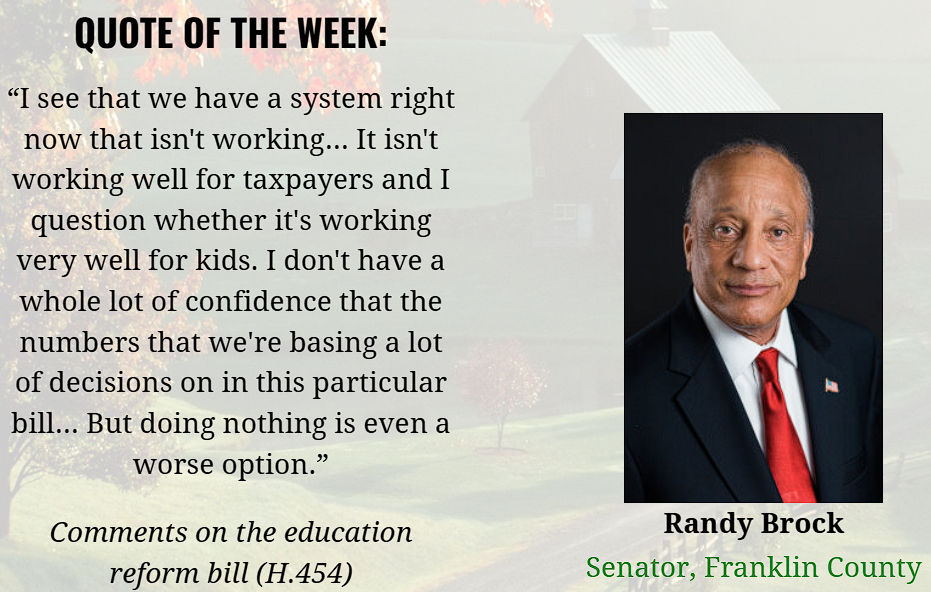
Quote of the Week:“I see that we have a system right now that isn't working... It isn't working well for taxpayers and I question whether it's working very well for kids. I don't have a whole lot of confidence that the numbers that we're basing a lot of decisions on in this particular bill... But doing nothing is even a worse option.” Comments on the education reform bill (H.454)
|
|

| Randy Brock |
| Senator, Franklin County |
| To continue reading, please sign up for our legislative updates (it's free!). |