


Changes started happening rapidly this week as the bulk of the work moved out of committee and onto the House and Senate floors. Nearly every major policy thread of the 2026 session is now being actively reconciled between chambers, and the outcomes of those negotiations will determine whether this session produces durable reform or elegant placeholders. Those negotiations also include the Governor in some instances, such as education reform efforts which were unveiled last night.
Reference-based hospital pricing cleared critical procedural hurdles and is now positioned to become law this session. The property tax yield bill conference committee dug into the mechanics of excess spending exemptions and a one-year renter credit expansion (and the fiscal analysts started raising red flags). The Act 250 conference committee finalized guardrails for accessory on-farm businesses while preserving the road rule repeal. Career technical education reform advanced with unanimous support. And on the Senate floor, a sweeping portfolio of bills moved through final readings, including a permanent ban on crypto kiosks, manufactured housing modernization, and the formal repeal of the Clean Heat Standard's dormant statutory language.
Let's jump in.
| This is a truncated version of our weekly legislative update. To receive the full version, please sign up for our legislative updates (it's free!). |
Health Care: Reference-Based Pricing Takes Shape
S.190 was the week's most consequential policy story, threading through three committees in four days and emerging with a fundamentally different architecture than what the House Healthcare Committee originally drafted.
The original House Healthcare version set prescriptive, multi-year percentage caps on hospital commercial reimbursement (300% of a Medicare-adjusted base rate in FY2028, stepping down to 250% in FY2029). By Friday, the bill had been transformed by a House Appropriations amendment into a one-year, session-law authorization that empowers the Green Mountain Care Board (GMCB) to order hospital-specific reimbursement reductions for Qualified Health Plans and school employee (VHI) plans for hospital fiscal year 2027 only.
The shift is significant. Rather than the legislature dictating a uniform rate, the GMCB now has discretion to tailor reference-based pricing hospital by hospital, item by item, using a percentage of a Medicare-adjusted base rate it determines. Hospitals with rates exceeding 500% of Medicare would be prioritized for deeper reductions. The bill prohibits balance billing, requires hospitals to publish machine-readable price files expressed as percentages of Medicare rates, and mandates additional transparency requirements.
Three additional provisions deserve some attention:
-
Section 1332 Reinsurance Waiver Authorization: The bill now authorizes the Department of Vermont Health Access to apply for a federal Section 1332 state innovation waiver to establish a reinsurance program. If approved, this could unlock substantial federal pass-through funding to stabilize the individual insurance market. The authorization was duplicated into the larger appropriations bill as a hedge against a veto of S.190.
-
Hospital Outpatient Drug Cap Preserved at 120%: The earlier proposal to raise the hospital-administered outpatient drug cap from 120% to 130% of Average Sales Price was struck. The existing cap remains.
-
Critical Access Hospital Disclosure Requirements: A new provision requires Critical Access Hospitals to identify outpatient services where charges exceed five times the Medicare-allowed amount and to post prominent consumer disclosures about the federal rule requiring Medicare beneficiaries to pay 20% of the hospital's charged amount (not the Medicare rate). This provision shines a light on a structural problem that can produce significant (an unexpected) out-of-pocket bills for rural seniors.
Hospital leadership remains strongly opposed to many of these measures. The Vermont Association of Hospitals and Health Systems warned of severe financial consequences. But proponents, led by Representative Alyssa Black, argued that the GMCB already has this authority and that the QHP and VHI markets (where premiums are hitting hardest) cannot wait for a multi-year rulemaking process to conclude. As Black put it, the bill is about using the reductions the Board is already ordering and concentrating them where they'll do the most good: "Affordability for Vermonters."
Separately, S.197 (primary care payment reform) cleared Ways & Means on a 9–1–1 vote. The bill remains a study-and-report framework directing the Blueprint for Health to produce baseline per-person-per-month spending data and implementation recommendations by January 2027.
Property Tax and Education Finance: The Devil in the Exemptions
The H.949 conference committee met multiple times this week, and the fiscal analysts indicated that the Senate's proposed exemptions to the excess spending threshold could fundamentally undermine the tool's purpose.
The Senate version drops the excess spending threshold to 112% but then layers on broad exemptions: excluding all bond payments (not just pre-July 2024 bonds), allowing districts with flat total or per-pupil spending to bypass the threshold entirely, and creating a Secretary of Education appeal mechanism. The Department of Taxes walked the committee through the consequences:
- Approximately 30 districts could qualify for a "hold harmless" exemption under current modeling, districts that aren't hitting the threshold today but would gain an exemption under new rules, potentially altering incentives and shifting property tax pressure onto other communities.
- The appeal mechanism introduces variability into Education Fund revenue forecasts and delays final property tax rate announcements, undermining the predictability that school boards and voters need.
- Strategic behavior risks are real: districts could inflate spending in one year and offset in subsequent years, effectively gaming the threshold (precisely the opposite of the policy's intent).
The renter credit expansion is more straightforward: raising the calculation rate from 10% to 12.5% of HUD fair market rent, with the maximum credit increasing from $2,500 to $3,250. The estimated cost is $4 million, funded by a slight reduction in the one-time General Fund transfer. About 17,000 out of Vermont's approximately 75,000 renting households would benefit. The provision is one-year only, which creates, yes, another one of those tax-rate cliffs we keep warning about.
The fundamental question hasn't changed: how much fiscal discipline is the Legislature willing to impose on education spending, and who bears the cost?
Act 250: Guardrails for On-Farm Businesses, Road Rule Repeal Finalized
The S.325 conference committee concluded its work this week with a detailed set of targeted amendments that were adopted by the House floor on Friday and messaged to the Senate. The bill's core function remains intact: repealing the road rule and removing Tier 3 Act 250 jurisdiction while creating new process mechanisms (a public engagement plan and a temporary joint legislative oversight committee) to address public engagement concerns.
The most contentious item, the accessory on-farm business exemption, received substantial guardrails after the conference committee spent the majority of its time wrestling with language that members acknowledged "you could drive a bulldozer through." The final package includes:
- Concrete examples of exempt events (concerts, farm stays)
- A noise cap of 70 decibels measured at property boundaries
- A 10 p.m. end time for events
- A requirement that the host farm's agricultural practices or qualifying products be a "substantial component" of any event
- A farm stay cap of five or fewer dwelling units
- A delayed effective date of July 1, 2027 (a full year after the rest of the bill takes effect) to allow towns, regional planning commissions, and the next legislature time to prepare
The delayed effective date was described as "perhaps the most important change" by the conference committee chair. It acknowledges that neither chamber took testimony on the on-farm events exemption before it was adopted as a floor amendment.
The oversight committee was also refined: membership was equalized between chambers (three House, three Senate) and duties sharpened from "coordination" to "interpretation of statute." The public engagement plan language was strengthened to require "nonpartisan" (not merely "neutral") facilitation and to examine risks to working lands and barriers to land stewardship.
Separately, H.932 (forestry regulation under Act 250) was concurred in with requested clarifying language that limits Act 250 jurisdiction to portions of a parcel that actually support a development; a clean, targeted fix that protects working forestland from overregulation.
Career Technical Education: Quiet Progress
The House Education Committee unanimously adopted an amendment to S.313 (CTE transformation) that makes three targeted but important changes:
-
Dispute resolution clarified: The Commerce Committee's awkward "pre-in enforcement intervention pathway" was replaced with "early stage mediation" between CTE centers and sending districts, language that appears easier for those on the ground implementing these changes to actually work with.
-
Adult diploma access to CTE: The AOE is directed to recommend how adult diploma program participants can access CTE programs and how that participation will be funded. This fills an operational gap created by recent adult education program transitions.
-
Governance working group removed: The committee concluded that CTE governance has been studied extensively and that ongoing legislative work (via H.955) makes a new task force redundant.
-
School boards are now required to apply credits or proficiencies earned in a State Board–approved CTE program toward graduation requirements. This eliminates prior board discretion that created regional inconsistencies and discouraged CTE participation. This is a concrete step toward treating career and technical education as a co-equal pathway, not a secondary one.
The Senate Floor: A Week of Consequential Votes
The Senate moved a broad portfolio of bills through final readings this week, several of which carry significant policy implications:
-
H.648 (banking/insurance): Implements a permanent ban on crypto kiosks and requires licensing of merchant cash advance providers — a consumer protection measure targeting predatory small-business financing.
-
H.757 (manufactured housing): A substantial modernization package ensuring parity with site-built housing in zoning and tax treatment, clarifying limited equity cooperative status, and expanding the sales tax exemption on manufactured home sales from 40% to 90%. Finance Committee noted the revenue impact (~$200K in FY27, ~$500K/year thereafter) and delayed the effective date accordingly.
-
H.817 (mental health in schools): The Senate wisely narrowed this from an immediate unfunded program to a statewide alignment and inventory approach, with AOE and DMH directed to report by January 2027. The staffing demand data is staggering: positions needed in schools to address youth mental health rose from 142 in FY22 to approximately 790 in FY25.
-
H.740 (greenhouse gas inventory): The House refused to concur with the Senate's strike-all amendment (which included a $300,000 ANR appropriation, privacy protections, and a repeal of the Clean Heat Standard's dormant statutory language) and appointed a committee of conference. The conference will need to reconcile funding triggers, privacy safeguards, and the disposition of Clean Heat language.
-
H.639 (genetic data privacy): Headed to conference after the chambers split over cure periods. The House's position (that genetic data breaches are permanent and "there is no cure") sets up a consequential negotiation.
Looking Ahead
-
S.190 (reference-based pricing) heads to the House floor. The key question is whether the one-year GMCB authorization survives intact and whether the 1332 reinsurance waiver authorization makes it into final law (either through S.190 or the appropriations bill).
-
H.949 (yield bill) conference committee must resolve the excess spending threshold exemptions, the renter credit structure, and the General Fund transfer allocation. The fiscal analysts' warnings about gaming and unpredictability should be taken seriously. So should the cliffs that one-time funding creates and tools for downward pressure on school spending.
-
H.740 (greenhouse gas inventory) conference committee will negotiate the Clean Heat Standard repeal, the $300,000 ANR appropriation, and data privacy provisions. Watch whether the repeal language survives, it's a politically charged decision with real statutory consequences.
- S.325 (Act 250) is nearing the finish-line. The on-farm business provisions won't take effect until July 2027, giving stakeholders a full year to prepare, and the next legislature an opportunity to refine.
-
S.313 (CTE transformation) moves forward with the Education Committee's amendment. The mandatory credit-acceptance provision is one to keep an eye on.
The Legislature is deep in reconciliation mode, not just between chambers, but with the Administration as well. The bills that emerge from this week's conference committees will define the effectiveness of this legislative session. The question, as always, is whether the compromises that get made to move legislation forward preserve the reforms that matter or hollow them out.
On behalf of Vermonters,
|
|
||
|

| Sign Up for Legislative Updates |
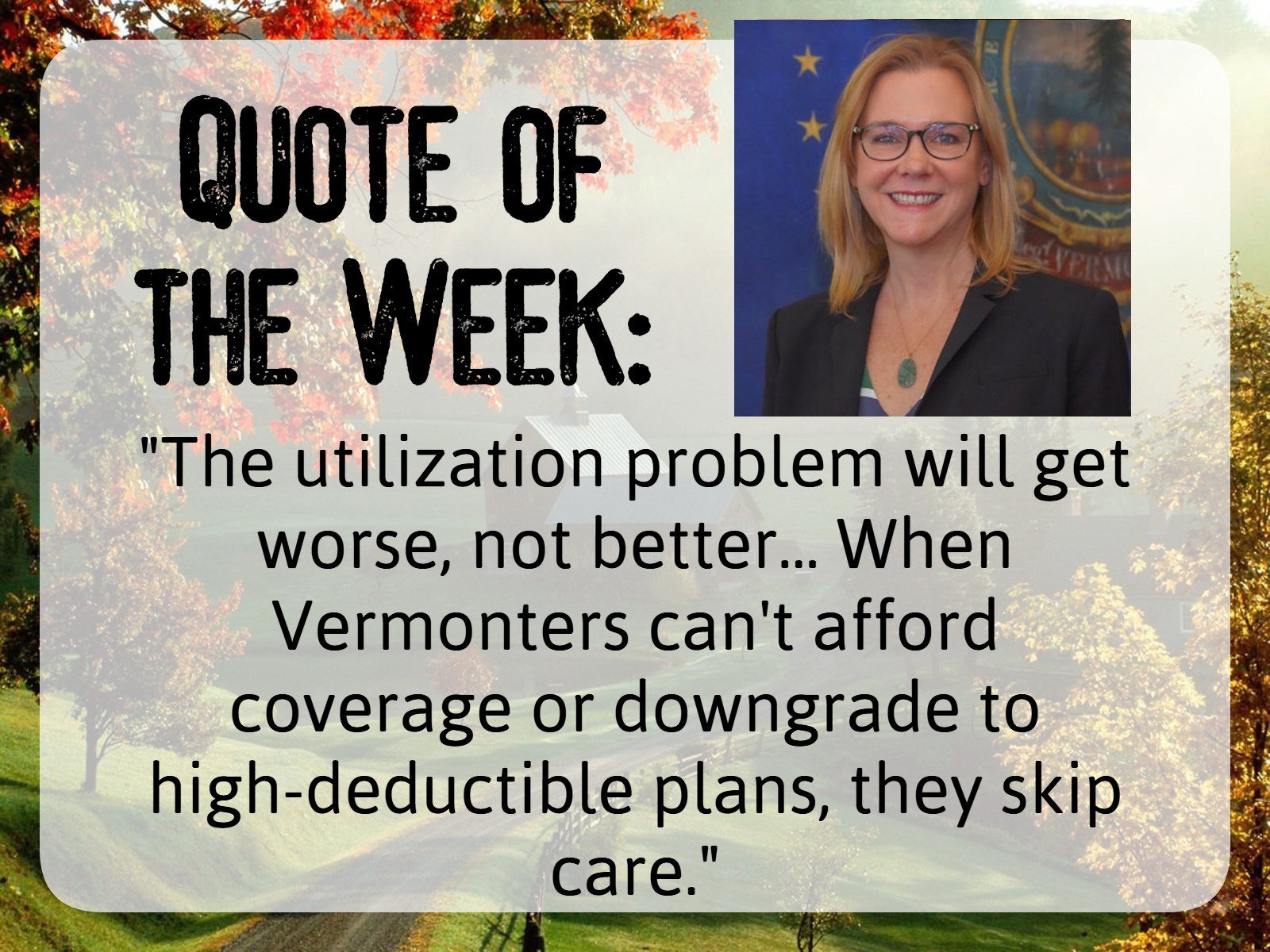
Quote of the Week:"The utilization problem will get worse, not better, if we allow the QHP market to keep shrinking. When Vermonters can't afford coverage or downgrade to high-deductible plans, they skip care." Comment in regards to S.190 health care reform bill that introduces reference-based prices... |
|
| Alyssa Black |
| Chair, House Health Care Committee |

Featured News: Behind closed doors, lawmakers and Gov. Scott near education deal without forced district mergers
After a week of secret meetings, Democrats, Republicans and the governor’s office agreed a compromise was close — and a Friday night amendment signaled an agreement was moving forward.
LETTER: Restoring the Off-Site Construction Accelerator Pilot Program
Vermont's housing crisis will not be solved by inaction or repeating the same things we have done for the last 40 years. The Off-Site Construction Accelerator represents exactly the kind of innovative, data-driven, and practical policy that this moment requires.

| To continue reading, please sign up for our legislative updates (it's free!). |