


The most significant event in Montpelier this week is the one that almost didn't happen... Sensing that the education reform bill (H.454) was going to have some challenges on the Senate floor, we issued an action alert on Monday. Those concerns turned out to be well-founded when Senate leadership announced on Tuesday that they were pulling the bill back from the floor.
| This is a truncated version of our weekly legislative update. To receive the full version, please sign up for our legislative updates (it's free!). |
The reason? Not enough Democrats supported it. To be clear, the bill seemingly had enough support to pass a floor vote, but more Republicans would have supported it than Democrats. That was unacceptable to Senate leaders who had apparently promised members of their caucus that they would not allow such a vote to happen. See the Vermont Public reporting on this; it's quite illuminating. What this set off was a mad scramble to find a compromise that had more bi-partisan representation.
Multiple proposals emerged and were reviewed by the relevant Committees. The proposal that floated to the top was an amendment by Senator Hardy that combined elements of the House and Senate versions of the bill. Many of the findings in this proposal were from the House version of the bill but integrated the governance working group structure from the House and Senate versions which contains legislators, administration officials, and education lobbyists. Most importantly, it delays the implementation of both governance and financing reforms until 2029 and raises the base funding amount to $15,033, which potentially increase overall spending (it's a little too early to tell), but would stabilize tax rates and provide downward pressure on high-spending districts.
Speaking of education cost, this amendment re-introduces minimum class size standards that were present in both the Governor's education reform proposal and the House version of H.454. This will absolutely drive down the cost of education in Vermont. We have the smallest class sizes in the country (by a large margin) and our report from December found that we could increase class sizes in Vermont without negatively impacting the quality of education (it might even have positive impacts).
I have mixed feelings about the overall bill. There is little to dislike in this version, but there are a number of places where things could go sideways. Having been a participant in the development of Act 46, I have concerns about how this will play out in the end. There are many opportunities for the administrators in the current education delivery system to divert the process towards their own desired outcomes (which is what happened with Act 46).
Encouragingly, the governance recommendations that are to be offered by the working group will still include at least one proposal that includes the use of supervisory unions to achieve economies of scale instead of dispending local school boards. This would allow our proposal for education reform to be considered by the working group.
Committees reviewed the amendment prior to passage and it was noted that while the bill addresses cost issues, it lacks provisions for improving educational quality. This discussion also highlighted the disparity between low-spending districts achieving good results, and high-spending districts failing to do so. The current funding model likely punishes districts that are efficient and effective in their spending. There was a realization that a transition away from this current model was necessary and the foundation formula contained in H.454 would accomplish this.
On a more sour note, the House Education Committee held a hearing this week on the impacts of federal education funding changes. The Department of Education has been rejecting many requests for ESSER funds, particularly for professional development and construction projects, which raises concerns about future funding availability within the state. The preliminary federal budget indicates significant cuts, including the elimination of Title III and reductions in adult education and Perkins funding available for college studies.
Changes in Medicaid and SNAP eligibility could also lead to a decrease in directly certified students for free or reduced-price meals, complicating the verification process for schools. The ongoing negotiations and proposed cuts in the federal budget could lead to significant challenges for Vermont's education system.
The Senate Government Operations Committee reviewed the catch-all elections bill (H.474). A new subsection was (re) introduced to prohibit candidates who lose a major party primary from being nominated by another party or running as independents in the general election. This "one bite" rule aims to maintain the integrity of the primary process. Committee members expressed mixed feelings about this provisionome supported it, arguing it prevents confusion among voters and ensures candidates align with their party's values. Others opposed it, suggesting it limits democratic participation.
The committee also removed electronic balloting provisions that were present in earlier drafts, indicating a shift in focus towards more traditional voting methods. Several committee members raised concerns about the complexity of the bill and the potential for confusion among voters. Suggestions were made to simplify the language and ensure clarity in the voting process.
Keeping with the federal theme, the Senate Finance Committee reviewed the workforce development bill (H.34). A major provision of that bill would exempt military retirement pay from state income tax. However, this raised concerns for the Committee about its implications for the overall workforce development strategy. The Committee debated whether to strip the military pension amendment from the bill or to allow it to remain and be addressed in the House Ways and Means Committee. The consensus leaned towards keeping the amendment to avoid complicating the legislative process.
The argument for this provision is to put us more in line with other states (the majority of which exempt military retirement pay) and attract new workers to the state to stimulate economic growth.
Speaking of economic growth, the House Commerce Committee reviewed changes this week that the Senate had made to the economic development bill (S.122). Some provisions were not funded because of budget constraints, such as the proposed expansion of services for small businesses and the extension of new downtown village tax credits.
Switching gears, both housing bills, which we profiled last week, snaked their way through multiple committees this week. S.127 started out in the House Appropriations Committee, which passed the bill early in the week. The Commerce Committee then reviewed an amendment which aimed to replace the existing tax increment financing sections with updated provisions. The purpose was expanded to encourage the development of new primary residences for low- and moderate-income households statewide.
The proposed amendment also removed the CHIP Board from the application process, streamlining the approval mechanism. The Vermont Economic Progress Council (VEPC) would be responsible for reviewing and approving (within 45 days) any CHIP applications. The program cap of $40M remained in place, but would now allow for an annual increase of up to $5M upon the Governor's request.
Several committee members expressed concerns about the potential impact of the cap on rural communities, fearing it may limit access to funding for smaller projects (which is a justified concern). The redundancy of including both the "but for" test and the cap was debated, with some members arguing that both may hinder the feasibility of certain projects.
Similar concerns were raise in the Ways & Means Committee when the amendment reached them. Some committee members expressed concerns about the potential impact on the Education Fund and the efficiency of using state dollars for housing development. While the proposed changes aim to streamline processes and broaden the scope of eligible projects, ongoing concerns about funding impacts and administrative burdens remain.
While the proposed changes aimed to streamline the approval process and expand eligibility for tax increment financing, the House General & Housing Committee (where the bill went next) still had concerns about transparency, the impact of the cap, and the prioritization of applications remained at the forefront of the conversation.
The second amendment to the bill was offered by the Rural Caucus and presented by Representative Laura Sibilia. This amendment aimed to address concerns from rural caucus members regarding the original amendment's complexity. The need to include electricity improvements in the amendment was emphasized, as rural areas face unique challenges with utility access and disaster funding. A proposal to lower the minimum floor area threshold to 51% was recommended to allow for the repurposing of vacant buildings in rural communities. The amendment also sought to eliminate the "but for" test from the bill, which was seen as adding unnecessary complexity.
This amendment did not fare as well as the first one, with each Committee voting it down handedly.
On the Senate side, the Natural Resources Committee worked on an amendment to H.479, which removed of language that would have streamlined municipal housing appeals and zoning. There were some other adjustments intended to address elements of S.127 that were not progressing in the House.
The Senate Finance Committee gave their stamp of approval to the bill on Thursday, after retaining the five-year forgivable loans within the Vermont Rental Housing Improvement Program alongside the grant option, contrary to the Senate's earlier proposal to eliminate them. Additionally, a minimum of 30% of funds must be allocated to grants and five-year loans for individuals exiting homelessness or working with refugee agencies.
On behalf of Vermonters,
|
|
||
|

| Sign Up for Legislative Updates |
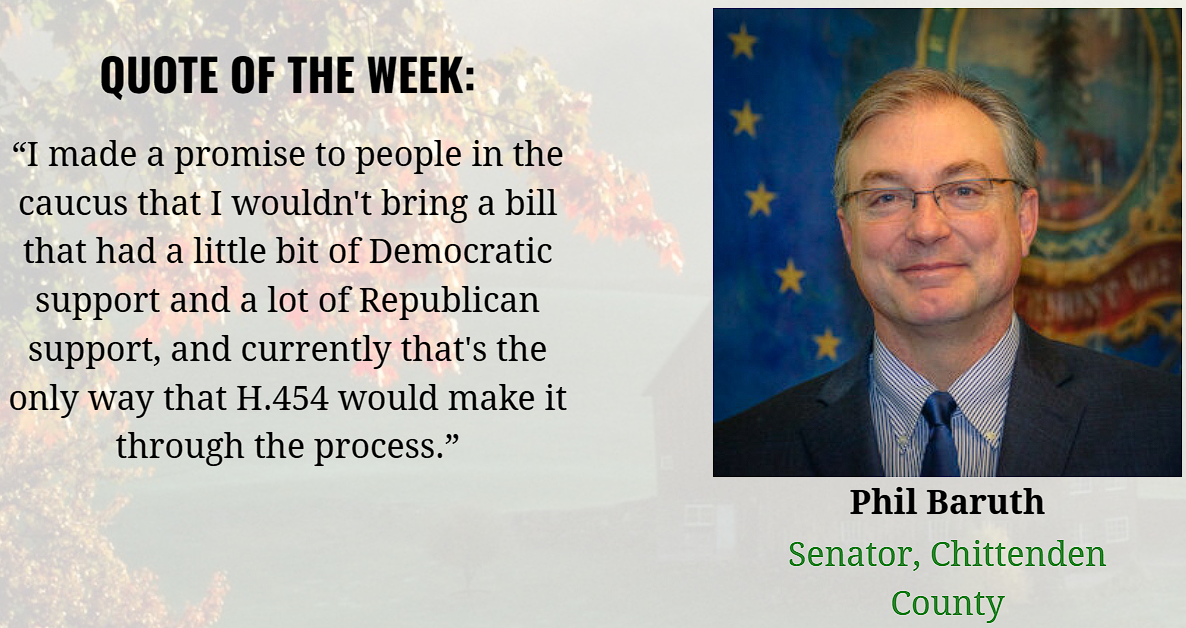
Quote of the Week:“I made a promise to people in the caucus that I wouldn't bring a bill that had a little bit of Democratic support and a lot of Republican support, and currently that's the only way that H.454 would make it through the process.”
|
|

| Phil Baruth |
| Senator, Chittenden County |
| To continue reading, please sign up for our legislative updates (it's free!). |