


The Legislature worked late last night, finally concluding that an education reform deal was out of reach. They are coming back in a couple weeks to (hopefully) finish the job.
| This is a truncated version of our weekly legislative update. To receive the full version, please sign up for our legislative updates (it's free!). |
Education reform efforts have turned into a precarious three-way negotiation between the House, Senate, and Governor. The latter is sort of a new phenomenon; Administration representatives have generally not been present in conference committee negotiations in recent years, but they are for this one. The Governor has already said he can't support either version of the bill, so there is pressure to include him in the negotiations to avoid needing to come back to Montpelier this summer to re-hash the legislation (again).
The Housing bill (S.127 is now the vehicle) also faced tense negotiations this week as the House and Senate tried to shore up their differences over the new CHIP program for project-base tax-increment-financing.
Now, on to the nitty-gritty...
Last week we reported on the difficulties the Senate had passing the education reform bill (H.454). This week, we break down the differences between the Senate and House versions of the bill.
- Instead of creating a new subcommittee of the Commission on the Future of Public Education (run by educrats), the Senate created a new Task Force to recommend school governance structures and boundaries.
-
The Task Force's membership includes various stakeholders, such as the Secretary of Education, legislators, and representatives from educational associations.
-
The task force must consider geographic barriers, demographic equity, and community connections when proposing new boundaries.
-
-
The Senate version allows for the formation of transitional boards to oversee the establishment of new school districts. These boards will be responsible for creating voting districts and preparing initial budgets for the new districts.
-
The Senate maintained class size minimums but adjusted the numbers for different grade levels. For example, kindergarten and first grade minimums were set at 10, while grades 2-5 were set at 12; the House version required class sizes up to 18.
-
The Senate lowered the threshold for independent schools to qualify for public tuition from 51% to 25% of students attending on a tuition basis. This means that at least 25% of the student body would need to be attending on on public tuition.
- The Senate version chose to study the base education amount instead of setting one in statute, differing from the House's approach of instituting a $15,033 base amount with a series of weighting factors.
Generally, the Senate version reflects a shift towards greater flexibility in school governance and funding structures, whereas the House version is more top-down and rigid in its approach. The establishment of transitional boards and task forces in the Senate version envisions more decentralized decision-making.
A Conference Committee began meeting on Tuesday to work out the differences between these two approaches. Senators raised concerns about the implications of closing schools on local communities and the need for protective measures for small towns.
The Committee also discussed early on the class size minimums and the development of uniform graduation requirements. There was a consensus that further testimony and research were needed before making definitive decisions on these issues. This turned into a broader theme as negotiations progressed.
Some legislators expressed wariness about the transition (phase-in) mechanisms in the Senate version due to past failures, emphasizing the need for careful implementation to avoid incentivizing districts to overspend before the transition (like what happened with Act 127).
House members raised concerns about the potential for some taxpayers to be worse off under the Senate's proposed property tax credit program, especially those earning between $50K and $110K household income. However, the House's proposal to smooth out these differences was estimated to cost approximately $45M more than current law, necessitating alternative revenue sources to cover the additional costs. Ultimately, Senators acquiesced to these concerns.
However, the biggest contentions surrounded the overall spending involved in the bill. The Governor has been adamant that the new funding system should not cost more than the current one (the House version does). However, another concern emerged this week around a mechanism present in both versions of the bill that would cause massive increases in property taxes for today's low-spending districts (which also tend to be rural and poor). Legislators did not find immediate solutions to this within the framework of the two versions of the bill.
In the end, this is what prompted the extension of the legislative session. We do have some thoughts about how to resolve this and will plan to offer them to the Conference Committee in the coming days.
As mentioned earlier, another set of tense negotiations unfolded this week over the housing bill, S.127. The House's amendment to the bill, led by Representative Kimble, replaced all CHIP (tax-increment financing) provisions from the Senate version.
Under this revision, the definition of improvements that CHIP financing can be used for shifted from a broad, non-exhaustive list to an exhaustive list, limiting what can be financed under the program. A program cap of $40M per year on education property tax increment retention was also introduced.
The Senate did not like either of these provisions, but the House was (initially) unwilling to move. Several Senators expressed concerns about the exhaustive list of permissible infrastructure improvements, arguing it may limit flexibility for communities. This was a consistent theme throughout the negotiations with the Senators worrying about too many restrictions on the program and the House members not willing to loosen restrictions as much as the Senate would like.
Senators requested the Joint Fiscal Office (JFO) to conduct new modeling to better understand the financial landscape and the impact of different caps. This resulted in a counter offer of a $200M annual cap, which the House ultimately accepted.
The perpetual primary residence requirement was also flagged by Senators as a potential burden for municipalities, complicating enforcement. The Senate version proposed a "time-limited affordability" model, where units remain affordable until all project indebtedness is retired. The House ultimately agreed to this, and suggested applying the same durational requirement for both owner-occupied and rental housing, simplifying the previous two-pronged approach.
Finally, Concerns were raised about the potential success of zoning appeals from individuals who may not be in the immediate neighborhood but can demonstrate they are "aggrieved." The House proposed a narrower exemption from the "but for" test that would apply to moderate-income housing developments, but low-income projects would be be exempt.
To this end, there was also some disagreement about how to define moderate-income housing. A Senate proposal was made to define moderate-income housing development, suggesting that at least 25% of units should be offered at 150% of Area Median Income (AMI) or less.
A deal was reached on Friday afternoon and was passed by both chambers Friday evening. Administration officials indicated that the Governor will support it. We will update our analysis of the bill in the coming days to reflect the version sent to the Governor.
Another conference committee worked on S.126 throughout the week. The Senate version of the bill had proposed global hospital budgets while House focused on reference-based pricing. The Senate version emphasized affordability benchmarks for commercial health insurance, while the House version broadened this to general healthcare affordability benchmarks.
Concerns were raised about the feasibility of implementing global budgets without all payers participating. Additionally some legislators worried about the number of reports required from the Agency of Human Services (AHS). AHS suggested consolidating reporting requirements to streamline updates and reduce redundancy.
Eventually, a compromise was struck, and the bill was sent to the Governor for a signature on Friday. We will update our analysis of the bill in the coming days to reflect the version sent to the Governor.
The House Government Operations Committee has been deliberating over the deepfake election bill (S.23) for months now, but finally decided to move the bill this week. Not everyone was happy about it though, as some members felt it was important to ensure the bill was as strong as possible (addressing first-amendment concerns) before passing it, while others argued that waiting for additional feedback could delay necessary action.
Deputy Secretary of State Lauren Hibbert supported passing the bill now, emphasizing the need for the Secretary of State's office to begin education efforts in preparation for upcoming elections. However, the Committee acknowledged that the bill might require future amendments as technology evolves and more information becomes available.
Ultimately, a motion was made to vote on the bill, and despite some members expressing reservations, the committee proceeded with the vote, which resulted in a favorable recommendation. The bill then moved to the House floor and was amended there on Friday before being passed.
On behalf of Vermonters,
|
|
||
|

| Sign Up for Legislative Updates |
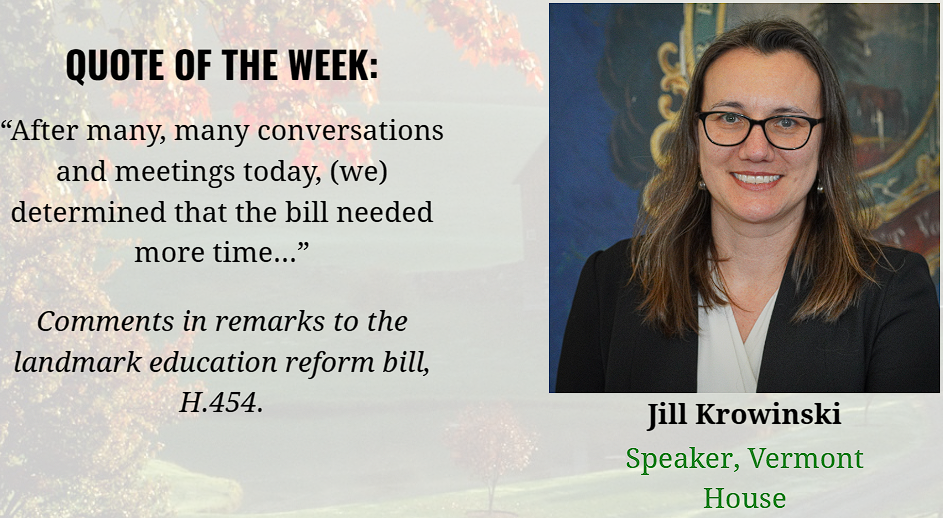
Quote of the Week:“After many, many conversations and meetings today, (we) determined that the bill needed more time...” Comments in remarks to the landmark education reform bill, H.454.
|
|

| Jill Krowinski |
|
Speaker, Vermont House |
| To continue reading, please sign up for our legislative updates (it's free!). |