


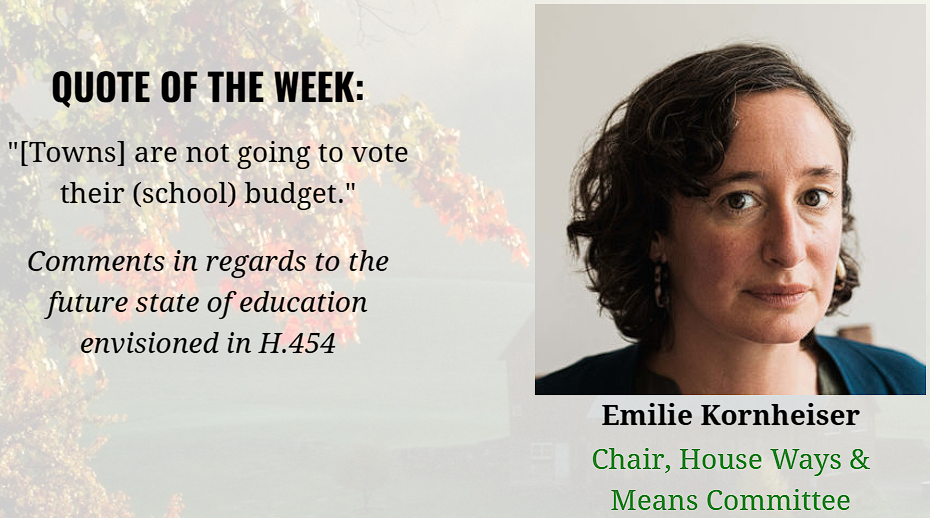
It is clear that the House does not want voters involved in setting school budgets. It has always been sort of implicit in this bill, but House members said it explicitly in debates this week: they do not envision a future system where local voters weigh in on their school budgets in any meaningful way.
| This is a truncated version of our weekly legislative update. To receive the full version, please sign up for our legislative updates (it's free!). |
That being said, nearly all of the debate this week surrounded setting tuition for independent schools, which serve about 3500 students in rural parts of the state where operating a public school is impractical. Many of these schools serve grades 9-12, much like union high schools in more urban parts of the state. It's a system that has existed for nearly 150 years.
In the House version of the bill, they decided to remove the funding weights that exist in the current system based on grade level (which provides more funding for higher grade levels). This is, largely, for two reasons: first, that money in the newly envisioned larger districts would be fungible because they believe all districts would operate K-12 and, therefore, be able to move money around in that larger system as necessary. Second, because one recent study suggested that it did not actually cost more to educate high school students than other grade levels.
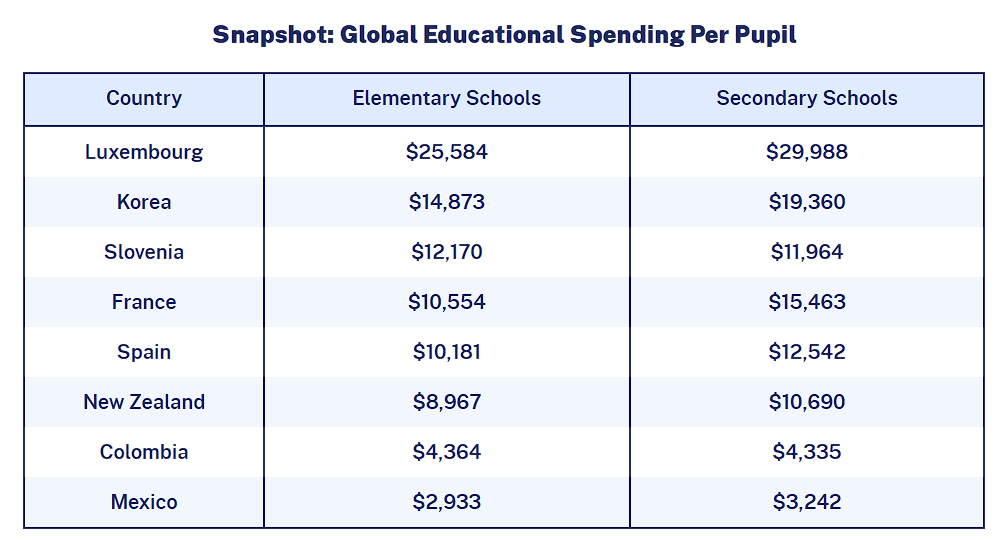
The Senate did not buy this argument, pointing to AOE data that shows that current districts operating grades 9-12 have 12% higher spending per student than districts operating lower grade levels. I'm inclined to agree with them. We know that 80% of education cost is related to staffing. It seems likely that personnel costs at higher grade levels exceeds those of lower grade levels. We also know, thanks to the Education Data Initiative, that most developed countries spend more secondary schools than elementary schools:
Where this really comes into play is for independent schools, which are generally not part of a larger K-12 system, but rather responsible for specific grade levels. For them, the money isn't fungible; they can't just move it around from one school or classroom to another. The removal of weights and the cap on district spending would mean they would see a cut in the tuition that a non-operating district could send them. This was the crux of the issue that the conference committee was hung up on this week.
The House was reluctant to budge, only offering an additional 5% that non-operating districts could approve to spend on tuition, but adding regulatory hurdles in order to achieve even that. This reflects a broader sentiment in the bill where nearly all spending decisions will be made at the state level.
I have said it before and I will say it again: this bill moves us from a system where roughly 90% of spending decisions are made locally to one where 90% are made at the statewide level.
Ultimately though, the conference committee and the Governor found common ground and a compromise was struck yesterday afternoon. We will dig into the details in coming updates, but the broader House and Senate still need to agree to the compromise, which is not a given. It was emphasized by all involved that this is really a starting point; much work remains over the next few years to get to the final state.
The only other action inside the building this week was related to the elections bill, H.474, which VTDigger reported last week was hung up by Senate Leadership. After the Secretary of State went public to decry the political gamesmanship, a trimmed down version of the bill was brought back before the Senate Government Operations Committee this week and voted out.
Most of the provisions removed in the new version related to local elections and election officials. Notably, the reported related to implementing Ranked Choice Voting was repealed as was the report on election ballot returns and candidate demographics. More structurally, the provisions related to primary nominations and Australian ballot requirements for local elections were also removed. And, finally, provisions related to how candidate names display on ballots were also re.
The draft was described as a result of Chairman Collamore asking the Secretary of State's office what was "must pass" this year. The bill will now make its way to the Senate floor when they come back (hopefully) next week.
On behalf of Vermonters,
|
|
||
|

| Sign Up for Legislative Updates |
Quote of the Week:"[Towns] are not going to vote their (school) budget." Comments in regards to the future state of education envisioned in H.454
|
|

| Emilie Kornheiser |
| Chair, House Ways & Means Committee |
| To continue reading, please sign up for our legislative updates (it's free!). |