

This week's legislative update isn't much of an actual update. That's because the conference committee charged with finding a path forward on education reform (H.454) did not meet at all this week. And, yes, the Legislature went home in order give this same committee time to work out a compromise...
| This is a truncated version of our weekly legislative update. To receive the full version, please sign up for our legislative updates (it's free!). |
Now, I'm sure that there's a backroom deal being cooked up between the House, Senate and Governor, but the rest of us won't be privy to it until next Wednesday when the Committee is finally scheduled to meet; that is only five days before the full Legislature is set to return, expecting to vote on whatever this magical compromise emerges.
The Governor has said that the timeline for reform in both bills is not quick enough. He is also concerned about overall spending exceeding the current system, which the House bill certainly does. The Senate wants more protections for independent schools and for extreme high- and low-spending districts, which would see dramatic changes to tax rates and budgets.
These are all solvable problems, but it will take finesse to navigate them. This week, we sent a letter to the Committee urging them to overcome the remaining obstacles and offered some solutions to finding a path forward. One of the said obstacles is the impact of the new foundation formula on extra high- and low-spending districts. Currently, the lowest spending district in the state is spending $8,740 per (weighted) student, while the highest is at $27,020 (over a 300% difference). The new foundation formula allows for a range in spending from $15,033 (the base) to $16,536 (the cap on supplemental district spending), if we assume the current-law weights are maintained. You can probably already see the problem.
In order for districts to adopt the new foundation formula, some will need to make dramatic cuts (over $10,000 per student) and others will see massive tax increases (up to $6,000 per student). Neither scenario is going to be acceptable for the communities impacted. Our solution is to lower this base payment and raise the cap on supplemental district spending to allow for a broader range in spending.
The $15,033 base payment is quite high, especially after it is adjusted for weighting factors. The bill essentially moves from a system where approximately 90% of education spending is locally-determined to a system where 90% of spending is state-determined. This is a significant shift in policy that has ripple effects. Most states have not gone this far, and instead opt for their base payments to cover somewhere between 50-80% of total spending; striking a balance between state and local control.
How do we see this working? Lowering the base payment to somewhere closer $11,000 (only five districts spend less than this based on FY2025 data) and capping weighted education spending per pupil at $20,000 ( this would only impact three districts) would be less disruptive to current education spending patterns but still offer the stability and transparency that the foundation formula provides. This cap could be left in place for several years in order to bring down the highest spending districts, compress the disparity between the highest and lowest spenders, and even bring down overall spending. Even so, this proposal would allow for an 82% range in spending, which is already significantly more equitable that today's 300% range.
In other news, the Governor allowed the bill delaying ethics oversight (H.1) to go into law without his signature. Smart. This is one of those bills that no one feels good about.
Another bill we've been following, which promises to control health care costs (S.126), was sent to the Governor before legislators evacuated Montpelier last week. The hallmark of this bill is a new payment system called reference-based pricing that sets reimbursement rates between hospitals and insurers. Additional financial oversight tools for the Green Mountain Care Board were also included.
The election deepfake bill (S.23) stalled at the one yard line, gaining an initial approval from the House, but a final vote was not held before the legislative session was put on ice.
On behalf of Vermonters,
|
|
||
|

| Sign Up for Legislative Updates |
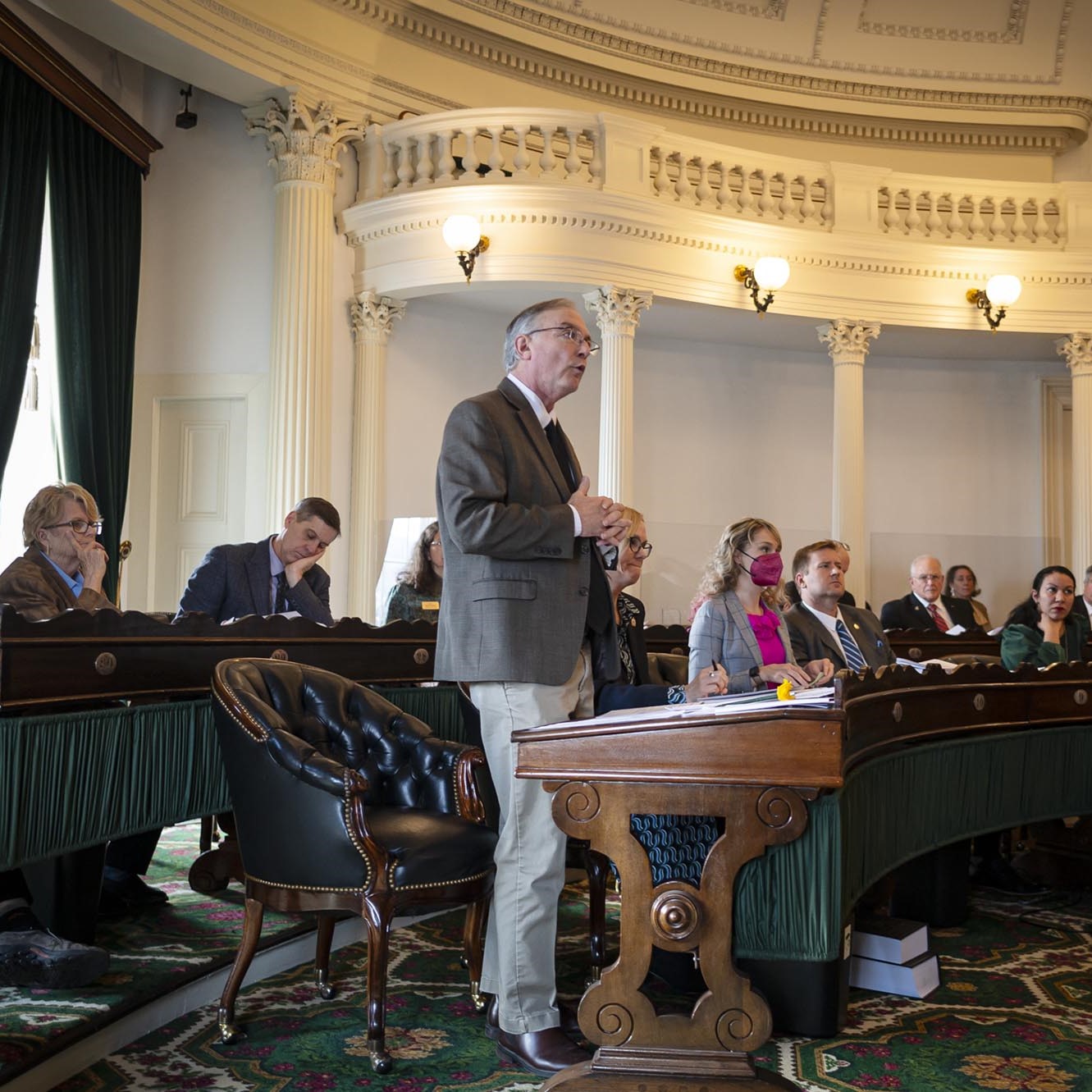
Quote of the Week:"Vermonters would have every reason to believe that we were not taking our work on education transformation seriously." Comments in regards to the delay in work on H.454, as reported by Vermont Public.
|
|
| Leadership |
|
Vermont Senate |
| To continue reading, please sign up for our legislative updates (it's free!). |