News

What is the Clean Heat Standard?

Many people have probably heard of the Clean Heat Standard, a "carbon tax", or a fee on carbon-based heating fuels. Governor Scott vetoed the legislation to design the Clean Heat Standard, saying that it would increase cost of living for those that could least afford it. Leaders of the super-majority in the Legislature have called some of these claims "misinformation" and are adamant that carbon-pricing is necessary to combat climate change.

So what is the Clean Heat Standard, and what does it do? We break it down here for you with the help of one of the people on the advisory group designing what this system will ultimately look like.

  • What is the Clean Heat Standard?

    Many people have probably heard of the Clean Heat Standard, a "carbon tax", or a fee on carbon-based heating fuels. Governor Scott vetoed the legislation to design the Clean Heat Standard, saying that it would increase cost of living for those that could least afford it. Leaders of the super-majority in the Legislature have called some of these claims "misinformation" and are adamant that carbon-pricing is necessary to combat climate change.

    So what is the Clean Heat Standard, and what does it do? We break it down here for you with the help of one of the people on the advisory group designing what this system will ultimately look like.

  • Are we Headed for Another Fiscal Cliff?

    July 1 has come and gone, and with it the end of Vermont’s 2024 fiscal year on June 30 and the start of fiscal 2025 on July 1. Given it’s an election year in Vermont, now is a good time to consider important fiscal trends within the budget that might bite taxpayers going forward.

  • A Slow Start for the Commission on the Future of Education

    The Commission on the Future of Public Education has recently begun its legislatively man­dated 18-month lifespan. The commission was established by  Act 183[1] of 2024 in response to wide­spread negative public reaction to the 13.9 percent statewide property tax increase needed to support FY25 public education spending.

  • Vermont's Rural Betrayal

    The rural-urban divide in Vermont has been exacerbated by historical and ongoing legislative decisions that disproportionately favor urban areas, leaving rural communities marginalized and underrepresented. This issue is rooted in the U.S. Supreme Court's 1960s rulings that established "one person, one vote," intended to ensure equal representation. However, this principle has led to a concentration of political power in urban centers like Burlington, which wields significant influence over state politics and policy decisions. This imbalance often neglects the unique needs and challenges faced by rural communities.

  • What's Really Going on With Education

    This letter is in response to Don Tinney’s 6/26 commentary in VTDigger.

    Tinney’s “hit piece” on Governor Scott is nothing new for the VT-NEA, although I’m surprised by the shrillness of the tone. Perhaps he realizes how much Vermonters have lost patience with rising property taxes and declining outcomes and is hoping to deflect attention away from his organization.

  • Property Tax Yield Bill (H.887) - Summary & Analysis

    The annual property tax yield bill was a little different this year. In response to a projected 20% increase in property tax rates, the legislature injected a number of policy reforms into the bill in hopes of reducing rates in future years.

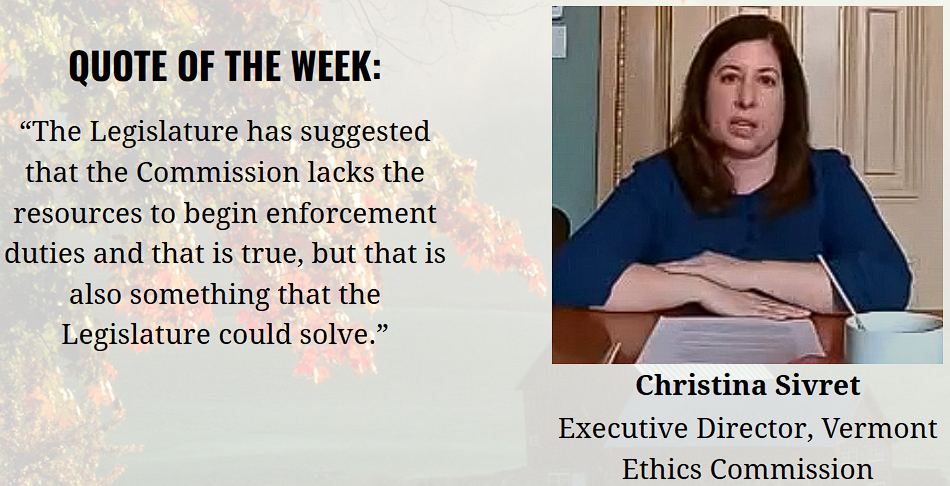
  • Expanded Ethics Oversight (H.875) - Analysis

    H.875 strengthens Vermont's ethics laws by creating enforcement over disclosure requirements and independent oversight over state officials by giving the State Ethics Commission investigatory powers for the first time. A new Municipal Code of Ethics will also be created to provide a baseline code of conduct for local officials across the state.


  • BILL ANALYSIS: Public Safety (S.58)

    S.58 is one of several criminal justice bills passed by the legislature this session. Key provisions of the bill add zylazine (an animal tranquilizer) to the list of regulated drugs and tightened up language that allows dealers to dodge responsibility by claiming they didn't know what was in the products they were selling. More controversially, the bill delays "raise the age" efforts in an attempt to allow the Department for Children and Families to deal with a current spat of violent juvenile offenders.

  • ANALYSIS: Updates to Open Meeting Laws (S.55)

    The General Assembly passed S.55, which updates Vermont's Open Meeting Law. It requires public bodies to be transparent about their deliberations and decisions, and to use standard rules and best practices for both meeting format and method of delivery.

  • Property Tax Yield Bill (H.887): House Floor May 10, 2024

    Representative Kornheiser introduced the Senate changes on H.887 to the House Floor Friday night. Her proposal of amendment embedded the education finance study into the Commission on the Future of Education. They also proposed an excess spending threshold of 118% above average district spend, which splits the difference between the original positions of the two bodies.