

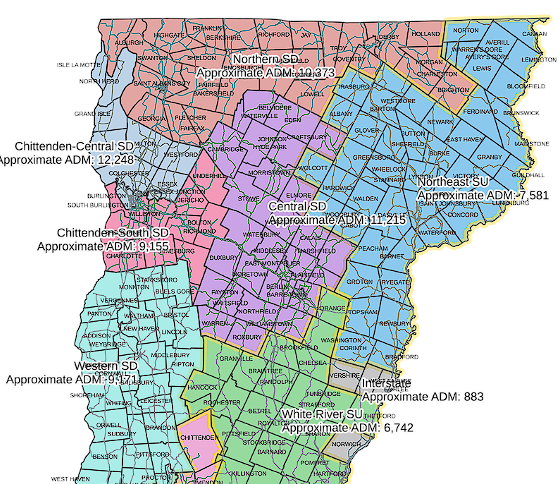
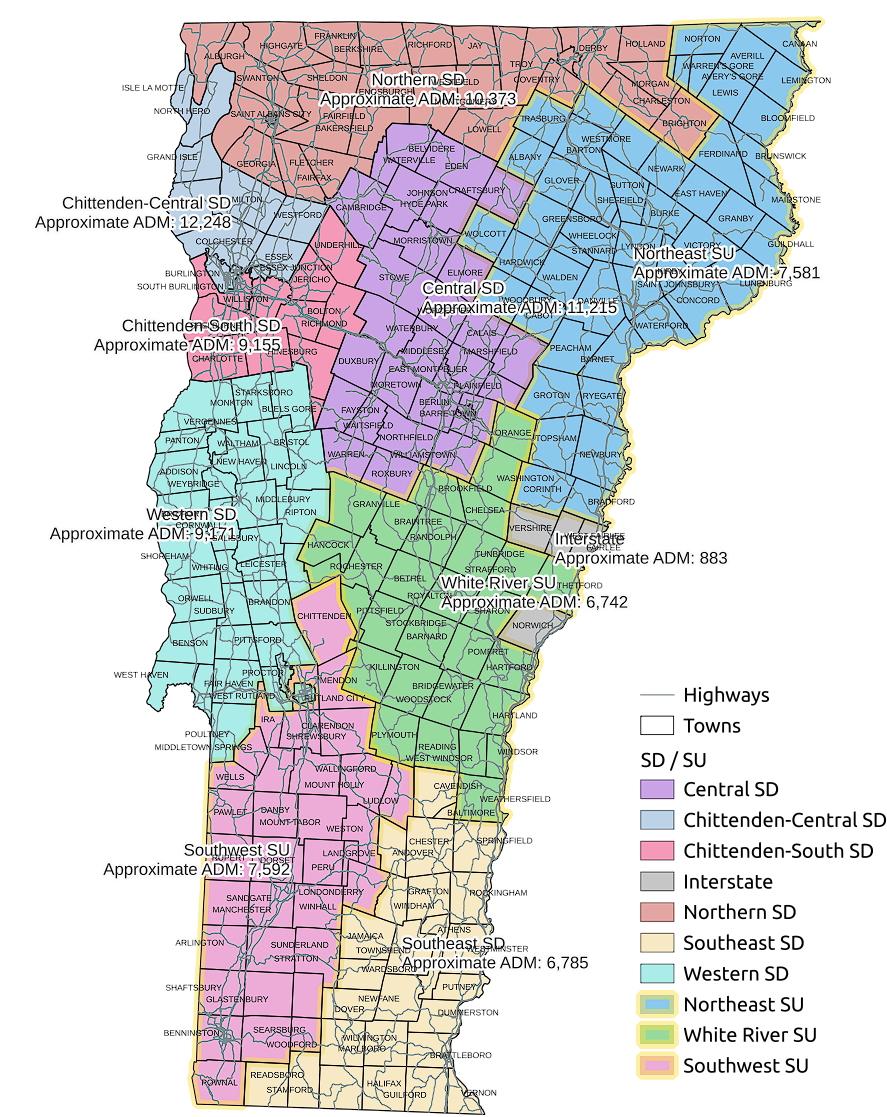
Seth Bongartz, Chair of the Senate Education Committee, drew a new map for education governance reform in response to Governor Scott's plan. The significantly reduces the number of governance bodies in the education system but also preserves inter-state and tuitioning school districts in most instances.
The Details:
- Consolidates 52 supervisory unions (SUs) and 119 school districts into 9+ governance structures.
- The new governance system would consist of 6 supervisory districts (a combined SU/district) and three SU's that contain a mix of operating and non-operation (tuitioning) districts.
- Within the SU's, districts with like operating structures (fully operation, partially operating, non-operating, etc.) would be consolidated.
- Tuitioning would be eliminated in Grand Isle County because the vast majority of students attend public schools (which would presumably be within their new supervisory district).
- Independent schools located in operating districts would no longer be eligible to receive tuition dollars.
- Independent schools located within non-operating districts and have at least 25% of their students on public tuition dollars would be eligible to continue receiving public funds.
The Good:
|
The Bad:
|
Analysis:
Bongartz plan solves some challenges with the Governor's proposal, namely the town tuitioning program and the interstate school districts. However it does not avoid the major pitfall of drastically reducing local control.
Local school boards and town meeting debates over school budgets are hallmarks of rural Vermont communities. They offer a way for Vermonters to engage with our school system and take ownership of it. Moving this responsibility to some far off board is a dramatic change and is, quite honestly, unnecessary. We know what the cost drivers are, and they aren't local school boards. They are staff and administrative overhead, which in today's system is largely at the supervisory union level.
You could gain most of the savings and leave local control intact by consolidating supervisory unions. Our suggest would be to align supervisory unions with our Technical Education Centers in order to strengthen our post-secondary educational opportunities. We released our own proposal a few weeks ago that outlines how this would work.
Current Status:
The proposal is being reviewed by the Senate Education Committee. They seem inclined to work off of this proposal instead of the Governor's going forward.
News coverage on the plan |
Read the Plan |
More bill summaries |
Last updated: 3/26/2025
DISCLAIMER: Generative AI used to assist in the production of this report.