

Act 170 advances the next phase of Vermont’s education system transformation by creating regional cooperative educational service areas (CESAs), requiring all districts to participate in structured studies of possible union school district formation, delaying major parts of the State’s broader education finance transition, and commissioning further work on prekindergarten funding, education governance, shared services, district reorganization, education finance, and early childhood access.
The Details:
-
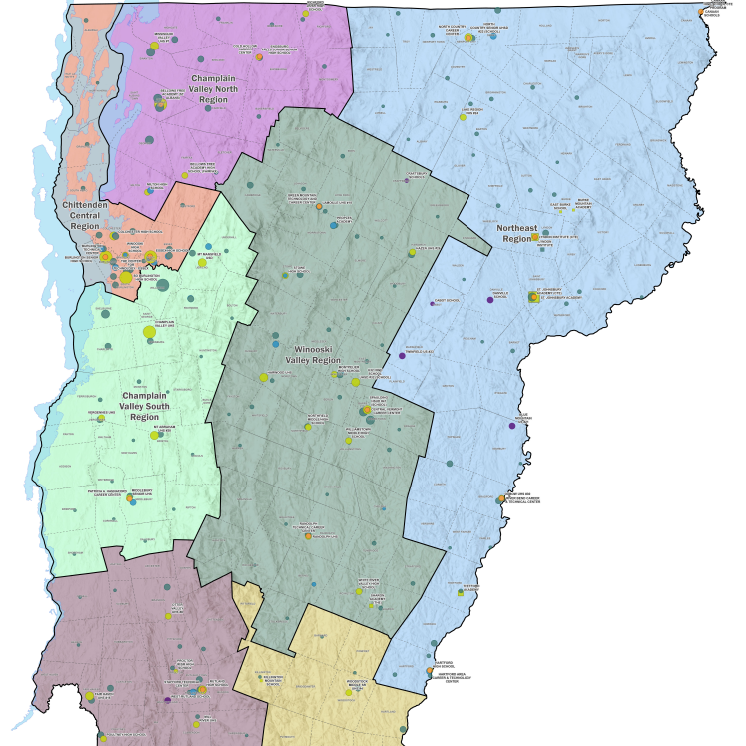
Renames boards of cooperative education services (BOCES) as cooperative educational service areas, or CESAs, and places every supervisory union into one of seven designated regional service areas.
-
Requires each CESA to provide at least three core functions for member supervisory unions: special education services, business and administrative services, and consultation and facilitation for possible union school district creation (mergers). They must also offer professional development, curriculum coordination, transportation, and facilities master planning.
-
Establishes governance rules for CESAs, including one appointed representative from each member supervisory union, minimum meeting requirements, conflict-of-interest rules, quarterly public updates, and authority to adopt bylaws and create subcommittees.
-
Creates financial management and transparency requirements for CESAs, including an education cooperative fund, uniform accounting, annual budgets, annual audits, annual reports, and public posting of board membership, meeting minutes, governing documents, and reports.
-
Authorizes CESAs to hire executive directors and staff, apply for grants, enter contracts, and procure services and facilities, while making existing employment, retirement, and collective bargaining laws apply to CESA employees.
-
Revises the existing CESA start-up grant program by increasing the available grant amount to $15,000 per CESA and adding additional funding support through the school budget process.
-
Repeals an earlier transition report tied to prior BOCES legislation and makes conforming amendments throughout Vermont law so that education, labor, and retirement statutes recognize CESAs.
-
Creates a transition process for the new CESAs, including deadlines for member supervisory unions to appoint board members (within 30 days of the bill's passage) and for the largest supervisory union in each region to convene (within 45 days) an initial organizational meeting.
-
Requires the Vermont Learning Collaborative (the CESA that already exists today) to hire or contract for seven regional facilitators and one lead facilitator to organize and support study committees on forming unified union school districts.
-
Mandates that all school districts participate in assigned study committees, with facilitators using statutory guidance to group generally contiguous districts and, where practical, aim for study groups serving at least 2,000 students. (Added in House Ways & Means version: facilitators are also directed to consider grand list values, homestead exemption effects, and current education spending when forming groupings.)
-
Requires study committees to follow Vermont’s existing statutory process for union school district study, while also examining the feasibility of regional middle schools or high schools that could expand educational opportunities and career and technical education access.
-
Requires study committees that recommend unification to analyze educational, financial, operational, and long-term sustainability effects, and requires committees that reject unification to explain why, including any legal or policy barriers and any minority views within the committee. Committee should also consider grand list values, homestead exemption effects, and current education spending, and to share updated fiscal modeling from ongoing legislative work with study committees.
-
Merger committees must be grouped and begin meeting by October 15, 2026, provide a status report by February 1, 2027, submit final reports by September 1, 2027, receive State Board findings by December 15, 2027, and hold local votes on proposed unified union districts on March 7, 2028.
-
Allows eligible districts that do not merge through the main process to propose joining an existing or newly created unified union district later, subject to local voter approval and final enactment by the General Assembly.
-
Imposes a moratorium through fiscal year 2035 on petitions to withdraw from or dissolve a union school district.
- Requires facilitators to monitor the Legislature’s education transformation work and share the most up-to-date fiscal modeling with study committees. (Added in House Ways & Means version.)
-
Requires follow-up reports to the Legislature on study committee results, barriers to district formation, and possible adjustments to supervisory union and CESA boundaries by January 1, 2029.
-
Provides funding for study committee reimbursements ($10k each), facilitator staffing and administration ($442k), and executive director grants for CESAs ($50k each) through amounts directed from Act 73-related appropriations. (Changed in House Ways & Means version: funding mechanism revised from the General Fund, but overall support for study committees, facilitators, and CESAs remains.)
- Delays major parts of 2025 Act 73’s education finance and governance transition from 2028 to 2029. Even 2029 is not assured unless specified conditions are met, including local merger-study opportunities, fiscal analysis, and additional legislative action on key elements of the proposed foundation formula. (Changed in House-passed version: conditions were revised and now include a Joint Fiscal Office comparison using fiscal year 2027 data.)
- Adds special education funding safeguards stating that education finance reform should preserve federal maintenance-of-effort requirements, protect students’ rights to services, and require districts to assess the impact of significant programming changes on students with disabilities. (Added by House Ways & Means.)
- Beginning with the foundation formula implementation, qualifying small-by-necessity schools and sparse-by-necessity schools will receive annual grants based on enrollment.
-
Creates regional assessment districts for property valuation and appeals. The act shifts toward coordinated, regionalized property assessment, six-year reappraisal cycles, standardized practices, and new regional appeals boards, with implementation largely beginning in 2031.
-
Creates new property tax classifications and transition planning. The act establishes homestead, nonhomestead residential, and nonhomestead nonresidential classifications, along with new dwelling-use attestation requirements and related transition reporting, though some of these provisions are contingent and subject to future legislative action.
-
Expands school construction planning and future aid structures. The act adds positions in the Agency of Education’s school construction division, funds facilities master planning grants, strengthens the State Aid for School Construction Program, and sets up future prioritization for projects that support governance consolidation, regional high schools, health and safety improvements, and access to educational opportunity.
-
Creates legacy debt aid for school construction. Eligible districts that are not identified as "bad-faith participants" in the merger process may receive aid covering 75 percent of annual debt service on certain preexisting school construction debt.
-
Adds transition provisions for educational opportunity payments, tuition, supplemental district spending caps, and homestead tax rate adjustments during fiscal years 2030–2038.
- The act requires statewide data collection, updated cost analysis, and legislative recommendations on how to incorporate pre-K more fully and equitably into Vermont’s education finance system while preserving a mixed delivery model.
The Good:
|
The Bad:
|
Analysis:
Act 170 does not complete Vermont’s education transformation, but it builds the regional structures, study process, transition measures, and implementation checkpoints that lawmakers appear to believe are necessary before larger funding and governance reforms can fully take effect. The act leans toward staged change rather than immediate systemwide consolidation. Compared with the earlier House version of H.955, the enacted law is broader and more consequential: it keeps the CESA and merger-committee framework, but also folds in major additions on prekindergarten, special education safeguards, small and sparse school support, school construction aid, tax classifications, and regional property assessment. Those are meaningful committee and end-of-session changes, not minor edits, and they materially reshape the bill from a governance-and-study measure into a wider education transformation package.
One of the most important policy questions behind the act is where Vermont can realistically achieve economies of scale. The structure of Act 170 suggests an understanding that regional shared services are likely to offer a more practical route to efficiency than district consolidation alone. That is significant because Vermont’s governance system remains highly fragmented, with many relatively small districts and supervisory unions. A regional service model could improve access to specialized supports, business functions, transportation planning, facilities planning, and possibly expanded academic and career technical offerings. In that respect, the act aligns with Campaign for Vermont’s long-standing argument that the supervisory or service layer is a more promising place to seek savings than local school board elimination by itself.
At the same time, the scale of the proposed CESA's is double what we had recommended in our education reform proposal. That matters because at nearly 1,380 square miles, these service providers may be at such a geographic scale that inefficiencies start to emerge. Additionally, they might be so far removed from school district operations, or working with so many schools or districts, that they are not able to coordinate effectively. Still there are savings to be had; our estimate showed that there is ~$300 million in potential cost-savings from shared services, but at a more moderate scale of 15 CESAs statewide. It seems reasonable to start smaller and these CESAs could always be combined in future iterations. It is easier to do this than to unwind a larger pre-existing CESA if they prove too unwieldly.
Significantly, the bill also requires all districts to participate in studies of possible school district mergers, even though the practical benefits of consolidation may vary widely by region and may be harder to realize where staffing contract equalization, transportation, debt service, and community concerns are significant. That leads to a central trade-off in the bill: efficiency and equity versus local control and implementation risk. CESAs may help reduce duplication and create more consistent access to services that small districts cannot easily provide on their own, particularly in special education and administrative support. For students and families, that could improve educational opportunity if regional delivery expands course access, stabilizes services, and strengthens operational capacity.
But the larger school districts that are called for can also feel more distant from local communities, and Vermont’s recent experience with Act 46 shows that governance change can generate resistance when residents worry that decision-making is moving too far away from the schools that anchor their towns. This is not just a local control issue, the data suggests that larger districts in Vermont do not perform better on either a cost or quality basis. This calls into question the effectiveness of widespread district consolidation without specific goals (cost savings, improved curriculum offerings, better quality instruction and outcomes, etc.). Consolidation alone should not be the goal, but that's the approach that this bill seems to take.
The delay of the foundation formula remains one of the act’s biggest weaknesses. Vermont education spending, on a per student basis, has grown at twice the rate of the national average since the current funding system was put in place. Implementing a proven system (a foundation formula has been implemented in ~40 states) is the most consequential thing we can do to arrest the rise in education spending. The House-passed version adds more transition modeling, calculators, and implementation guardrails than the original version of the bill, but it still postpones the core finance change
There are also reasons to question whether or not the consolidation process in the bill is as voluntary as advertised. Even though the bill only mandates study committees be formed, it forces districts into conversations with one another irrespective of operating models, grade levels, attendance patterns, and cultural differences. Current law does not allow for a particular district to opt-out of these discussions if they are non-viable and pursue more enticing options with neighboring districts. There is also some risk that smaller districts might be railroaded by larger districts during the process. Or, that one district may sink an entire regional proposal because they feel jilted.
In short, it's likely better for districts to initiate these conversations themselves instead of having their dance partners chosen for them. The combination of the foundation formula (if it were implemented more quickly) and expanded construction incentives could provide the necessary incentives for inefficient districts to merge if they cannot gain significant enough scale through the CESA structure. That said, the House-passed version’s added information requirements, fiscal modeling, and transition tools may make the study process somewhat more informed than before.
From a transparency standpoint, the study committees must document both positive and negative findings. Those findings could improve accountability and provide a more evidence-based record for future legislative decisions in the future. That's a positive, but the bill misses an opportunity to require an overall study of the efficacy of either the shared services approach or the consolidation approach.
Economically, the bill aims to create the conditions for long-term efficiency, but it does not guarantee savings, and reasonable people may disagree about whether the mix of regionalization and merger studies is the best route to a more sustainable system. The additional House Ways & Means provisions on special education, prekindergarten, transportation, and small/sparse schools acknowledge real implementation challenges, but they also add moving parts to an already complex transition.
Current Status:
The bill passed the Legislature and was signed into law by the Governor as Act 170 on June 18, 2026.
Last updated: 6/21/2026
DISCLAIMER: Generative AI used to assist in the production of this report.
News coverage on H.955 |
Read the Act |
More bill summaries |