


What do we know about the group of people that will guide the next phase of education reform?
The working group that Act 73 put in charge of developing a plan for the new education governance system was named a couple short weeks ago. What do we know about them? What solutions will they try to advance? Perhaps more importantly, whose interests will they advocate for?
Members of the working group:
Senator Scott Beck (R-Caledonia)
A Caledonia Republican and educator at St. Johnsbury Academy, Beck has said, “I look forward to this important work and providing Vermont students from all corners of Vermont with an excellent education.” This suggests a commitment to accessibility and equity, particularly for rural areas, with a focus on ensuring all students benefit from the redistricting. He served on the Act 73 conference committee and demonstrated a propensity to advocate for independent schools and town tuitioning.
Senator Martine Gulick (D-Chittenden Central)
A retired high school teacher and former Burlington School Board member, Gulick has expressed that she is looking forward to "working with colleagues to create an educational landscape that is right-sized and provides equity within a thriving public education system.” This indicates a focus on equity and sustainability, aiming for a balanced approach that maintains educational quality across districts. She has also advocated against public dollars going to independent schools, but has argued (on occasion) that we are not actually spending too much on education.
Senator Wendy Harrison (D-Windham)
As a Windham Democrat and chair of the Senate Committee on Institutions, Harrison has stated, “We’ve established the framework and our success in improving the system will depend on getting the details right. I look forward to working with my colleagues on those details.” This suggests a cautious, detail-oriented approach, likely focusing on ensuring the redistricting process is thorough and considers community feedback. Still Harrison is an unusual pick as she was not directly involved in the passage of Act 73.
Representative Edye Graning (D-Jericho)
As chair of the Mount Mansfield School Board, Graning may prioritize local community needs and the impact of redistricting on school governance, given her role in local education administration.
Representative Rebecca Holcombe (D-Norwich)
As former Vermont Secretary of Education, Holcombe was involved in implementing Act 46, which encouraged school consolidation, and helped establish the Rivendell Interstate School District. However, she voted against Act 73, expressing skepticism about its process goals. She is concerned about the impact on school choice, handling interstate districts like Dresden (established in 1963 under federal law), and the potential harm to stressed schools and communities due to uncertainty. She has emphasized the need to reflect how people live, highlighting the complexity in her district (Norwich, Thetford, Strafford, Sharon) with varying structures, such as Norwich’s involvement in Dresden and Thetford Academy’s public tuitioning status for grades 7–12.
Representative Beth Quimby (R-Lyndon)
A retired middle school math teacher and member of the House Education Committee, Quimby is likely to focus on classroom-level impacts, ensuring that consolidation does not compromise educational quality for students.
Dave Wolk
As the Governor’s appointee with extensive experience as a superintendent, a Commissioner of Education, and university president (Castleton), Wolk is likely to bring a pragmatic perspective. Governor Scott noted, “I believe Dave’s experience in education and leadership will bring an important perspective to this work and will prioritize what’s best for our kids,” suggesting a focus on student outcomes and affordability. However, specific statements on consolidation are not yet public.
Dr. Jennifer Botzojorns
A retired superintendent of the Kingdom East School District. As such, she may emphasize maintaining educational quality in rural areas of the state as well as advocate in favor of the town tuitioning program.
Chris Locarno
A retired director of finance and facilities for the Central Vermont Supervisory Union. As such, he may focus on practical and cost-effective solutions.
Dr. Jay Badams
With experience as superintendent of SAU 70 and in reorganizing Erie, PA, schools (reducing 23 schools to two high schools over 2.5 years, cutting $26 million from a $180 million budget), Badams advocates for a data-driven approach. He suggests using improved technology for mapping, similar to his Erie experience, and emphasizes communication, transparency, and using data on student locations. He is also known for advocating against students in non-operating districts using their tuition dollars in independent schools. He is also understandably concerned about interstate districts and notes legal counsel monitored Act 73. Badams claims to approach the task with optimism, hoping for a sensible solution based on hard data.
Kim Gleason
As a former member of the Vermont State Board of Education (during the implementation of the Act 46 consolidations), Gleason may bring a policy-focused perspective, emphasizing the broader implications of redistricting on state education systems and compliance with Act 73’s goals. It is also likely she will bring some learnings with her from the last round of school district consolidations.
While it is still quite unclear what solutions the working group will come up with, one thing is clear; this group will not be as single-minded as the Commission on the Future of Education. That should be a good thing for the end-product, but it may mean that they struggle to reach consensus in the timeframe required to hit the 2028 implementation target. Members like Gulick and Graning, which hail from more urban parts of the state, are likely to clash with Beck and Botzojorns, who represent rural areas that could experience greater impacts from a consolidation push.
Act 73 focuses almost entirely on the cost of education and the sustainability of the delivery system. There is another, equally important, component to this, which is how well our students are actually performing. We've known for a while now that our national standardized test scores have been sliding for over a decade. Some argue that this is not a good measure of performance, but it is the most objective one that we can measure our outcomes against those of other states. Besides, any other statistic we look at is also not holding up well either...
A new commentary (Vermont’s School Quality: The Invisible Elephant in the Room) we published from Art Woolf shows that the situation is actually worse than we might think. At face value we are middle of the pack in terms of outcomes, but when you start accounting for our demographics (poverty, english language learners, etc.) we are actually closer to the bottom. As Woolf points out, "It’s important to consider that Vermont’s student population is very different from the U.S. Fewer than one-half of all U.S. students are non-Hispanic White (NHW), while in Vermont nearly 9 in 10 students are NHW."
On the 4th grade reading and math tests for NHW students, only three states’ scores are below Vermont’s. Vermont’s scores for 8th graders are a little better, but not much. Vermont’s rank puts 8th graders in the bottom eight states for math and the bottom four for reading.
Vermont also does not do a good job at educating NHW students from economically disadvantaged families. For 4th grade students, Vermont ranks 48th in the nation for math and 47th for reading. For 8th grade, only 11 states’ scores are below Vermont’s in math and we rank 46th in reading.
This seriously calls into question what we are getting for the money we are paying. Vermont spends more per student than any other state in the country on education, except for New York. We have the lowest student/teacher ratios in the country by a mile. They are so small that our research indicates it actually may be harming student outcomes.
When we talk about right-sizing education, many policymakers frame it in the context of the size of the governance structures, but the unfortunate reality is that we actually need to be talking about overall staffing ratios.
On behalf of Vermonters,
Pat McDonald
President, Campaign for Vermont

Banter & BeansWe will be digging into everything the Legislature did this session over the summer in our short-format TV show! Join us as we break down each bill and digest what the legislature did (and did not) accomplish this year.
|
|
|
 |
COMMENTARY: Vermont’s School Quality - The Invisible Elephant in the RoomEconomist Art Woolf delivers a blistering review of the quality of education VT schools are delivering in his latest commentary.
|
|
Adjusting the Green Mountain Care Board Regulatory Oversight (S.63 / Act 62)S.63 modifies the regulatory duties of the Green Mountain Care Board (GMCB) with a focus on health information technology, accountable care organizations (ACOs), and hospital budget oversight. The legislation amends several sections of law to enhance coordination, transparency, and efficiency in Vermont’s health care system. |
 |
|
 |
Medical Debt Relief (S.27 / Act 21)Act 21 allocates $1M to a nonprofit to purchase and abolish medical debt for eligible residents with incomes ≤400% of the federal poverty level or high debt burdens, ensuring no cost or tax consequences and removal from credit reports. |
|
Vermonters Feeding Vermonters (H.167 / Act 34)Act 34 establishes the Vermonters Feeding Vermonters Grant Program within the Agency of Agriculture, Food and Markets. The legislation aims to address food insecurity by supporting the purchase and distribution of local food through the Vermont Foodbank. |
|
|
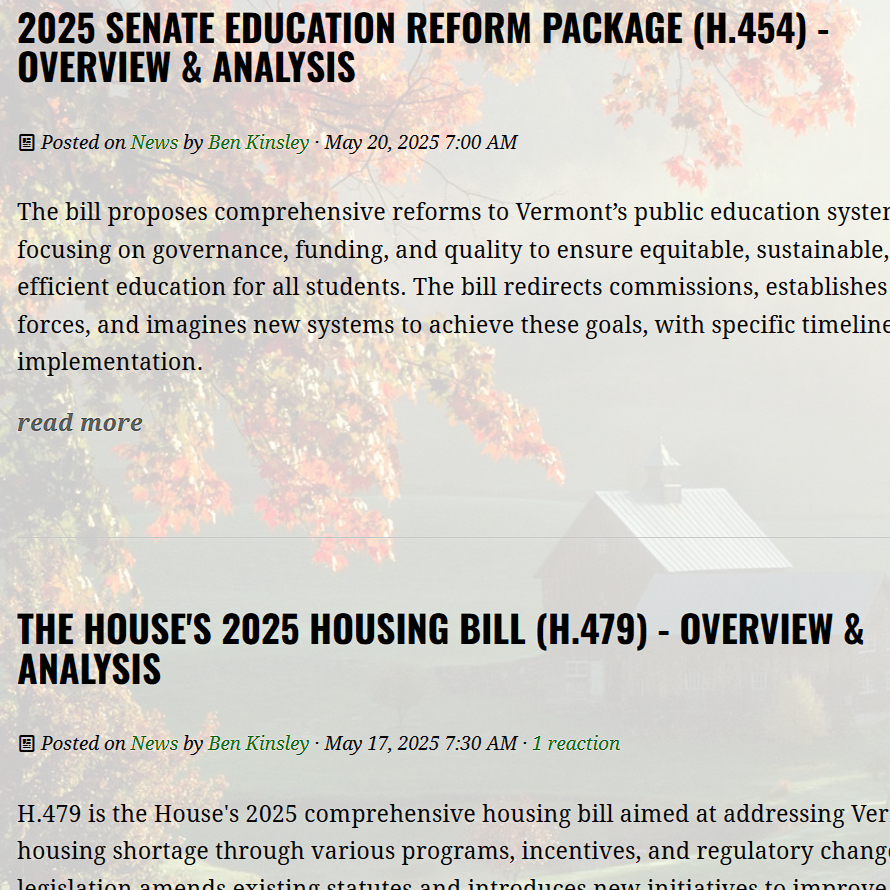 |
Robust yet Approachable Bill SummariesWe have published 27 bill summaries (so far!) this year. They dig into what you need to know about key pieces of legislation that impact everyday Vermonters, but do so in a way that is quick and easy to digest. We a thrilled to be able to leverage this tool more as a way to keep Vermonters informed about what is happening in Montpelier. |
|
CFV on The Morning DriveBen Joined Anthony & Dan to on The Morning Drive (WVMT) to talk about key issues we worked on during the legislative session; including ethics, housing, and education. |
 |
|
|
|
VT Public: Improving the Vermont legislature's ethics enforcementWe were invited to call into a Vermont Edition show on ethics oversight in Vermont, highlighting our involvement in moving the process forward in the state.
|
|
Yale Report: Evaluating the Impact of School District Mergers in VermontThis study examines the causal effects of school district mergers on educational spending, budget allocations, tax rates, and perceptions of equity in Vermont, exploiting a series of voluntary and mandated mergers from 2017 to 2020 as a natural experiment. |
 |
|
|
|
CFV is HiringCampaign for Vermont is hiring! After years of being a board-run organization we are looking to staff up again to address major legislative initiatives. |


News Worth Reading:
Our top picks of local must-read news this month.
- Panel Named to Take Next Big Steps in Education Reform - Seven Days
- US Department of Education withholds millions in funding for Vermont school districts - VT Digger
- Vermont’s largest hospital says it’ll cut insurance rates by 8% - Vermont Public
- Two Rookie Reps Headed to the House. Here's What They Learned. - Seven Days
- Gov. Phil Scott signs new campaign finance rules, other election changes into law - VT Digger
- Complaints allege Vermont senators with private school ties violated ethics rules during education bill negotiations - VT Digger
- Two members, including chair, resign from the Commission on the Future of Public Education in Vermont - VT Digger
- Vermont launches website to simplify starting a business - My Champlain Valley
Recently Completed Research & Policy Proposals:
- Wealth Migration Report - Published December 11, 2024
- Education Spending & Outcomes Report - Published December 30, 2024
- A Pathway to Viable Education Reform - Published March 7, 2025
- Letter to Education Reform Conference Committee - Sent June 6, 2025
In order to continue pursuing all of these priorities, we need support from Vermonters like you!
Campaign for Vermont's mission is to advocate for public policy changes by reconnecting middle-class Vermonters to their government.