

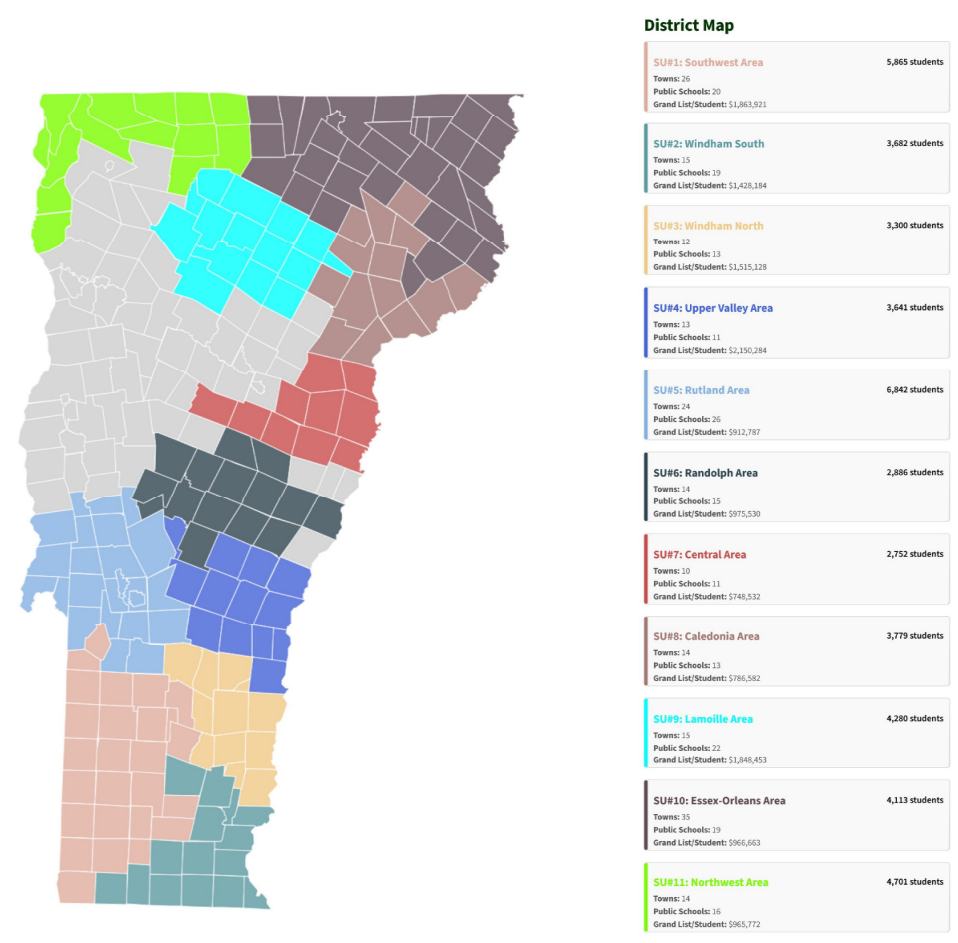
The bill, which does not yet have a number, restructures Vermont’s school governance system by creating a new statewide map of supervisory unions, pushing districts toward larger governance models, and revising parts of the education funding formula, supervisory union boundaries, district mergers, transition grants, education funding, student weighting, and implementation timelines.
The Details:
-
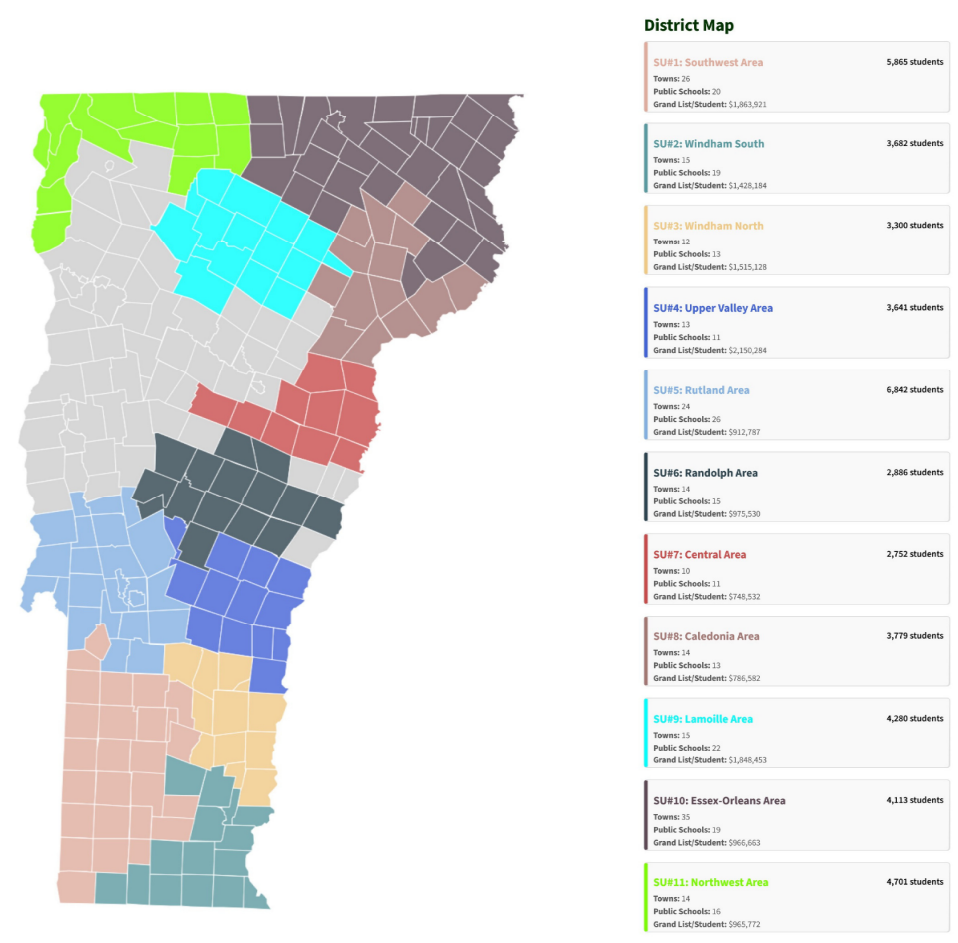
Creates a new statewide supervisory union structure by naming 11 supervisory unions and assigning existing school districts to each one. Critically, each school district would continue to operate with some autonomy within that new supervisory union structure (except those that are merged via the process described below).
- Establishes a transition process for the new supervisory unions, including transition boards, interim governance work, employee transition requirements, and an operational start date of July 1, 2027.
-
Allows school districts to propose supervisory union boundary changes through school board action or voter petition, with required public hearings, ballot procedures, public notice, and final enactment by the General Assembly.
-
Requires the State Board of Education to act on boundary adjustment requests within 75 days and permits advisory votes by affected supervisory union boards.
-
Directs the State Board to recommend further boundary adjustments for supervisory districts (which are combined school districts and Supervisory Unions) by December 1, 2026, with a target minimum average daily membership of 2,752 students. These supervisory districts were not assigned to the 11 supervisory unions previously identified in the bill.
-
Sets a statewide goal of reducing the number of school districts by 50 percent by July 1, 2029.
-
Requires member districts in 11 listed supervisory unions to create study committees by September 1, 2026 to examine voluntary merger options under existing union school district law.
-
Preserves current operating models by protecting both tuitioning districts and districts that operate their own schools, stating that governance changes may not force a district to abandon its basic model of delivering education.
-
Directs the State Board, when reviewing merger proposals, to consider statewide goals and avoid creating geographically isolated districts, especially districts with lower fiscal capacity or higher shares of economically disadvantaged students.
-
Requires districts that do not merge to submit proposals by November 30, 2027 explaining how their governance structure will still meet the bill’s goals and improve performance.
-
Authorizes the Agency of Education to develop a statewide merger plan by June 1, 2028 if voluntary action is insufficient, and authorizes the State Board to approve and order mergers by November 30, 2028.
-
Limits state-directed mergers to districts with the same operating structure and generally to smaller districts, while also requiring attention to geography, infrastructure capacity, student opportunity, and possible administrative efficiencies.
-
Exempts certain districts and entities from the state-directed merger provisions, including interstate districts, career technical center districts, some districts not listed in the bill, and some districts that complete voluntary merger steps in time.
-
-
Requires ongoing review and reporting by the Secretary of Education on merger activity, education quality data, equity of opportunity, academic outcomes, school climate, staffing quality, and financial efficiency.
-
Creates several grant programs, including $250,000 transition grants for each newly created supervisory union, up to $10,000 for merger study committee costs, and merger support grants for some newly formed larger union districts.
-
-
Appropriates Education Fund money in fiscal year 2027 for transition facilitation, study committee work, and merger support, with funds carrying forward until spent or reverted.
-
Increases the education funding formula base amount from $15,033 to $16,780, with inflation adjustments, effective July 1, 2029.
The Good:
|
The Bad:
|
Analysis:
This draft is best understood as a hybrid governance reform bill: it sets a new statewide supervisory union map in statute, gives districts in 11 large supervisory unions a voluntary period to pursue mergers, and then creates a state backstop if that voluntary process does not achieve the bill’s consolidation goals. This structure was intentionally designed as a middle path between purely voluntary local reorganization and a far more centralized statewide model. In committee, legislators and counsel described the map as a starting point rather than a finished product, but the bill itself moves well beyond a conversation draft by establishing boundaries in law, transition boards, grants, and deadlines. That adds clarity and momentum, but it also raises the stakes if boundaries or assumptions prove poorly matched to local conditions.
The bill’s strongest policy rationale is the focus on supervisory unions as regional governance models that could be leveraged for shared education services. It does not immediately eliminate local districts, and it expressly protects districts from being forced to change their core operating model. That is an important distinction in Vermont, where governance structures and educational delivery models do not always align neatly.
Compared with Campaign for Vermont’s governance proposal, this bill moves in a similar direction on one major point and diverges on another. Both approaches recognize that Vermont likely needs fewer administrative structures, stronger oversight, and a governance model that better supports a foundation-style funding system. Both also place real value on preserving local operating choices and avoiding reforms that simply erase community identity. But the CFV proposal was more explicit about keeping local school districts and local school boards intact while concentrating most administrative scale at the supervisory union level, ideally by consolidating around career and technical education regions.
This bill, goes further by also setting a target of cutting the number of school districts in half and authorizes state-directed mergers if local actions fall short of his goal. So while both models seek efficiency and accountability, the CFV approach leans more heavily toward preserving local governance, whereas this bill is more willing to restructure both the supervisory and district layers. This bill takes an approach similar to Act 46 in both scale and approach when it comes to district governance changes. That legislation fell short when it came to efficiency gains and it feels like there needs to be more guardrails in this bill to prevent the same from happening.
These distinctions matter for Vermont students and families. If this bill succeeds, larger and better-aligned governance systems could improve access to specialized services, strengthen administrative capacity, reduce spending, and support more consistent educational opportunity across regions. But the committee hearings also underscored unresolved questions about fiscal impacts, board representation, superintendent workload, and whether the bill’s numeric targets are evidence-based.
Reasonable people may agree on the need for change yet disagree on how far and how fast the state should go. The central policy question is not whether Vermont needs modernization, but whether this particular balance of voluntary action, statutory restructuring, and possible compelled consolidation is the most durable way to improve educational quality, public accountability, and long-term economic security for Vermonters.
Current Status:
The bill is currently being drafted by the Senate Education Committee.
Last updated: 3/21/2026
DISCLAIMER: Generative AI used to assist in the production of this report.
News coverage on the draft |
Read the Bill |
More bill summaries |