


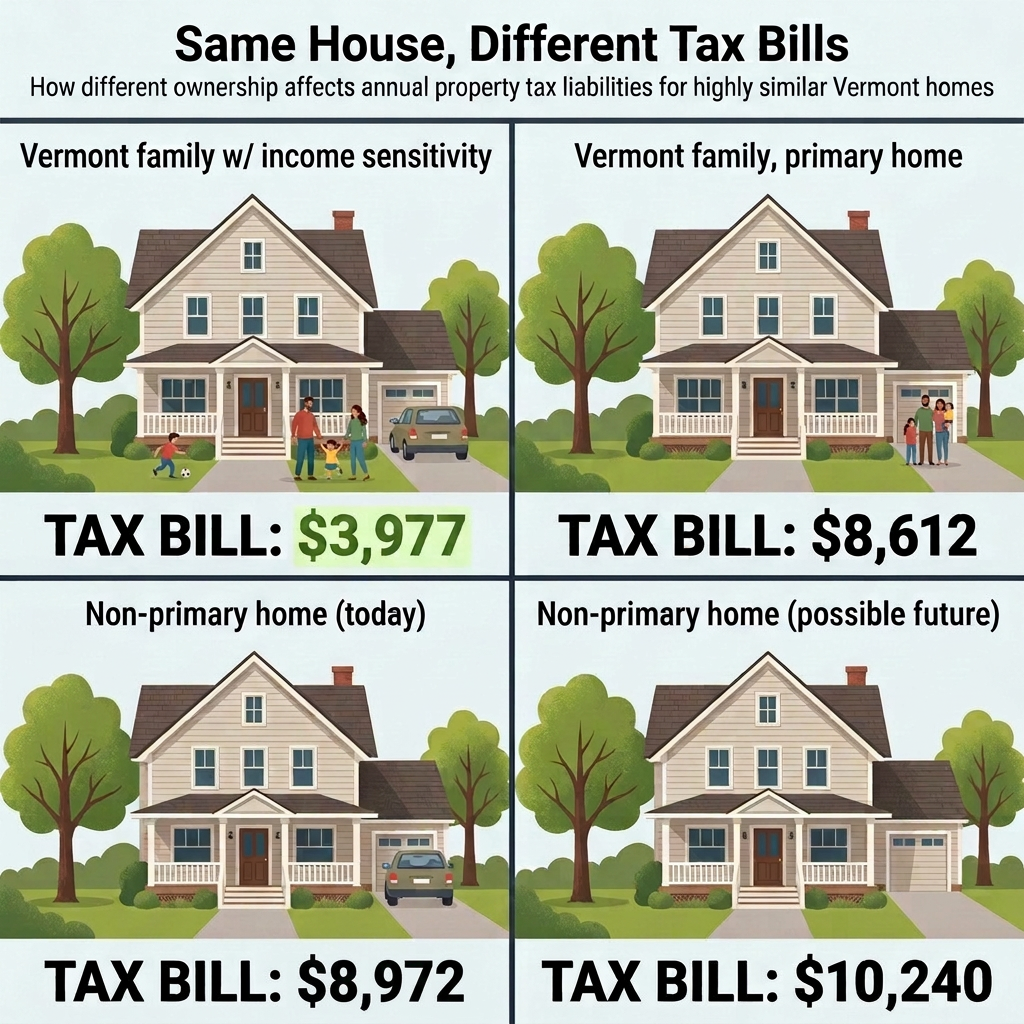
Polls show most Vermonters like the idea of a tax on "second homes." Before we can truly judge whether one makes sense, we need to understand the system it would be added to. Vermont's property tax works differently from most states so there are a lot of misunderstandings, misconceptions, and oversimplifications about how property taxes work here. At a basic level which class your property is in decides which rate you pay, and the rate decides your bill.
Two taxes on the same bill
Every Vermont property tax bill has two parts:
-
Municipal tax. This pays for town services like roads, police, fire, and the town office. Your town sets the rate by dividing the money it needs by the total value of the town's grand list. Within a town, the same municipal rate generally applies to every class of property.
-
Education tax. This pays for schools. It's a statewide tax that flows into the state Education Fund. The rate you pay depends on your property's classification.
The basic math for each part is the same:

Rates are stated "per $100 of assessed value." A rate of $1.643 means $1.643 for every $100 of assessed value (or 1.643%).
Property classifications today
For education tax purposes, Vermont currently sorts property into two buckets.
|
Classification |
What's in it |
How it's determined |
|---|---|---|
|
Homestead |
A Vermont resident's primary home (the principal dwelling and the land around it) |
The owner must file a Homestead Declaration (Form HS-122) every year |
|
Non-homestead |
Everything else: second homes, camps, vacation condos, short- and long-term rentals, commercial and industrial property, farmland, and vacant land |
The default when no homestead is declared |
The burden is on the property owner. If you live in your home but don't file a Homestead Declaration, the town has to tax the property as non-homestead.
Which education rate applies to each class?
Homestead rate: set by local school spending. The homestead rate follows your local school district's spending per pupil. For FY2027 (the 2026–27 tax year), the Legislature set the "homestead property yield" at $9,401:

Non-homestead rate: one rate for the whole state. For FY2027 the non-homestead rate is $1.643 per $100 in every town. It DOES NOT vary with local education spending the way that the homestead rate does.
In most towns, about 178 of 249, local education spending is low enough that the non-homestead rate is higher than the homestead rate. In the rest, apartment buildings, businesses, and "second homes" can pay a lower education tax rate than the year-round home next door.
The final adjustment: CLA and the Statewide Adjustment
Towns don't reappraise every year, so a town's listed values drift away from market value. To keep every town paying its fair share, the state divides both education rates by a correction factor: the town's Common Level of Appraisal (CLA) divided by the Statewide Adjustment (SA).

Here is the state's own example of this. A town has a CLA of 90%, the SA is 70%, and the district homestead rate is $1.50. The final homestead rate is

and the final non-homestead rate is

The same factor applies to both classes, so it changes the size of each rate but not the ratio between them. Town-by-town final rates are published by the Vermont Department of Taxes every year.
Income sensitivity, Vermont's property tax credit
Vermont is unusual in that many homeowners pay their education taxes based on income, not property value. About two-thirds of resident homeowners get this income-based credit each year.
Who qualifies
-
The property must be a declared homestead.
-
You must have been domiciled in Vermont for the full prior calendar year.
-
Household income must be under the annual limit: $115,400 for claims filed in 2026, based on 2025 income.
-
The maximum credit is $5,600 against education taxes and $2,400 against municipal taxes. The municipal credit is only for households with income of $47,000 or less.
-
More info here: Vermont Property Tax Credit
How it works
Each district has a household income percentage, set much like the homestead rate but using the "income yield" ($12,960 for FY2027) and a 2% base rate:

The credit is the amount by which your property-based education tax on the housesite (the house plus up to two acres) is more than your income percentage times your household income. The state pays that difference to your town and the education fund, and it shows up on your bill as an "Education State Payment." See Example C below for an illustration of how this works.
In essence this transitions a family who qualifies to an income tax instead of a tax on the value of their property, but there are some important caveats.
Things to know about the credit
-
It looks back a year. The credit on this year's bill is based on last year's taxes and last year's income (Vermont Department of Taxes, FS-1038). If your income drops suddenly, you won't get relief right away.
-
It phases out. The credit shrinks to zero as household income nears the limit, and other caps and limits apply, so higher-income households usually see much smaller credits.
-
It's paid for statewide. Credits in one town are funded by property taxpayers across the state, including non-homestead owners.
-
It only applies to a homestead. No income-based relief is available for a second property (classified as non-homestead), regardless of what the owner's income is. Also, if the property your home sits on is more than two acres, the additional land still get's taxed at the normal homestead rate.
-
It's set to change. Act 73 of 2025 would replace the credit with a capped homestead exemption, a percentage off the first $425,000 of value for households with income up to about $115,000. That change takes effect July 1, 2028 at the earliest, and only if certain conditions are met see (Joint Fiscal Office, Act 73 Review).
The new class, "non-homestead residential"
Act 73 of 2025, refined by Act 170 of 2026, splits today's non-homestead class in two. Vermont would then have three education tax classes (see Vermont Department of Taxes, Property Tax Classifications Implementation Report).
|
New classification |
What would be in it |
Examples |
|---|---|---|
|
Homestead |
Same definition as today |
A Vermonter's primary residence |
|
Non-homestead residential (the "second home" class) |
A dwelling with no declared homestead that isn't rented long term |
A ski condo, a lake house, a year-round-capable family camp, an entire home used as a short-term rental |
|
Non-homestead nonresidential |
Everything else |
Long-term rentals, commercial and industrial property, vacant land |
How properties would be sorted
Owners of buildings with 1 to 4 dwelling units would file a new Dwelling Use Attestation in place of today's Homestead Declaration. The Tax Department has given some examples of how this might get complicated, for example an owner-occupied duplex gets split. The owner's unit is homestead, and the other unit is non-homestead nonresidential if it's rented long term. However, an in-law apartment that is being used for occasional guests would get taxed as if it where a non-homestead residential unit.
What rate would apply?
None has been set. The law makes the new class depend on several conditions that have yet to be realized. As things stand, the new class won't take effect before July 1, 2029.
The Tax Department has modeled sample rate sets that close in on $2.00 of assessed value, but this is nowhere near final. However, Example D below shows what one of these modeled rates would mean for a "second home."
The important thing to understand here is that Vermont already has a "second home tax" on the books, it just isn't in effect yet.
The property transfer tax
The property transfer tax is a separate tax paid once, when a property is sold. In Vermont the buyer pays it, and it's due within 30 days of closing. Most transfers also carry a 0.22% Clean Water Surcharge.
|
Situation |
Rate |
Tax on a $500,000 purchase |
|---|---|---|
|
Primary residence |
0.5% on the first $200,000, then 1.47% on the rest (1.25% + 0.22% surcharge) |
$1,000 + $4,410 = $5,410 |
|
Primary residence financed through VHFA, USDA Rural Development, or a VHCB homeland grant |
First $250,000 exempt, then 1.47% on the rest |
$3,675 |
|
Non-primary home fit for year-round living, not a long-term rental (second homes, short-term rentals) |
3.4% + 0.22% = 3.62% on the full price |
$18,100 |
|
Non-primary home not fit for year-round living (such as an unwinterized camp) |
1.47% |
$7,350 |
|
Non-primary home rented long term (a real landlord-tenant relationship, with a Landlord Certificate filed) |
1.47% |
$7,350 |
|
Commercial property, buildings with 5 or more units, licensed lodging, open land, unfinished construction |
1.47% |
$7,350 |
A few details matter here:
-
Vermont already has a second home tax, at the point of sale. The 3.4% non-primary residence rate was created by Act 181 of 2024 and refined by Act 164 of 2026.
-
"Fit for year-round habitation" depends on the building itself, not how the owner uses it. The state looks at insulation, a heating system, plumbing, and running water when the property changes hands.
-
The long-term rental exemption is enforced. A buyer who claims the lower rate must have a tenant within a year and file a Landlord Certificate. Arrangements with family members at nominal rent, or companies set up only to avoid the tax, can be challenged.
How a new second home tax could fit, and where it runs into trouble
There are three main ways to add a second home tax to this system:
-
A higher annual rate on the new non-homestead residential class. This is the path Act 73 already sets up.
-
A higher transfer tax rate on second home purchases. Vermont already does this with the 3.62% rate.
-
A surcharge on high-value non-primary homes, like Rhode Island's new tax on non-primary homes worth more than $1 million (Campaign for Vermont, October Newsletter).
Each approach has real limits.
1. The definition is hard to get right
"Second home" can mean a slopeside condo, an AirBnB in a village center, a deer camp in the Northeast Kingdom, or a cottage on Lake Champlain that has been in a family for four generations. The current dividing line, "fit for year-round living," is one the Tax Department itself has called "very subjective."
A camp that was winterized decades ago to extend the season could now be taxed the same as a luxury vacation home.
2. Many "second homes" belong to Vermonters
Housing data show that more than a third of Vermont's seasonal homes are owned by Vermonters who live in another town. Those owners already pay a full property tax bill on their primary home and get no income-based relief on the second property.
3. It can't target out-of-staters
Under the U.S. Supreme Court's 1997 decision in Camps Newfound/Owatonna v. Town of Harrison, states can't write property taxes that discriminate against interstate commerce. Any Vermont tax would have to hit Vermonters' second properties equally. Selling it as "making out-of-staters pay" could itself weaken it in court. Rhode Island's luxury home surcharge is being challenged on similar grounds right now by a group of 50 plaintiffs.
4. The revenue is uncertain
Each penny on the non-homestead nonresidential rate has been estimated to raise about $2.35 million, but that figure will drop once "second home" is defined more narrowly. Transfer tax revenue rises and falls with the housing market, and early results from the 2024 surcharge have been mixed. That makes it a poor base for ongoing programs.
5. It may not do much for housing
Much of the debate is about pushing vacant homes back into year-round use. About 19.4% of Vermont homes are vacant, and roughly three-quarters of those are seasonal. But many seasonal units aren't realistic year-round homes, and many of the ones that are would be out of reach for local buyers. Very few Vermont salaries support a $1M home.
6. It doesn't touch what drives costs
Vermont's education tax rates go up because education spending goes up. The yields are set each year to raise whatever is needed after other revenue is counted. New money from second homes only lowers homeowners' bills if the Legislature dedicates it that way and doesn't simply let spending grow into it.
Better policy options
If Vermont moves ahead with a "second home tax," these principles would make it fairer, more durable, and more effective.
-
Define the class and collect the data before setting a rate. Use the Dwelling Use Attestation to count and describe second homes first. Publish how many there are, who owns them, what they're worth, what they're used for, and whether they're fit for year-round living. That will allow policy-makers to set rates based on actual data instead of assumptions.
-
Use objective tests, not judgment calls. Replace "fit for year-round habitation" with clear standards that owners and listers can apply the same way everywhere.
-
Protect legacy camps and middle-class owners. Consider a value threshold, an exemption for the first slice of value, or allowing owners to claim income sensitivity on these properties. That way the tax falls mainly on high-value, year-round-capable homes and not on family camps.
-
Put any new revenue into lowering homestead taxes, in statute. Dedicating the money to the homestead rate or the new homestead exemption, instead of new spending programs, is the only way to keep the promise of relief for Vermont homeowners.
-
Make long-term renting the easy way out. If the goal is more year-round housing, owners who rent long term should move into the lower class quickly and without hassle, backed by the same Landlord Certificate enforcement the transfer tax already uses.
-
Don't build ongoing programs on transfer tax revenue. Because it swings with home sales, use it for one-time investments such as housing infrastructure or school construction. Before raising it again, require a public review of how the 2024 surcharge has actually performed.
-
Design it to hold up in court. Treat residents and nonresidents identically in both the law and the way it's described. Watch how the Rhode Island case turns out before following its approach.
-
Deal with the cost driver. The longest-lasting property tax relief comes from finishing Act 73's foundation formula, controlling education costs, and improving outcomes for every dollar spent. A new tax class only shifts who pays. Controlling costs or growing the overall state grand list lowers the bill for everyone.
How they apply: property tax examples
To keep the math readable, all four examples here will use one hypothetical town, "Maple Ridge," with these assumptions:
-
The school district spends $14,600 per pupil, so the homestead rate is $14,600 ÷ $9,401 ≈ $1.5530.
-
The non-homestead rate is the statewide $1.643.
-
The municipal rate is $0.60.
-
The town's CLA ÷ SA equals 1.00, so there is no extra adjustment.
-
Every property is assessed at $400,000.
Example A: Homestead (a Vermont family's primary home)
|
Component |
Calculation |
Tax |
|---|---|---|
|
Education (homestead rate) |
$4,000 × $1.5530 |
$6,212 |
|
Municipal |
$4,000 × $0.60 |
$2,400 |
|
Total before any credit |
|
$8,612 |
This is what a homestead owner pays if their household income is above the credit limit, or if they don't file for the credit.
Example B: Non-homestead (second home, camp, rental, or commercial property)
Under current law, a ski condo, an inherited lake camp, a long-term rental house, and a Main Street general store all fall in this one class and pay the same rate.
|
Component |
Calculation |
Tax |
|---|---|---|
|
Education (non-homestead rate) |
$4,000 × $1.643 |
$6,572 |
|
Municipal |
$4,000 × $0.60 |
$2,400 |
|
Total |
|
$8,972 |
On paper, the gap between Example A and Example B is only $360 a year. The real gap is usually much bigger because of the income-based credit, which only homesteads can get. See Example C below for how these likely compare.
Example C: Homestead with the income-based credit
Take the Example A family and add one fact: their household income is $70,000, well under the $115,400 limit.
-
Maple Ridge's income percentage is $14,600 ÷ $12,960 × 2% ≈ 2.253%.
-
Their income-based education tax is $70,000 × 2.253% ≈ $1,577.
-
Their property-based education tax is $6,212 (from Example A).
-
Their credit is $6,212 − $1,577 = $4,635, which is under the $5,600 cap.
-
Their income is above $47,000, so they get no credit on the municipal tax.
|
|
Before credit |
After credit |
|---|---|---|
|
Education tax |
$6,212 |
$1,577 |
|
Municipal tax |
$2,400 |
$2,400 |
|
Total |
$8,612 |
$3,977 |
The Example B owner pays $8,972 on a property of the same value, more than twice what this family pays. That's true even if the Example B owner is a Vermont family with the same $70,000 income, because the credit never applies to a second property.
Example D: Non-homestead residential at the modeled $1.96 rate
Now picture a ski condo that is insulated for year-round use under Example B after the new class takes effect. To be clear, we don't actually know what this rate would be yet, but let's assume the Tax Department's modeled rate of $1.96.
|
Component |
Calculation |
Tax |
|---|---|---|
|
Education (non-homestead residential rate) |
$4,000 × $1.96 |
$7,840 |
|
Municipal |
$4,000 × $0.60 |
$2,400 |
|
Total |
|
$10,240 |
Three things stand out:
-
The second home would pay $3,040 a year more than a long-term rental or commercial building of the same value (according to the tax department). That gap is the tax incentive the new property class is meant to create.
-
Compared with today's Example B bill, it would pay $1,268 more. This doesn't match the Tax Department's estimate because they assumed a lower non-homestead rate as a result. This illustrates how much of a moving target a tax like this is.
-
A Vermont family's inherited camp would pay the same $10,240 as an out-of-state owner's ski condo if it is deemed year-round habitable.
Key terms
-
Homestead: A Vermont resident's primary home, declared each year on Form HS-122.
-
Housesite: The house plus up to two acres. This is the portion that counts for the income-based credit.
-
Yield: A figure set by the Legislature each year that turns per-pupil spending into a homestead tax rate ($9,401) or an income percentage ($12,960).
-
CLA (Common Level of Appraisal): A town's listed values as a share of market value. It's used to adjust education tax rates so every town pays its fair share.
-
Non-homestead residential: The new "second home" class created by Act 73. It isn't in effect yet and has no rate.
-
Property transfer tax: A one-time tax paid by the buyer when a property changes hands.