

The legislative gears are grinding towards crossover, with committees balancing ambitious reforms against practical fiscal and rural realities. This week the House Education Committee grappled with how to move forward on education reform. The Committee appears deeply divided and was looking for solutions to break a stalemate. It was perfect timing for our testimony on Friday. Our research on the efficiencies of replacing supervisory unions with CTE-based Education Service Agencies, we believe, will help inform the Committee's deliberations, by leveraging regional models to capture administrative savings without top-down mandates or the need to buy out collective bargaining agreements.
| This is a truncated version of our weekly legislative update. To receive the full version, please sign up for our legislative updates (it's free!). |
Speaking of House Education, they continued with testimony this week around a draft bill to address chronic absenteeism, hearing from the Vermont School Counselors Association. That association, by the way, also supports a shared services model like the one we are suggesting; although they stressed IDEA compliance and the possibility of up-front investments to get ESAs off the ground.
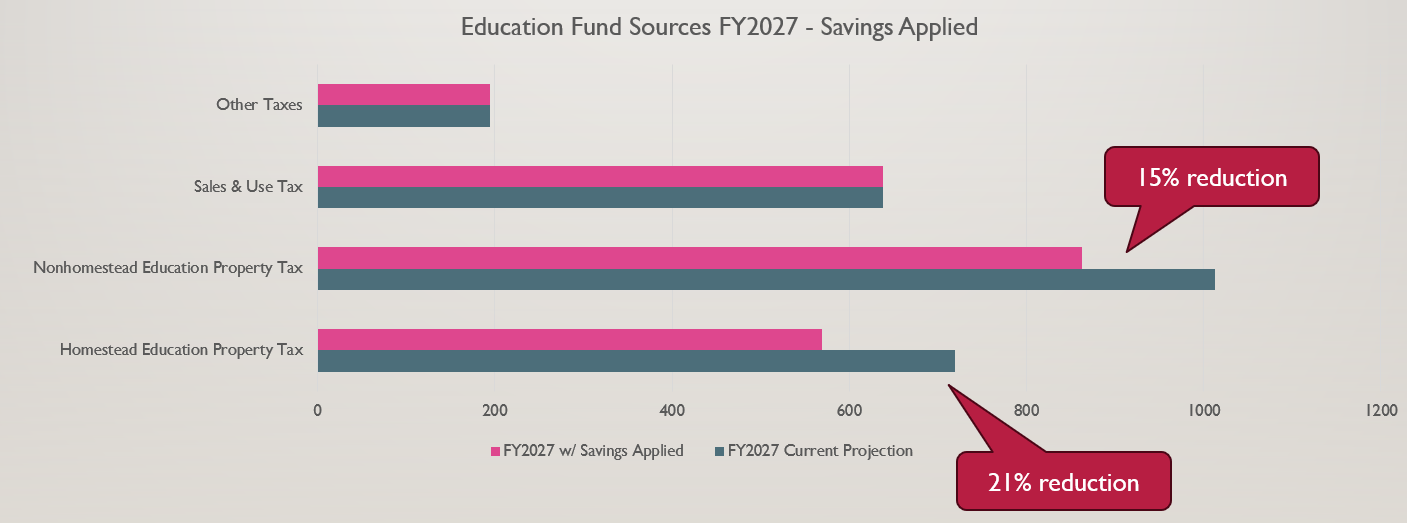
The Vermont Superintendent's Association also weighed on on mergers, saying they would support "like-with-like" mergers (i.e. only merging districts with similar operating structures) only if it was paired with modeling household property tax implications. We did that for our proposal by the way. Here's what it might look like if we split the cost-savings from our proposal evenly between homestead and non-homestead property taxes:
I guess House Education was busy this week, because they also found time to pass H.542, which terminates PCB testing mandates that were viewed as an unfunded mandate ($44M has already been spent and there is 2027 deadline to complete testing that could force schools into a tricky situation). While certainly not ideal for staff or student health, the bill pragmatically recognizes the current fiscal reality.
The Joint Fiscal Office (JFO) shared the week that 84% of school budgets have been reported in. With a little bit of good news, spending is now expected to increase 4.3% instead of 5.8%, which will temper the increase in property taxes next year. JFO also modeled some scenarios for legislators around what it would look like to use the Governor's proposed $105 million in property tax buy-down funds over multiple years instead of just one. This would result in a smoother increase of 10% in FY27, 8% in FY28, and 5% in FY29. If all of the funds were applied in FY27, it would yield a 5% increase for that year, but then a 16% spike in FY28 if no other one-time funds are available.
One of the fundamental problems here is that education spending growth has outpaced the underlying economy and the growth in the Sales & Use Tax, which (as you can see in the chart above) contributes significantly to the Education Fund. If spending is increasing at 5% (about average), but Sales & Use revenues are only growing at 3% then property taxes pick up the difference. In order to control long-term growth in property taxes, it is necessary to get spending increases in line with underlying economic growth.
On the Housing front, House General passed H.775 after adding a provision requiring municipalities to conduct housing needs assessments and report them to the Department of Housing and Community Development. Legislators also heard that a new draft of the Act 181 (Act 250 replacement) maps is coming in March, which will be a key indicator of what housing and economic development will look like for the next few decades.
Testimony on health care reform targeted primary care's "four C's," (continuous, comprehensive, coordinated, and connected care) this week. Elliot Fisher (Professor of Medicine and Health Policy, The Dartmouth Institute) argued that Vermont's primary care system is failing because the workforce is shrinking, burnout is widespread, and access to coordinated, team-based care is deteriorating. He presented a long‑range MIT-based simulation model showing that an early, modest set of investments in primary care, payment reform, and public health could create a virtuous cycle that improves health, reduces utilization, and increases local GDP over 20-25 years.
The Senate took testimony on S.190 from Blue Cross and Blue Shield of Vermont (BCBS) as well as the Green Mountain Care Board (GMCB) which focused on rate reductions for the highest-priced hospital services (some of which are up to 900% of Medicare reimbursement) as a means to reduce excessive spending in the health care system. BCBS estimated between $50 and $100 million in annual savings from tamping down on these services. There was also some concern about the outsourcing of clinical services, because when hospitals outsource these to independent/private groups, the revenue for those services may fall outside GMCB’s budget cap guidelines and rate oversight. There was concern that this presented a loophole for GMCB's oversight of hospital spending, but hospitals argued that most of these services are local providers who help preserve access to services.
These patterns signal pragmatism in a number of areas. We are expecting significant movement next week as bills get pushed out of committee amid the looming crossover deadline. We will see what survives...
On behalf of Vermonters,
|
|
||
|

| Sign Up for Legislative Updates |

| To continue reading, please sign up for our legislative updates (it's free!). |