

It was a busy week here at Campaign for Vermont. We testified in two different legislative committees this week and interviewed on a popular NEK TV show. Our hard work is paying off, we are getting positive indicators from legislators on multiple fronts!
| This is a truncated version of our weekly legislative update. To receive the full version, please sign up for our legislative updates (it's free!). |
Alright, lets dive in... This week, Vermont lawmakers intensified efforts to overhaul education delivery and funding, with the Senate Finance Committee working on S.220 and getting closer to endorsing a tiered spending cap for FY2027-29. High-spending districts would be limited to 3% per-pupil growth and low-spenders up to 9%; serving as a bridge to Act 73's foundation formula while incorporating a fall back mechanism that would allow districts to revert to the prior-year spending, adjusted for inflation (based on NIPA). This refinement addresses last week's volatility concerns, while adding an appeals process for unforeseen costs like facility repairs and excluding debt service from the caps to hold capital projects harmless. Modeling showing $57M-$67M in annual near-term savings based on these proposals.
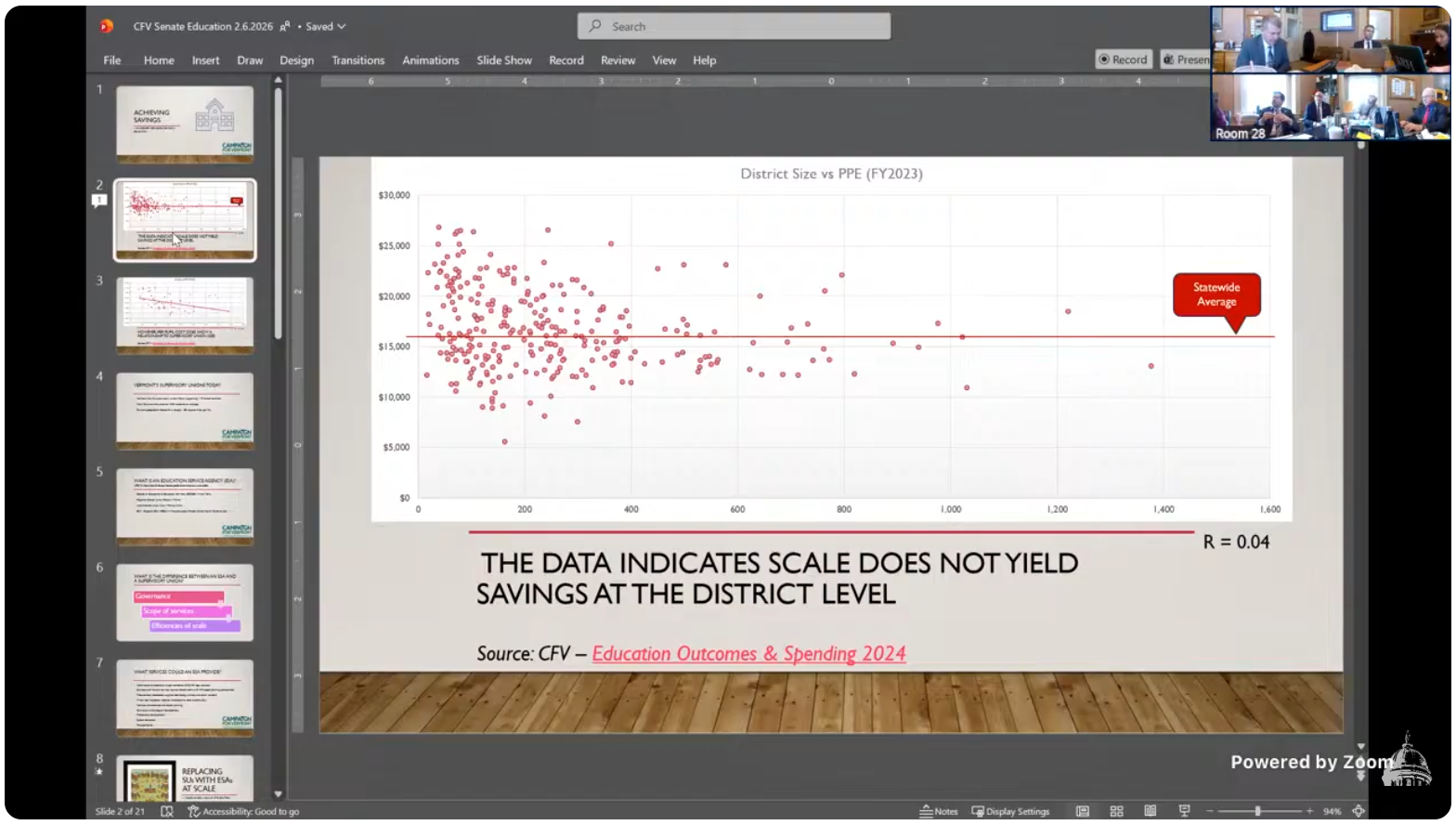
On the policy side, the Senate Education Committee heard testimony on S.313 from Advance Vermont and the Business Roundtable around the growing importance of CTE governance and universal access to counter post-pandemic workforce declines and declining male higher-ed enrollment. This was followed by our testimony on Friday urging the Committee to focus on consolidating Supervisory Unions around CTE centers and pushing additional services up to that level to achieve the scale and cost-savings that other states see from similar models.
In parallel, chronic absenteeism conversations gained traction the House Education Committee as they heard from the Agency of Education about their proactive reforms, which incorporate clearer excused/unexcused absence definitions and inter-agency prevention strategies. That Committee also released a new map proposal to force the existing 119 school districts into a new configuration of 27. Even the proposers of the map hedged their bets, saying it was "faulty" and “fraught with political decisions.” It's not fully clear that the map is even supported by the majority of the committee members.
In other education news, a joint hearing reviewed a special education report highlighting $6M in funding shortfalls under the proposed Act 73 foundation formula. This largely stems from a federal funding requirement called Maintenance of Effort (MOE), which requires that special education programs spend the same or more in state/local funds as the prior year. The idea is that this ensures that federal IDEA funds supplement, rather than replace, local funding for special education. The problem with the current proposed weights under the new state funding formula is that it would potentially reduce funds specifically allocated to special education, even if the overall spending allocation would be the same or greater, which could trigger the federal MOE requirement.
Housing policies appeared to solidify bipartisan support this week, as the House General Committee's H.775 markup refined the bill creating new housing tools. Department of Housing and Community Development Commissioner, Alex Farrell, stressed that the Vermont Housing Improvement Program's $4M base funding become permanent because it is one of the departments most cost-effective tools for bringing new housing units online. He and others also highlighted the off-site construction accelerator program that would allow for bulk procurement of housing units to target the extraordinarily high $500 per sq/ft state-project costs.
Senate Economic Development's S.238 walkthrough introduced the concept of a 2% lodging surcharge (hotels/short-term rentals) yielding $16.4M-$20M annually for housing, this might be accompanied by a sugar-sweetened beverage tax to backfill the Education Fund (which could be impacted by a reduction in the rooms and meals tax revenue). Similarly, the Committee reviewed S.282, which proposes a wealth proceeds surcharge on high earners' investment income (modeled on federal net investment income tax, which features a $200k threshold that has been unadjusted since 2013) to fund school construction. The latter bill sparked a number of concerns around taxpayer mobility and fairness for those that would be subject to such a surcharge.
Other discussions in the House grappled with how to fill a $10M yearly gap in the Education Fund as tax proceeds from vehicle purchases are moved back into the Transportation Fund. Some options discussed are a tax on high-value vehicles (heavy trucks most likely) and/or a mileage-based fee for electric vehicles.
In the health care space, a joint hospital transformation hearing spotlighted $230M in collective hospital cuts this year via retirements and other efficiencies, with CEOs like Northeastern's Sean Tester and UVM's Steve Leffler noting a pivot towards resource-sharing amid a renewed emphasis on efficiency and sustainability. Sounds a bit like what we should be doing in education, eh?
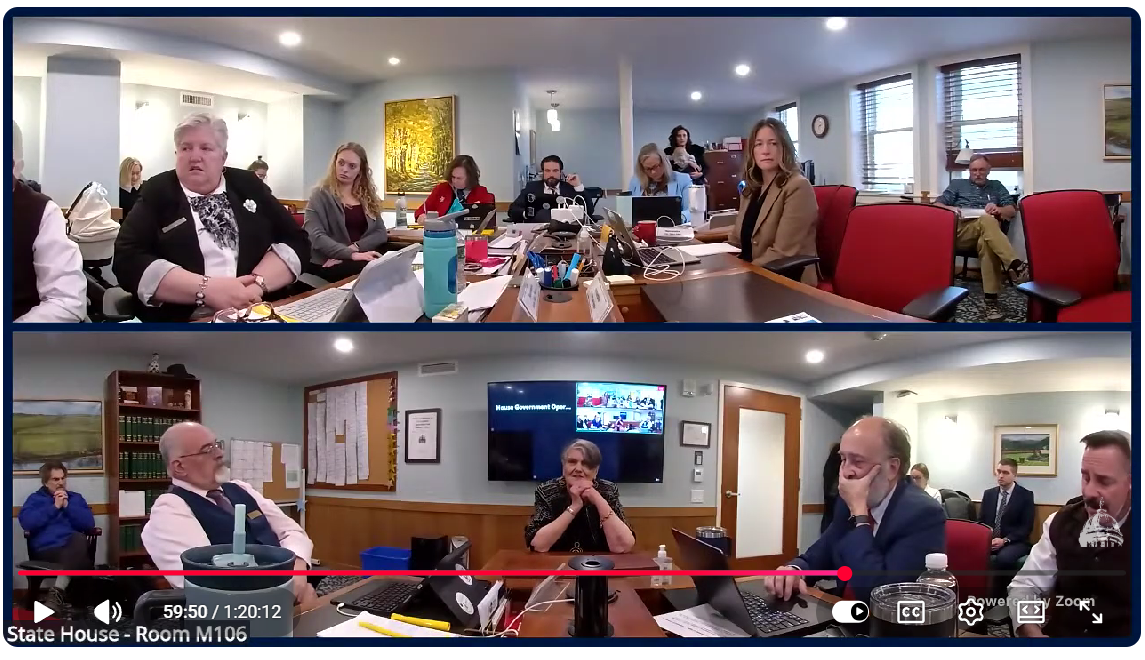
Finally a new proposal, S.164, in Senate Government Operations this week that would create legislator health benefits (with an 80/20 premium split). Estimates show $1.2M-$5M in new costs depending on enrollment. The intent is to address young lawmakers' barriers to entry into public service and the skewed demographics present in the current legislative makeup.
While discussions of new revenue sources signal a reluctance to focus on cost-containment, there is some of that happening too. Particularly in the health care and education space. I have been pleasantly surprised by the clarity of thought in the last week or so around some of these big must-tackle issues. There is an eagerness to do something productive, whether or not their solutions are likely to produce positive outcomes remains very much up in the air, but I am optimistic.
On behalf of Vermonters,
|
|
||
|

| Sign Up for Legislative Updates |

| To continue reading, please sign up for our legislative updates (it's free!). |