

The 2026 legislative session reached its conclusion this week, and the slate of bills that emerged in its final days paints a complicated picture. After months of competing visions and the ever-present shadow of a gubernatorial veto, the final days produced a set of interlocking conference reports that together represent a consequential education policy, a modestly disciplined budget, targeted property tax relief, and a new chapter for transportation finance. But the week also delivered reminders that sometimes ambition reaches too far, as the Governor's veto of the data center bill was sustained on the House floor.
Let's bring this in for a landing.
| This is a truncated version of our weekly legislative update. To receive the full version, please sign up for our legislative updates (it's free!). |
The Education Package: A Bipartisan Landing After Months of Turbulence
After weeks of competing visions, the House's voluntary framework, the Agency of Education's top-down consolidation model, Senator Beck's late hour CTE-centered restructuring proposal, and the Senate's own earlier governance plan, the Legislature landed on an education transformation package that preserves local decision-making (mostly) while putting structure and timelines around the restructuring process.
H.955 passed the House on a 125–10 vote Friday afternoon and was sent to the Governor. The conference report retained the House's core framework: voluntary, community-driven merger committees, Cooperative Educational Service Areas (CESAs) to regionalize services (specialized supports, transportation, back-office functions), and inclusion of Career and Technical Education centers in the conversation. The Senate's contributions (which conferees on both sides praised) added clearer reporting requirements, protections and pathways for districts that might find more value in self-curated governance changes rather than the pre-prescribed ones, and critical procedural detail on school construction ballots and timelines.
The most consequential negotiated change was on timing. Negotiations returned the foundation formula implementation to the Act 73 timeline of FY2030, rather than the FY2031 date that had appeared in some earlier House drafts. This also accelerates the merger voting timeline by eight months, from November 2028 to March 2028 (Town Meeting Day). The compressed calendar means facilitators must be hired by September 2026, merger committees convened by mid-fall, and final reports delivered by September 2027.
School construction was the sharpest policy divergence between chambers, and the conference committee accepted the Senate's more conservative subsidy ratios: a base state contribution of 30%, plus up to 45% in bonuses (75% total), compared to the House's more generous 50–95% range. Critically, the Senate tied full bonus eligibility to merger activity. Only consolidated school districts (or with ADM of 2,000 or more) are eligible. This is the clearest lever in the bill to incentivize actual consolidation.
The conference also added a PCB/indoor air quality testing requirement for pre-1980 buildings seeking state construction aid, a provision that connects directly to the Senate's earlier refusal to terminate the statewide PCB testing program under H.542.
The Yield Bill: Near-Term Relief, Long-Term Questions
H.949, the property tax yield bill, deployed the full $104.9 million from the General Fund in a single year (the House had originally proposed spreading it across two) to reduce the average FY2027 property tax increase to approximately 3.5%, down from earlier projections of roughly twice that rate.
The negotiations also delivered a one-year, $4 million expansion of the renter credit (maximum raised to $3,250, calculated at 12% of market rent) and raises the circuit breaker income threshold from $47,000 to $50,000. These are targeted, helpful intervention, but they are, once again, one-time provisions that create the tax-rate cliffs we have warned about repeatedly this session.
The more consequential long-term provision is the stepped reduction in the excess spending threshold, which the bill ramps down from the current 118% of statewide average spending toward 112.5%–113% over several years, with the expectation that the foundation formula replaces it in FY2030. At 115.5% (the FY28 target), the number of districts exceeding the threshold jumps from 8 to 13, with notable clusters in Windsor County. The bill also caps tuition rate increases charged by receiving schools to the prior year's overall state education spending growth (approximately 3.8% in recent years).
The excess spending threshold ramp-down is, in effect, the Legislature's primary cost-containment lever during the transition to the foundation formula. Whether it actually constrains spending or simply shifts political pressure onto local school boards will depend on how districts respond and whether CESAs and shared services can deliver the efficiencies that have been promise.
The Budget: Disciplined but Still Outpaces the Economy
The FY2027 budget (H.951) landed on the House and Senate floor with a unanimous conference committee agreement. The overall increase is modest: approximately 2.9%, reflecting fiscal discipline in a year of significant competing demands. However, the underlying economic growth is still averaging 2.1% annually. While reserved, this level of growth may not be sustainable if it continues.
Two late-breaking revenue discoveries shaped the final product:
-
Unclaimed property: The Treasurer's office identified roughly $10 million more in unclaimed property across FY26–27 than initially estimated, enabling a $12 million appropriation to UVM for a multipurpose sports facility (the university sought $20M; the Governor proposed $15M. The conference committee compromise split the difference, funded through $2M from the Higher Ed Endowment Trust Fund and $10M from unclaimed property).
-
Federal program eligibility: With SNAP caseloads already declining and Medicaid redetermination changes looming, conferees redirected $3.5 million from a previously reserved $30M federal contingency pool to fund community organizations (AHS partners, Hunger Free Vermont, the Office of the Health Care Advocate, and others) to help eligible Vermonters retain or re-establish benefits.
Other targeted investments include: over $5 million for food programs (Vermont Food Bank, Meals on Wheels, Farm Share), primary care loan repayment and clinic funding, Read Vermont ($700K that AOE had forgotten to budget), NEK flood assistance for towns excluded from FEMA, housing repair and rental assistance, a Vermont Legal Aid immigration attorney and helpline, $2 million for the rural industrial development program, $150,000 to the Vermont Small Business Development Center, and several new staff positions (Ethics Commission attorney, Labor Relations Board mediator, flood safety position).
Transportation: A New Chapter (and revenue source) Begins
The FY2027 transportation bill (H.944) was adopted Thursday, and its headline provision will implement a mileage-based user fee (MBUF) for battery electric vehicles at 1.44 cents per mile, effective January 1, 2027. Multiple payment options will be available, and the Agency of Transportation is directed to study how and when to add plug-in hybrid vehicles.
This is the first concrete step toward replacing declining fuel-tax revenue as Vermont's vehicle fleet electrifies. The committee was candid about the underlying math: Vermont needs to repave roughly 300 miles of road annually to maintain its system; the state is currently managing barely over 100 miles per year, deepening a backlog that grows more expensive with every deferred season.
Other notable provisions: $1.7 million originally earmarked for town highway aid will be redirected to state paving (a move municipalities should watch closely), $300,000 from the General Fund for volunteer driver recruitment to rebuild post-COVID capacity for medical transportation, EV charging price-transparency requirements, and a directed study of bonding as a financing option to accelerate project delivery. The Miscellaneous Tax Bill adds to this story by transferring a share of purchase-and-use tax revenue from the Education Fund to the Transportation Fund (~$9.7M in FY28), offset by meals-and-rooms transfers back to the Education Fund (to avoid property tax increases).
Data Centers: Ambition Meets the Two-Thirds Threshold
Likely the week's most contentious outcome was the failure to override the Governor's veto of H.727, the Vermont Sustainable Data Centers Act. The bill would have explicitly placed large data centers (20+ megawatts) under Act 250 review and required PUC-reviewed utility contracts to protect ratepayers.
The override vote fell short: 83 yes, 52 no, with 90 votes needed. The arguments on both sides were substantive. Supporters cited national forecasts of rapidly increasing electricity demand driven by AI and cloud computing, with a single 100MW facility potentially consuming 10% of Vermont's peak demand. Opponents expressed confidence that existing regulatory tools (Act 250, PUC authority) are sufficient and questioned whether large data centers would actually target Vermont (with relatively high energy prices).
The veto stands, but the issue does not go away. National concerns around data center siting will continue to intensify, and the 83-vote show of support suggests the Legislature will revisit this (likely with targeted revisions designed to attract more votes).
Also This Week: Data Privacy, Housing, and the Senate Floor
H.211 (data brokers) was concurred in by the House and sent to the Governor. The Senate amendments broaden the scope of what falls under the "data broker" regulatory regime, align definitions with the recently passed S.71 consumer privacy law. The bill also expands the Cybersecurity Advisory Council, and add an education technology registry at the Secretary of State. Notably, the Senate removed the consumer data deletion mechanism and the $50,000 appropriation to study it — a disappointment for privacy advocates who wanted a California-style one-stop deletion portal.
On the Senate floor earlier in the week, H.772 (residential rental agreements) was substantially narrowed from the broad House package to focus on Good Samaritan protections (essentially tenant protection for seeking overdose assistance), a bifurcation pathway for victims of domestic violence, limited no-trespass authority for landlords regarding tenants' guests, and a study on a dedicated residential rental docket (report due January 2027). Many contentious provisions (rent increase caps, application fee limits, security deposit caps) were deferred for further study.
H.567 (Treasurer's omnibus) advanced through third reading, creating a Pension & Benefits Funding Task Force, transferring post-employment benefits (OPEB) investment management to the Vermont Pension Investment Commission (VPIC), and temporarily redirecting up to $300,000/year from unclaimed property to support Vermont Saves until the program reaches self-sufficiency (projected ~2032–2033).
S.208 (law enforcement identification standards) was the one bill that didn't make it across the finish line. A motion to suspend the rules and take it up on the final evening of the session failed to reach the three-quarters threshold (81 yes, 51 no, with 99 needed). The bill will now expire and need to be re-introduced next year.
Looking Ahead
The Governor addressed the House before final adjournment, thanking members and emphasizing that Vermonters want policies grounded in affordability and practical, bipartisan solutions. The adjournment resolution was adopted Friday evening, formally closing the 2026 legislative session. But the work is far from over. The bills that passed this year are, in many cases, enabling frameworks that require substantial follow-up:
-
Education transformation (H.955) now requires implementation: facilitator contracts by September 2026, merger committees by mid-fall, and a full year of community engagement before March 2028 merger votes. The Legislature must also return next session to finalize the foundation formula before it takes effect in FY2030.
-
The yield bill's one-time provisions create an immediate fiscal question for FY2028: without the $105 million in one-time monies, what happens to property tax rates? The excess spending threshold ramp-down and tuition caps are designed to exert downward pressure, but likely not enough to offset $105M (only 13 districts are expected to be over the cap).
-
Transportation enters a new era with the BEV mileage-based user fee. AOT must stand up collection infrastructure by January 2027 and produce recommendations on hybrid vehicle inclusion.
-
The Governor now has the education package, the budget, the yield bill, and the transportation bill on his desk. His decisions on signing or vetoing (signing seems likely at this point) will set the table for the 2027 session.
-
Federal risks, including SNAP redeterminations, Medicaid eligibility changes, and the uncertain trajectory of federal education and infrastructure funding, will test the resilience of this session's targeted investments. The budget's $30 million contingency reserve was built for exactly this scenario.
The 2026 session produced a legislative package that is more coherent and more consequential than many (including me) expected at the outset. The education transformation, in particular, represents a genuine bipartisan achievement. This is even more impressive because for months it has looked like the Governor would veto a bill with voluntary governance changes. The bill is no doubt imperfect, contingent on follow-through, but is structurally sound and respectful of local voice. Whether or not it will fully avoid many of the pitfalls that Act 46 ran into remains to be seen. The transportation revenue transition is overdue and welcome. And the budget is disciplined without being punitive, but does raise questions about sustainability.
The hardest work begins now.
This is our last legislative update of the year. We will be back in January. We will continue to roll out bill summaries over the next few weeks as we assess the bills that have survived the cutting room floor. Then, it's on to our research season as we dig into what data, information, and policy ideas we want to bring back to the legislature next year.
Thanks for sticking it out with us, I hope you have found these useful and informative. Please give us feedback on what we can do better next year (you can reply to this email!) and consider supporting our work so we can enter the 2027 legislative session in a strong position.
On behalf of Vermonters,
|
|
||
|

| Sign Up for Legislative Updates |
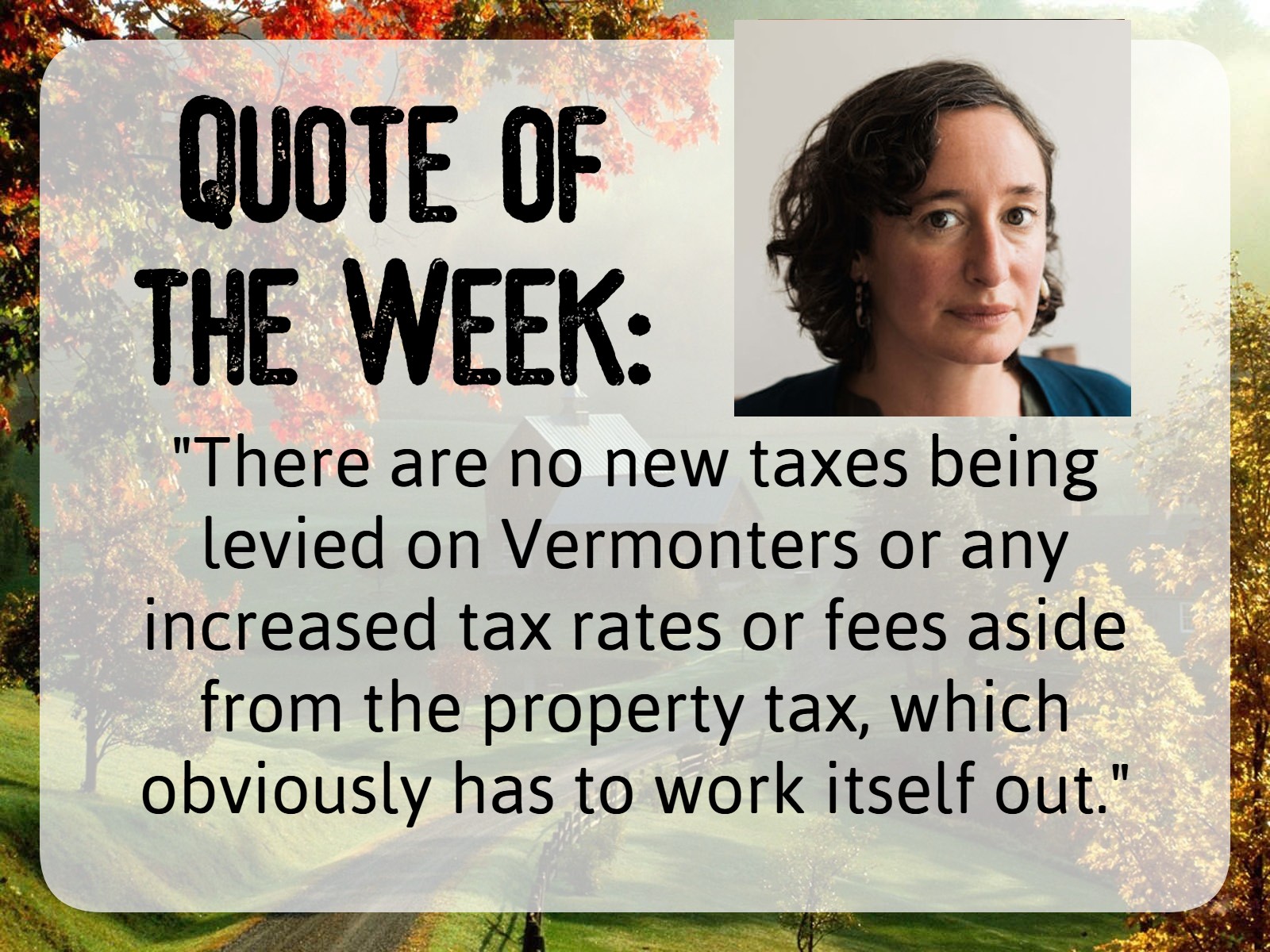
Quote of the Week:"There are no new taxes being levied on Vermonters or any increased tax rates or fees aside from the property tax, which obviously has to work itself out." Comment in regards to the budget and the miscellaneous tax bill passed this week. |
|

| Emilie Kornheiser |
| Chair, House Ways & Means Committee |
UPDATED: Vermont Voting Rights Act (S.298)
The Senate kept the problematic transfer of responsibilities from the Secretary of State to the Ethics Commission in S.298, but made them temporary.
Featured Article: Vermont Legislature adjourns 2026 session that centered, again, on education reform
“I didn’t get everything I wanted, and neither did you,” Gov. Phil Scott told lawmakers in remarks before they adjourned. “But that’s the way compromise works.”

| To continue reading, please sign up for our legislative updates (it's free!). |