

Housing is a cornerstone of stability and prosperity in any community, but in Vermont, its importance is amplified by the state's unique demographic, economic, and environmental challenges. With a population that is aging rapidly—projected to see 170K households aged 55+ by 2029—and a persistent shortage of affordable units, housing directly influences the ability of Vermonters to live, work, and thrive. Our state requires an additional 24K to 36K homes by 2029 to meet growing demand, normalize vacancy rates, and accommodate workforce needs, yet only about 2,300 new homes were permitted in 2022, far below the annual target of 5,000 to 7,000. This shortfall exacerbates issues like homelessness, where Vermont ranks second nationally in per capita rates, with over 3,295 individuals counted as unhoused in 2023, including a 200% increase in child homelessness since 2020. Without sufficient housing, basic social structures erode, affecting health outcomes, family stability, and community cohesion. This is particularly true for low-income and BIPOC families.
Economically, housing serves as a vital engine for growth in Vermont, where shortages hinder business expansion and workforce retention. Employers across industries have long identified housing affordability as a major barrier. The state's low unemployment rate of 2.6% masks underlying issues, as unfilled jobs persist because workers cannot afford to live near employment centers, leading to longer commutes that reduce productivity and increase absenteeism. Investing in housing yields returns in supporting jobs, wages, (primarily in construction and retail sectors) and general economic activity. In a state reliant on tourism, agriculture, and small businesses, accessible housing ensures a stable labor pool, prevents outmigration of young families, fills empty school buildings, brings in new tax revenues, and bolsters local economies facing rising construction costs and post-pandemic recovery challenges.
Environmentally and socially, Vermont should also balance housing development with its commitment to land conservation, as the state's natural beauty and rural character are integral to its identity and economy. Conserved lands support biodiversity, flood resilience, carbon sequestration, and industries like farming ($786M annually) and outdoor recreation (51,000 jobs), but overly restrictive zoning has contributed to the housing crisis, particularly in rural areas like the Northeast Kingdom, where poverty and unemployment are higher. Legislation such as the 2023 Housing Opportunities Made for Everyone (HOME) Act promotes denser, multi-family housing and reduces barriers to development, while the Community Resilience and Biodiversity Protection Act aims to conserve 30% of land by 2030 without unduly limiting housing growth. This equilibrium is essential to prevent environmental justice issues, where small towns bear conservation burdens that strain services like schools and emergency response, while ensuring affordable housing fosters vibrant, inclusive communities amid climate threats like the 2023 and 2024 floods that damaged thousands of homes.
All of these reasons are why housing is high on our list of priorities for 2025. Joining it are issues like education, health care, and water quality (probably the biggest hidden liability the state has). Definitely check out our recently released research priorities for this year for more detail.
On behalf of Vermonters,
Ben Kinsley
Campaign for Vermont

Letter to the Education Reform (Act 73) Task ForceSince 2010, Vermont has consolidated 271 school districts down to 119. During that same timeframe, we have seen spending accelerate and outcomes fall. Today, we are spending 79% above the national average but performing below average when you account for Vermont’s demographics. |
 |
|
 |
Letter: Our Schools Aren't as Good as We ThinkWe sent a letter to legislators highlighting a recent commentary from economist Art Woolf highlighting how Vermont's schools are underperforming, particularly when you account for our demographics. |
|
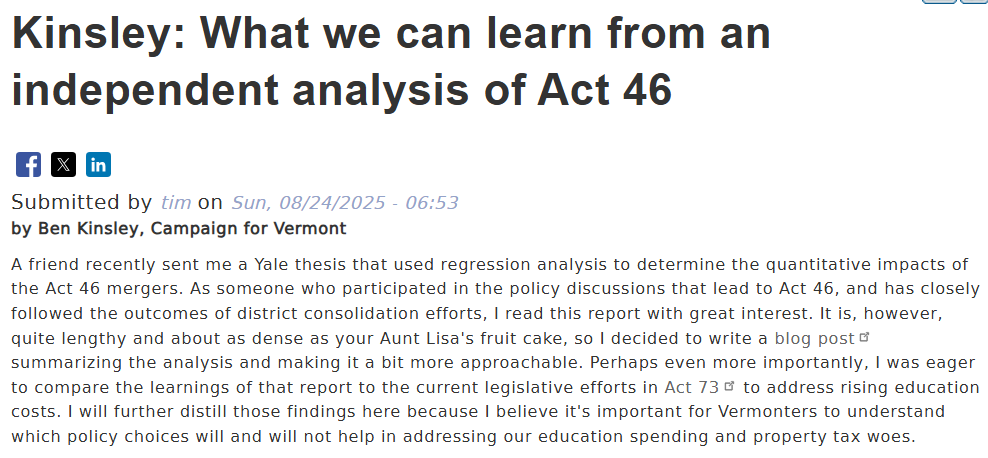
CommentaryBen recently released a commentary highlighting the learnings from Act 46 and applying them to the current education reform efforts.
|
|
|
 |
Banter & Beans: 2026 Property Tax Rates (Act 24)Pat and Ben review the 2026 property tax bill that sets the homestead property tax yields and the non-homestead property tax rate and what it means for Vermonters. |
|
Banter & Beans: Economic and Workforce Development (Act 65)Pat and Ben review Act 65, the legislature's approach to economic revitalization, emphasizing collaboration, innovation, and community support. As these initiatives unfold, their success will depend on effective implementation and adaptability to changing circumstances. |
 |
|
 |
Banter & Beans: Stormwater Management (Act 37)Pat and Ben review Act 37, which amends stormwater management regulations to enhance water quality protection, particularly for impervious surfaces of three or more acres. The legislation addresses permitting, funding, and municipal responsibilities while establishing a study committee to explore regional stormwater utility districts. |
|
Reducing Healthcare Admin Burdens (H.31 / Act 3)This legislation fits into a broader national and state-level push to reform healthcare administrative processes, particularly in response to complaints from providers about burdensome insurance requirements that delay care and increase costs. |
|
|
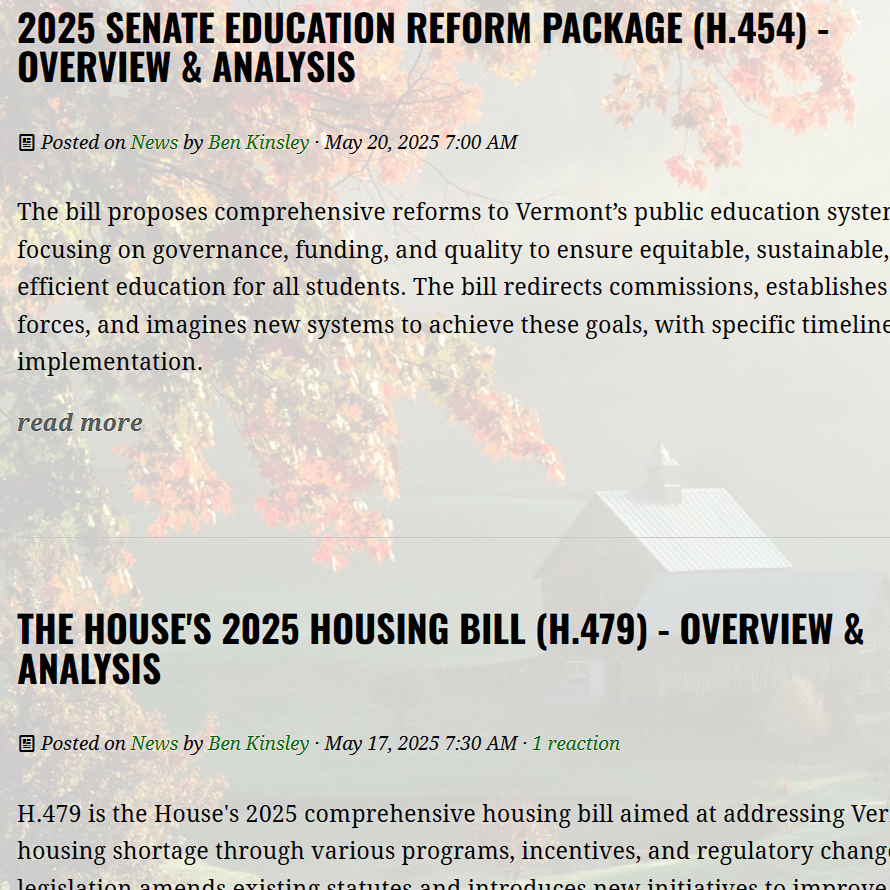 |
Robust yet Approachable Bill SummariesWe have published 27 bill summaries (so far!) this year. They dig into what you need to know about key pieces of legislation that impact everyday Vermonters, but do so in a way that is quick and easy to digest. We a thrilled to be able to leverage this tool more as a way to keep Vermonters informed about what is happening in Montpelier. |
|
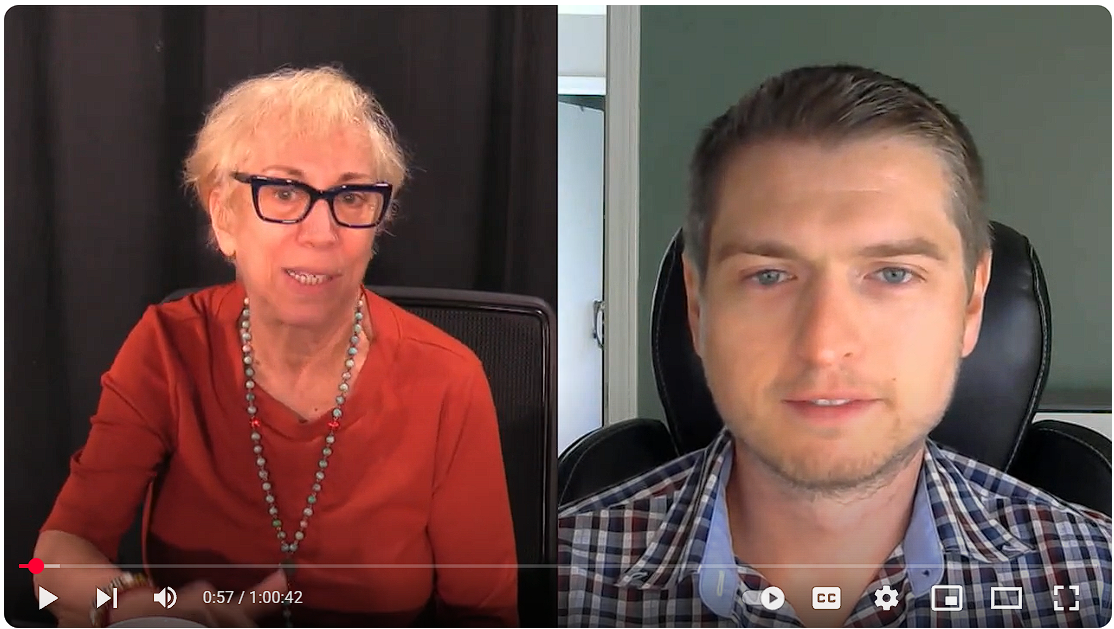
Straight Talk Interview - 7/28In this in-dept interview, we explore Vermont’s ongoing education reform efforts, focusing on Act 73, its origins, key differences from previous legislation, and the implications for school governance, funding, and community involvement. The discussion emphasizes the complexities of consolidating school districts, the roles of appointed committees, and the critical questions surrounding the reform process. The goal is to understand how these changes might impact students, communities, and taxpayers. |
 |
|
|
|
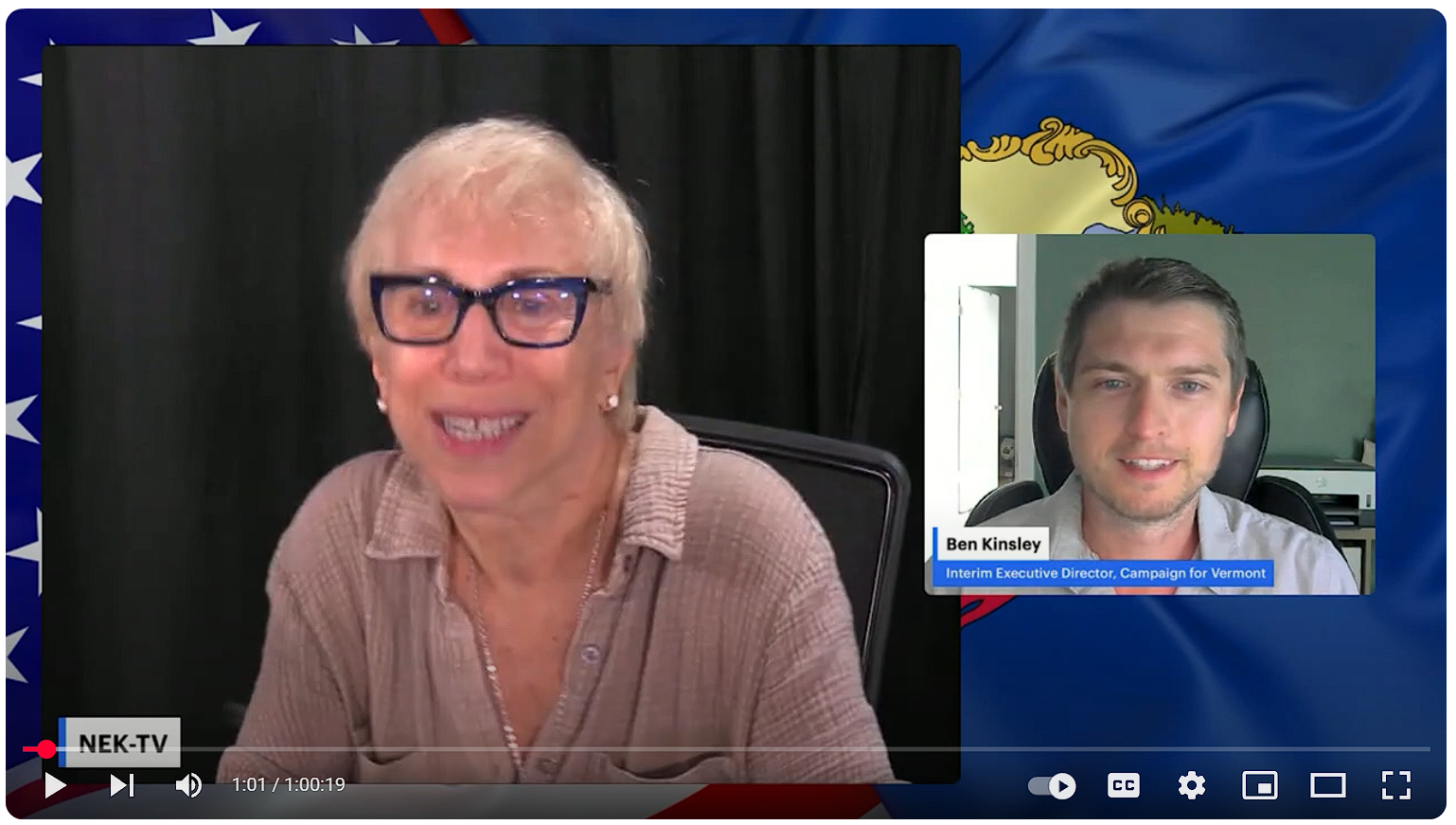
Straight Talk Interview - 8/11 Ben and Linda follow up their previous interview by talking about the first meeting of the Act 73 Task Force, who the leaders of the group are and what types of new education governance structures do they seem interested in. |
|
Featured Article: Vermont housing crisis deepens as people struggle to keep up“Five years ago, if someone want to buy the median priced home, they would have to earn around 60,000 a year. Today, it would take 120,000 a year to afford a house in Vermont,” said Collins. |
 |

News Worth Reading:
Our top picks of local must-read news this month.
- A majority of US adults are stressed about grocery costs, an AP-NORC poll finds - NBC 5
- UVM Health Network announces layoffs as part of budget cuts - VT Digger
- Bernie Sanders warns 45,000 Vermonters could lose health insurance under the ‘Big Beautiful Bill’ - VT Digger
- Vermont hospitals largely plan to break even or lose money to keep prices in check - Vermont Public
- Four healthcare laws that took effect this summer: What they do - Burlington Free Press
- As the school redistricting task force begins its work, some supervisory unions hope to sway the process - VT Digger
- Braver Angels Reach Across a Growing Political Divide - Seven Days
- After Vowing to Curb Reports, Legislators Are Ordering Up More Than Ever - Seven Days
- North Country Hospital Praised by Green Mountain Care Board, Reports Financial Turnaround - Newport Daily Express
- Research finds depression rates in Vermont youth have nearly doubled in recent years - Vermont Public
Recently Completed Research & Policy Proposals:
- Wealth Migration Report - Published December 11, 2024
- Education Spending & Outcomes Report - Published December 30, 2024
- A Pathway to Viable Education Reform - Published March 7, 2025
- Letter to Education Reform Conference Committee - Sent June 6, 2025
- Review of Yale Report on Effectiveness of Act 46 - Published July 22, 2025
- Letter to Act 73 Task Force - Sent August 12, 2025
In order to continue pursuing all of these priorities, we need support from Vermonters like you!
Campaign for Vermont's mission is to advocate for public policy changes by reconnecting middle-class Vermonters to their government.