News

November Newsletter: Vermont is Ground Zero for the Reading Wars

Here's a sentence I keep rereading: no state in the country fell as far in early reading over the last decade as Vermont. Not one.

I know that's hard to hear. Many of us grew up believing Vermont's schools were among the best in the nation, and for a long time they were. But the data has been telling us a different story for years, and our kids can't afford for us to keep looking past it.

So this month, I want to talk about reading. There is good work that the state has started, and I want to share what Campaign for Vermont is doing to help.

  • November Newsletter: Vermont is Ground Zero for the Reading Wars

    Here's a sentence I keep rereading: no state in the country fell as far in early reading over the last decade as Vermont. Not one.

    I know that's hard to hear. Many of us grew up believing Vermont's schools were among the best in the nation, and for a long time they were. But the data has been telling us a different story for years, and our kids can't afford for us to keep looking past it.

    So this month, I want to talk about reading. There is good work that the state has started, and I want to share what Campaign for Vermont is doing to help.

  • PRESS RELEASE: CFV Announces the Addition of Pelin Kohn

    Montpelier, Vermont – Today Campaign for Vermont Prosperity (CFV) announced that Pelin Kohn is joining their Advisory Council, expanding the organization’s capacity to advance data-driven, public policy solutions that strengthen Vermont’s economy and communities.

  • How Does Vermont's Property Tax System Work?

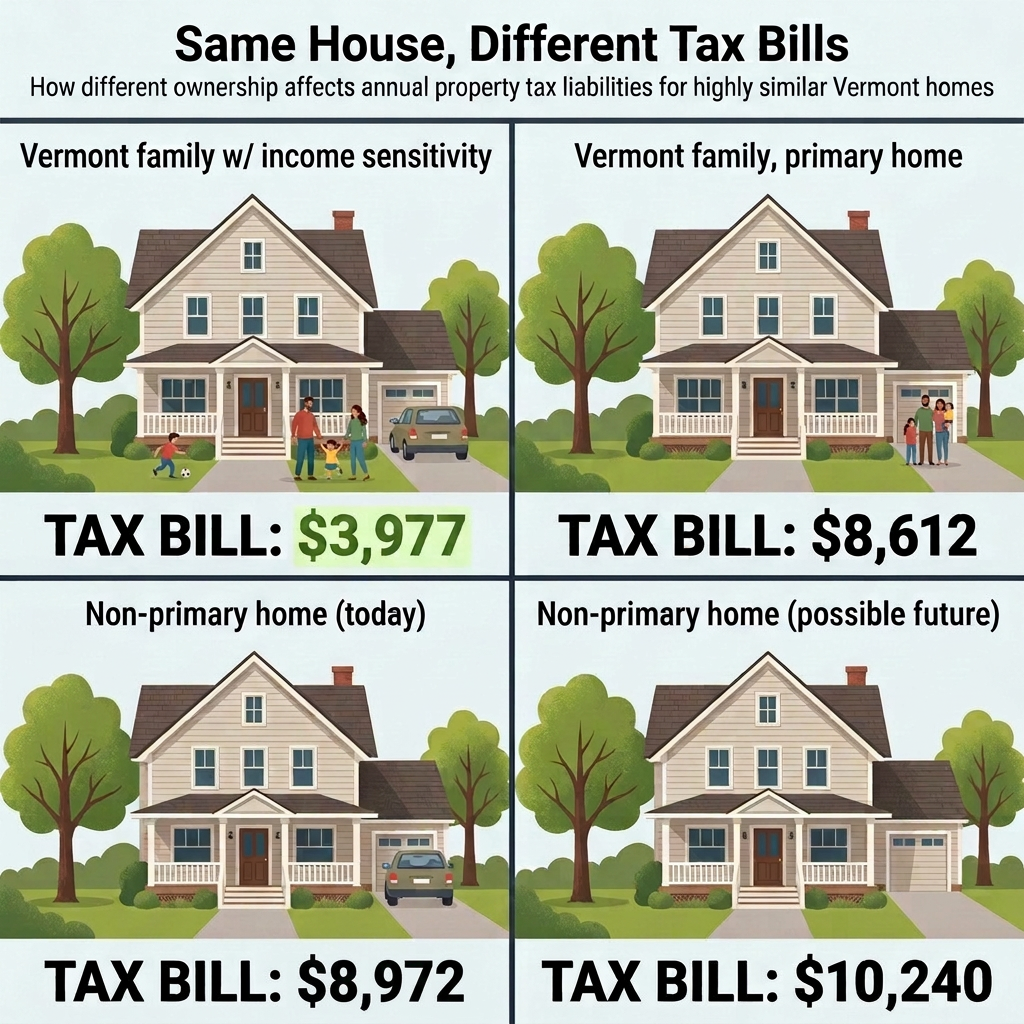
    Polls show most Vermonters like the idea of a tax on "second homes." Before we can truly judge whether one makes sense, we need to understand the system it would be added to. Vermont's property tax works differently from most states so there are a lot of misunderstandings, misconceptions, and oversimplifications about how property taxes work here. At a basic level which class your property is in decides which rate you pay, and the rate decides your bill.

  • A Second Home Tax: Is it Equitable?

    Vermonters care deeply about community and equity. The debate over a second home tax has become a battle over state identity: is Vermont still Vermont if we discourage second-home ownership?

  • October Newsletter: Is a Second Home Tax Viable?

    Most Vermonters support a second home tax. In a recent Vermont Public Poll, 57% said the state should impose a new tax on second homes. Twenty-eight percent disagreed, and 15% weren't sure. (A UNH poll found 78% support, but its question was worded more broadly.)

    The poll didn't define "second home" or ask respondents whether they own one. Many probably pictured an empty slopeside condo owned by a family from Connecticut, and much of the public debate has pointed that way. But the reality of trying to define a "second home" is more complex. So let's test our assumptions.

  • ‘Virtual’ Mergers Will Likely Produce Better Results

    Here in Vermont, we value local communities and local connections. Small is valuable, and rural is an asset (not a liability). Yet in education policy, many Vermonters have embraced the assumption that bigger districts are inherently better. The evidence suggests otherwise: Vermont can pursue savings and stronger student outcomes without forcing communities into larger districts and without erasing their local identity.

    The data shows that bigger schools and bigger districts do not inherently produce better outcomes for either students or taxpayers. Let me explain.

  • September Newsletter: What we are planning for this year

    When I stepped into this role in June I shared with you that we would sharpen our focus in the months ahead. Last month, I laid out why that urgency behind that focus: 64% of Vermonters under 35 are planning to leave the state within five years, while close to 100,000 Vermonters are approaching retirement age. On top of that, we are shrinking faster than any state in the country.

    A problem that size invites a dramatic response, throwing time and attention in every direction. We are not going to do that.

  • Our 2026/27 Priorities

    Every year, Campaign for Vermont sets an agenda for the work ahead and the issues where we believe nonpartisan advocacy can actually move the needle for everyday Vermonters.

    This year we made a deliberate choice: fewer, bigger fights. We lead where we are uniquely positioned to lead, and we support other credible organizations where they are already doing the work. We are a tiny organization, but we can have a big impact if we focus our attention and invite others to do the same.

  • August Newsletter: Two-Thirds of Vermonters Under 35 Want to Move Away

    Vermonters are already well-aware that our state is one of the highest spenders on education. Anyone who has shopped for real estate or an apartment recently knows how astronomical housing prices are. Families shopping on Vermont’s insurance marketplace have realized that our health care premiums are the most expensive in the world (no joke).

    Household incomes have not kept up with these skyrocketing costs. While slightly above the national average, 18 other states generate higher household incomes than Vermont’s economy does.

  • Homelessness Response Continuum (Act 143) - Overview & Analysis

    Act 143 replaces Vermont’s former General Assistance hotel and motel emergency-housing approach with the Vermont Homelessness Response Continuum, administered by the Department for Children and Families’ Office of Economic Opportunity.

    The act aims to make homelessness rare, brief, and nonrecurring by prioritizing prevention, diversion, shelters, supportive services, and permanent housing over prolonged reliance on hotel and motel placements. It recognizes that, as of December 2025, Vermont’s Homeless Management Information System counted 4,022 people experiencing homelessness, including 863 children.