


Vermonters have always valued education as the cornerstone of our communities—places where children learn not just facts, but the grit that comes with rural life and the kindness to lend a hand to a neighbor. I remember my own school days: lessons in reading, arithmetic, as well as those that went beyond the textbooks. Vermont education has worked for generations because it was accountable—to parents, to townsfolk, to the shared stake we all hold in our kids' futures.
Today, that foundation feels unsteady. Our public schools remain vital to our towns, yet they're caught in a troubling bind: declining student outcomes amid escalating costs that strain budgets and drive families out of our state. Enrollment has dropped 20% over the past two decades, leaving echoing hallways and underutilized resources, while education spending tops $2.4 billion annually; more per pupil than nearly every other state. All the while, students are struggling to achieve the same outcomes they did just a decade ago.
We're a resilient people, the sort who jump in with both hands to rebuild after disaster strikes without waiting for handouts. Yet our education system, our proudest investment, is faltering under this dual crisis of quality and cost. The right to a strong public education demands our responsibility to ensure it's delivering; not just in value, but in the lives it shapes.
We hear educators indicate that we're so focused on compliance that we're losing sight of competence. Fourth grade students are now, on average, reading at a second grade level. Mississippi students are now performing better in both reading and math than Vermont students. That is a failure of our education system to deliver on its promise to our students.
Since 2015, Vermont's performance on the National Assessment of Educational Progress (NAEP), the nation's benchmark for student achievement, has slipped markedly. Fourth-grade reading proficiency has declined the equivalent of 1.5 grade levels, placing us 36th nationally in both reading and math, below the U.S. average for the first time. Forty-two percent of our fourth-graders fall below basic reading levels for their grade. The problem gets even worse when you account for demographics. When this is taken into account, Vermont's 4th grade reading scores fall to 47th in the nation.
Unions representing teachers and administrators will point to the pandemic and mental health challenges as the cause for our student performance woes, but these are not unique to Vermont. The decline started well before covid hit and most other states recovered in the years following, Vermont has not. Presumably, all states are facing mental health issues. I have heard no one claim this is unique to Vermont and researchers like Jonathan Heidt, in his book The Anxious Generation, claim this problem extends across the entire Western world. So, if this is a global problem, why are only Vermont students suffering? NAEP scores in Vermont have declined more sharply than anywhere else so this argument doesn't seem to hold water. We need to look elsewhere to identify causes and solutions.
One of the defining characteristics of Vermont’s education system over the past 15 years has been constant change. In the business world we often describe the lifecycle of teams as forming, storming, norming, and then performing. Every time something disrupts the team, assignments change, or there is staffing turnover, the cycle starts over again. The trouble in Vermont’s education system is that we have been constantly stuck in the first two stages of the cycle: forming and storming. We’ve never gotten to the performing stage and schools have been left turned on their heads in chaos. Even more, the cycles of change have been so rapid that policymakers haven’t sufficiently been able to evaluate the success of any individual change. In other words, they don’t leave the new approach in place long enough to prove whether it’s working or not. This is a difficult operating environment for all.
Contributing factors run deep. Over the past decade of decline, teachers have been asked to implement a complex and opaque new evaluation system called proficiency-based learning. Administrators and school boards have been distracted by forced consolidation and a funding crises that has shifted the focus away from student achievement. Other policies have shifted too, in terms of how we identify students who need extra supports and whether or not students with behavioral issues remain in the classroom. As a former Deputy Secretary of Education, I can say with confidence that there has been a lack of leadership at the state level. There are no clear goals for what outcomes are expected from our schools and no statewide framework to hold them accountable.
Act 139's push for evidence-based reading instruction in early grades is a positive step, but other subjects also lag without similar mandates or enforcement. The Agency of Education acknowledges these policy gaps in its recent reports, but has yet to offer a plan to correct it. Looking to Mississippi again; they were once trailing far behind the nation. Now they have rocketed ahead through targeted reforms: systematic phonics, dedicated math instruction, intensive teacher training, and metrics that hold systems accountable. They're now ninth in fourth-grade math and 16th in reading—above national averages—while spending roughly half what we do per pupil.
On the cost side, the pressures are equally acute. Education property taxes surged double digits in 2024, with the possibility of another significant increase for the coming year. Total education spending has climbed 47% since 2019, pushing per-pupil costs to nearly $30,000, the nation's second highest. Staffing, overhead costs, and health insurance premiums drive much of this. Deferred maintenance adds insult to injury as students endure leaking roofs in Barre and aging infrastructure in Bennington. Districts favored by the current funding formula like Burlington and Winooski can afford expansive support programs and new buildings, inflating the statewide tax rate, while rural areas trim arts or AP classes to stay solvent. This isn't equitable or sustainable; it's a funding formula so complex it's practically opaque, eroding the town-meeting democracy that defines us.
The opacity of the system itself is a core problem. As we have noted before, it's often unclear whether tax hikes stem from local decisions, unfunded state mandates, or legislative choices. The result is clear though: unchecked spending growth and property tax burdens without corresponding accountability. Vermont boasts the highest adult-to-student ratio in the nation and spending that is 79% above the national average, yet outcomes haven't improved. Act 46, intended to streamline operations through consolidations, failed to reduce staffing levels or boost performance. Worse, there is evidence that the Act 46 consolidations increased spending across our education system as a whole.
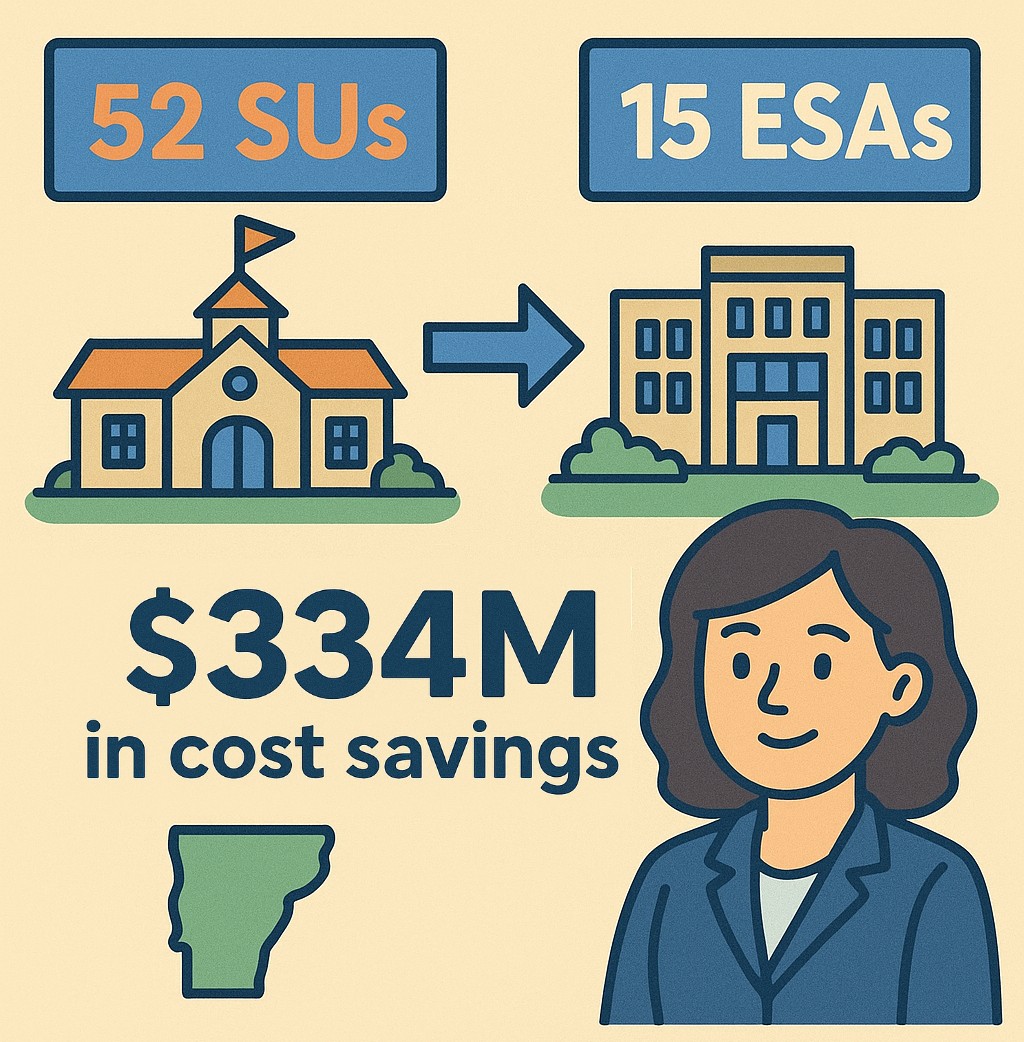
Yet there's reason for cautious optimism in recent efforts. Act 73, enacted this spring after extensive input, represents a comprehensive response: a framework designed to curb costs while elevating equity. The Task Force driving it didn't convene in isolation; over 5,000 Vermonters participated in forums in all four corners of our state, delivering a clear mandate: preserve local control. No top-down mergers that sever community ties. Evidence supports this: larger districts rarely yield savings or better scores; shared services and staffing efficiencies do. The resulting recommendations emphasize voluntary collaboration: incentivized sharing of administration, special education, transportation, and procurement through Education Service Agencies, generating savings without eroding local boards. We issued a report this month that identified over $330 million in savings from such a plan and the Act 73 Task Force is advancing a recommendation to the legislature that shares core tenants of this plan.
Another, somewhat overlooked aspect, of Act 73 is that it explores larger class sizes where research shows benefits (high-achieving systems often average 15-18 students per class, versus our 10:1). This move is likely to have additional savings measured in the hundreds of millions.
We are at a low point in Vermont's proud history of public education, but we can view this as an opportunity for renewal. We have been excellent and we can be excellent again. The Task Force provided a roadmap guided by everyday voices; lawmakers must now navigate it with transparency and resolve. We've seen what works elsewhere: shared services, focused instruction, accountable spending and outcomes, community-rooted decisions. To ignore these is to risk further erosion.
My call to you, is to engage. Attend that town meeting. Contact your legislator—not in anger, but with clarity: Demand local voices, measurable results, and reforms that deliver value. Back plans that deliver actual savings, not hoped-for savings like Act 46. Our students deserve schools that equip them to lead fulfilling lives, whether in innovation hubs or on family farms. And we deserve a system that upholds our educational ideals with prudent stewardship.
In Vermont, education has always been more than instruction—it's our compact with tomorrow. Let's honor it by building a stronger one.
On behalf of Vermonters,
Pat McDonald
Campaign for Vermont

NEW REPORT: Finding Savings Through Shared Services in VT SchoolsAcross the country, states use Education Service Agencies (ESAs) as regional delivery vehicles so that small and mid-sized districts can pool demand and centralizing expensive, low-frequency services. This lowers per-student costs for participating districts and expands program offerings without every district building its own duplicative capacity. |
 |
|
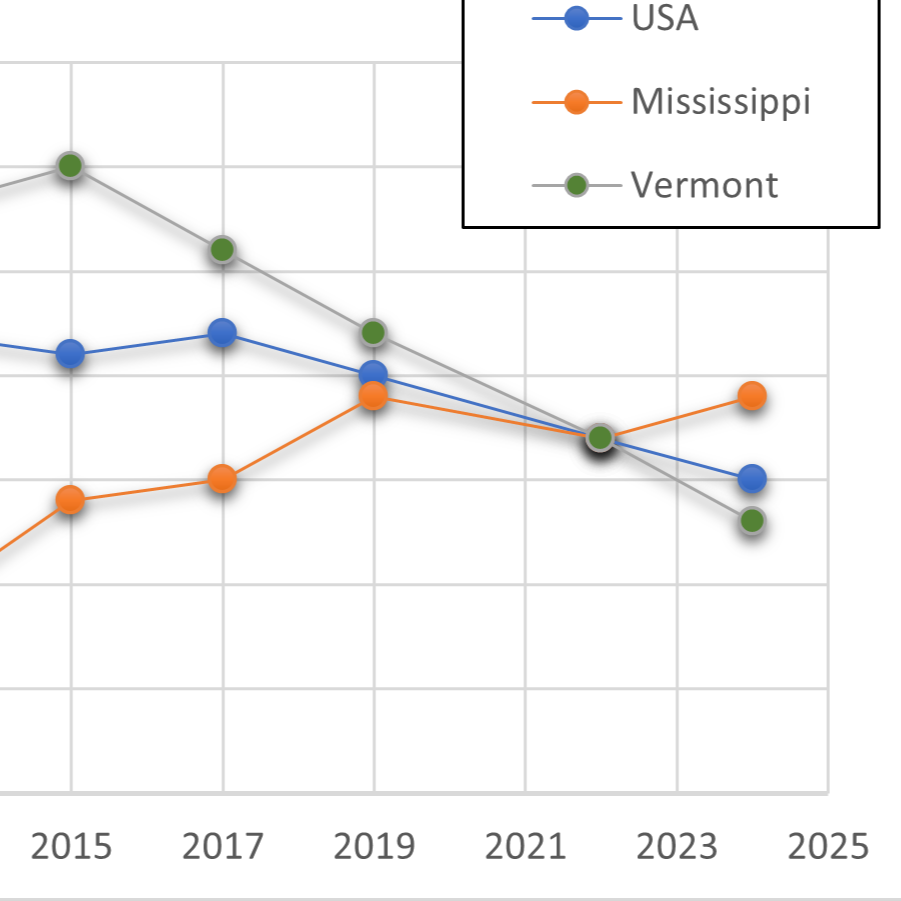 |
Mississippi Students Now Outperform Vermont StudentsThe decade-long nosedive in Vermont elementary school student performance has occurred in the National Assessment of Educational Progress (NAEP) standardized testing program (otherwise known as The Nation’s Report Card). |
|
The Act 73 Task Force Didn’t Fail. They Listened.Governor Scott says the Act 73 School Redistricting Task Force “failed” because it refused to deliver a mandatory consolidation map that would force Vermont into a handful of mega-districts. Respectfully, I disagree with this assessment. |
 |
|
 |
Spotlight: Wreaths Across AmericaOn this episode, Pat introduces a heartfelt Vermont initiative: Wreaths Across America. The program, rooted in nationwide charity work, honors those who served by placing wreaths on graves of veterans. Two local volunteers, Lynn and Gail, share their journeys, motivations, and the transformative impact of this annual event. The goal is simple but profound: remember, honor, and teach future generations about the sacrifices of those who served. |
|
Robust yet Approachable Bill SummariesWe have published 27 bill summaries (so far!) this year. They dig into what you need to know about key pieces of legislation that impact everyday Vermonters, but do so in a way that is quick and easy to digest. We a thrilled to be able to leverage this tool more as a way to keep Vermonters informed about what is happening in Montpelier.
|
|
|
 |
Our 2025 Research PrioritiesEvery year, Campaign for Vermont sets a research agenda for when the legislature is out of session. These are topics that we want to focus on in the spirit of bringing forward new information and recommendations for our state's policymakers. This work might result in new research papers, new position statements, new legislation, or just furthering our own understanding of an issue. |
News Worth Reading:
Our top picks of local must-read news this month.
- Task Force, Scott Admin at Odds Over Education Reform Proposals - Seven Days
- Vermont Futures Project releases 2025 Vermont Business Climate Survey - VermontBiz
- BETA Technologies Goes Public - NBC5
- Vermont housing authorities ask lawmakers for urgent infusion of funds - Vermont Public
- Miro Weinberger: The next chapter in the politics of abundance in Vermont - VT Digger
- Act 73 is already changing Vermont's education system - Vermont Public
- Vermont’s fiscal leaders worry feds won’t repay the state when government reopens - VT Digger
- 'We don't have a safety net': A family confronts a future without health insurance - VT Digger
Recently Completed Research & Policy Proposals:
- Wealth Migration Report - Published December 11, 2024
- Education Spending & Outcomes Report - Published December 30, 2024
- A Pathway to Viable Education Reform - Published March 7, 2025
- Letter to Education Reform Conference Committee - Sent June 6, 2025
- Review of Yale Report on Effectiveness of Act 46 - Published July 22, 2025
- Letter to Act 73 Task Force - Sent August 12, 2025
- Finding Savings Through Shared Services in Vermont - Published November 10, 2025
In order to continue pursuing all of these priorities, we need support from Vermonters like you!
Campaign for Vermont's mission is to advocate for public policy changes by reconnecting middle-class Vermonters to their government.