


The House Education Committee finally advanced their education reform bill after months of discussion. Of course they couldn't resist drawing maps, even if they are "only advisory" in nature. While the bill does not force arranged marriages (school district consolidation), per se, it does require that you attend the dance (merger study committees) and it chooses who your dance partners will be (which other districts you have to discuss mergers with).
In theory you could choose to dance with someone else or not at all, but that will probably be frowned upon. Okay, enough with that analogy... let's talk about what happened this week...
| This is a truncated version of our weekly legislative update. To receive the full version, please sign up for our legislative updates (it's free!). |
Education Transformation: Voluntary, or not?
CESAs Are Now in Statute: Last week we reported that House Education was building momentum. This week, that momentum carried through to a new bill. In a 7–4 committee vote this week, H.955 advanced. The bill creates seven Cooperative Educational Service Areas (CESAs) in statute, replacing the voluntary regional collaboration model. Each CESA must offer special education, business services, curriculum coordination, professional development, transportation, and assistance with union school district creation (aka district consolidation). Because CESA membership is set in statute, there is no withdrawal mechanism. This means that any changes to CESA boundaries will need to go back to the legislature.
Facilitators and the Map: The Vermont Learning Collaborative (VTLC) must contract for seven regional facilitators and one lead facilitator by October 1, 2026. They'll organize study committees using approximately 21 "advisory" district groupings from a guidance map the Committee finalized this week. These facilitators will lead those merger study committees I mentioned earlier. Think of them as the school dance chaperones (sorry I'm still using this analogy).
Here is what the new "advisory" map looks like:
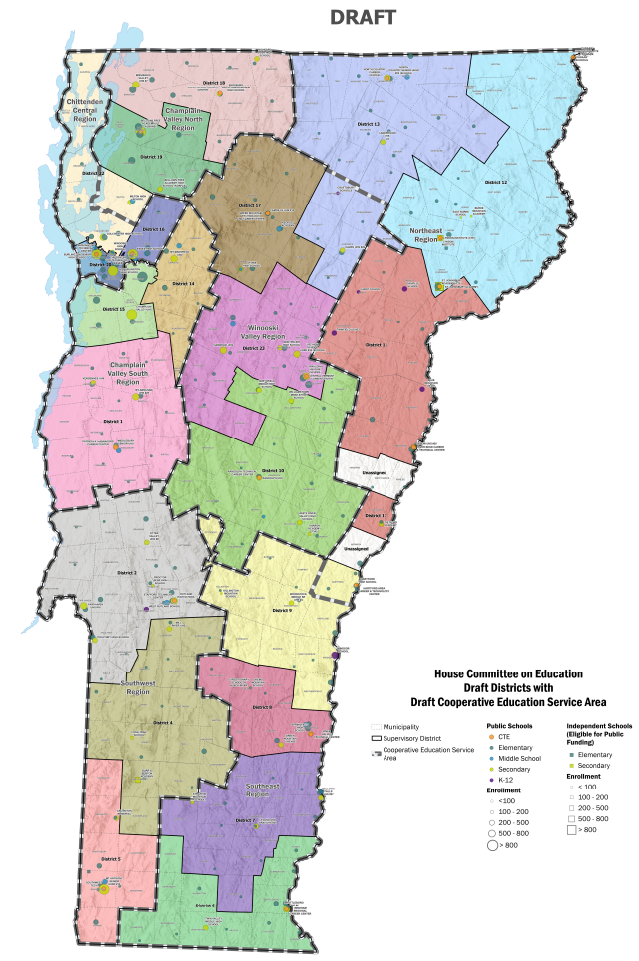
If you want to see in more detail (like town names, etc.) see here.
Other Details
Deadlines: Study committees must convene by December 1, 2026; final reports due December 1, 2027; voter approval of mergers by November 7, 2028.
Funding: $1,002,000 is appropriated to support merger discussions and form the CESA's. This does not include any capital construction needs that districts may require if reconfiguring operating models.
Foundation Formula: In a significant shift, the bill also pushes the foundation formula's contingent effective date from July 1, 2028 to July 1, 2030.
Ways and Means: Merger Incentives, Are They Effective?
The House Ways and Means Committee heard testimony this week that should shape future merger incentive design. Two different superintendents who lead districts that consolidated during Act 46 stressed that temporary tax breaks didn't drive merger decisions. Further, such tax break incentives often confused taxpayers about what the impacts of the merger decisions actually were and sparked frustration when those tax rate discounts began to expire in subsequent years.
Committee members broadly favored construction aid and direct grants over small tax-rate adjustments, and emphasized removing disincentives (debt disparities, tuitioning distortions, transportation costs) over creating new incentives.
Primary Care Payment Reform Surfaces
The House Health Care Committee introduced H.680 and reviewed the newly arrived S.197, which would establish a voluntary Primary Care Access Reform Program. The model: pool participating insurers allocations and make capitated per-member-per-month payments to primary care practices with no patient cost-sharing. The target: raise primary care spending from 10.2% to 15% of total health spending by 2029 — through reallocation, not new spending.
Rep. Herb Olson, the sponsor of bill, noted that "A dollar spent on primary care is going to eventually save the system about 13 bucks."
The bill also includes $6.75 million in FY2027 workforce investments (residency, scholarships, loan repayment), administrative simplification, and access improvement standards.
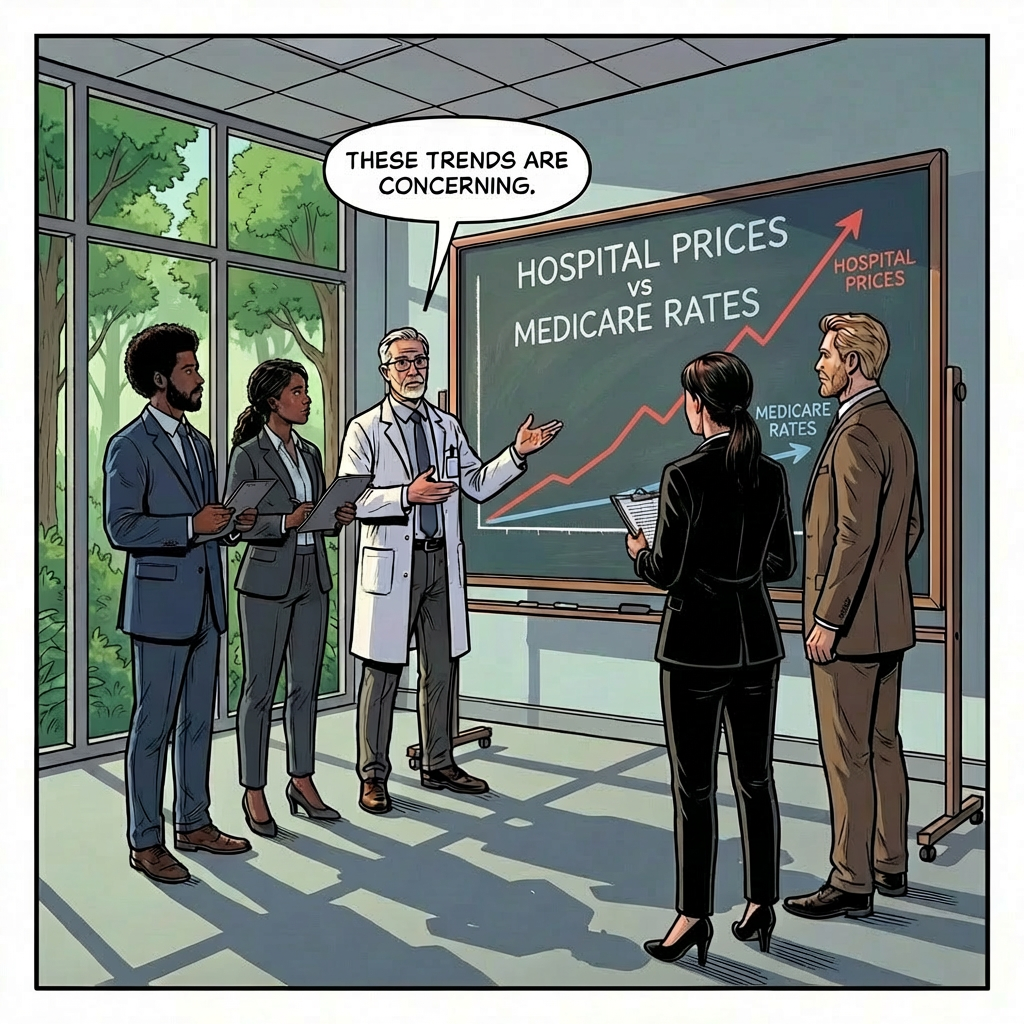
NOTE: Combined with S.190's reference-based pricing (now heading to the House), the Legislature is attempting a two-pronged approach: cap what hospitals charge and invest more in primary care providers.
FY27 Budget Hits the Senate
Senate Appropriations reviewed the House-passed budget (H.951). Most of the appropriations are very similar to the Governor's proposed budget, but there are some differences. His budget writers weighed in on the House version of the bill, here are some key disputes:
- Education Fund Transfer: The House split the Governor's $105M Education Fund transfer across FY27/FY28. As we have reported previously, this is essentially a property tax buy-down using General Fund dollars. The problem with this is that it creates a cliff in the next year that requires a spike in property taxes (nearly half of the 12% increase in property taxes that was projected in December was because of a buy down passed by the Governor/Legislature last year). The House approach this year was to split the funds available this year over two years in order to create an off ramp from this cycle of using one-time monies. However, the Governor is "not happy" with this approach even though it is likely more fiscally responsible in the long-term.
- One-Time Spending: The House added ~$9.5M in one-time items (~40 items vs. the Governor's ~10), raising sustainability concerns.
- Technology Fund: The House diverted ~$9M of interest from the Tax Computer Modernization fund to other parts of the budget. Something the Governor's budget-writers called "particularly egregious."
- Transportation: The House enacted only a one-year purchase & use tax shift from the Education Fund to the Transportation Fund instead of the Governor's proposed five-year step-down.
Other Notable Developments
Literacy (Senate Education): the Stern Center made the case for sustained, coaching-based teacher development as the primary lever to reverse Vermont's reading decline. The Stern Center's Read Vermont coaching contract was truncated after only six weeks when federal funds were pulled back last year. This loss of funding jeopardizes Vermont's efforts to reverse the declines in reading scores.
Building Energy (H.718): the House Environment Committee reviewed an incremental, market-oriented approach to improving residential energy code compliance (~53% compliance today) through registry improvements, voluntary certifications, and a safe harbor for builders who followed the Governor's executive order on the 2020 energy code. No new penalties or enforcement are included in the bill.
Act 250 / Act 181 / S.325: the head of the Land Use Review Board (LURB) clarified that Tier 3 areas cover only 2–3% of the state. The LURB strongly supports S.325's date extensions for implementation of Tier 3 rules, noting widespread public confusion about the Act 181 framework.
Looking Ahead
- H.955 will move through the Ways & Means and Appropriations committees in the House. Watch for whether merger incentive language gets added.
- S.190 (reference-based pricing) arrives in the House — potentially one of the most consequential cost of living policies of the session.
- H.680/S.197 will receive stakeholder testimony. Insurer and hospital responses will signal the viability of these primary care efforts.
- S.325 date extensions appear broadly supported, but road rule calibration remains politically sensitive as does the final balance that will be struck between land use rights and conservation efforts.
On behalf of Vermonters,
|
|
||
|

| Sign Up for Legislative Updates |
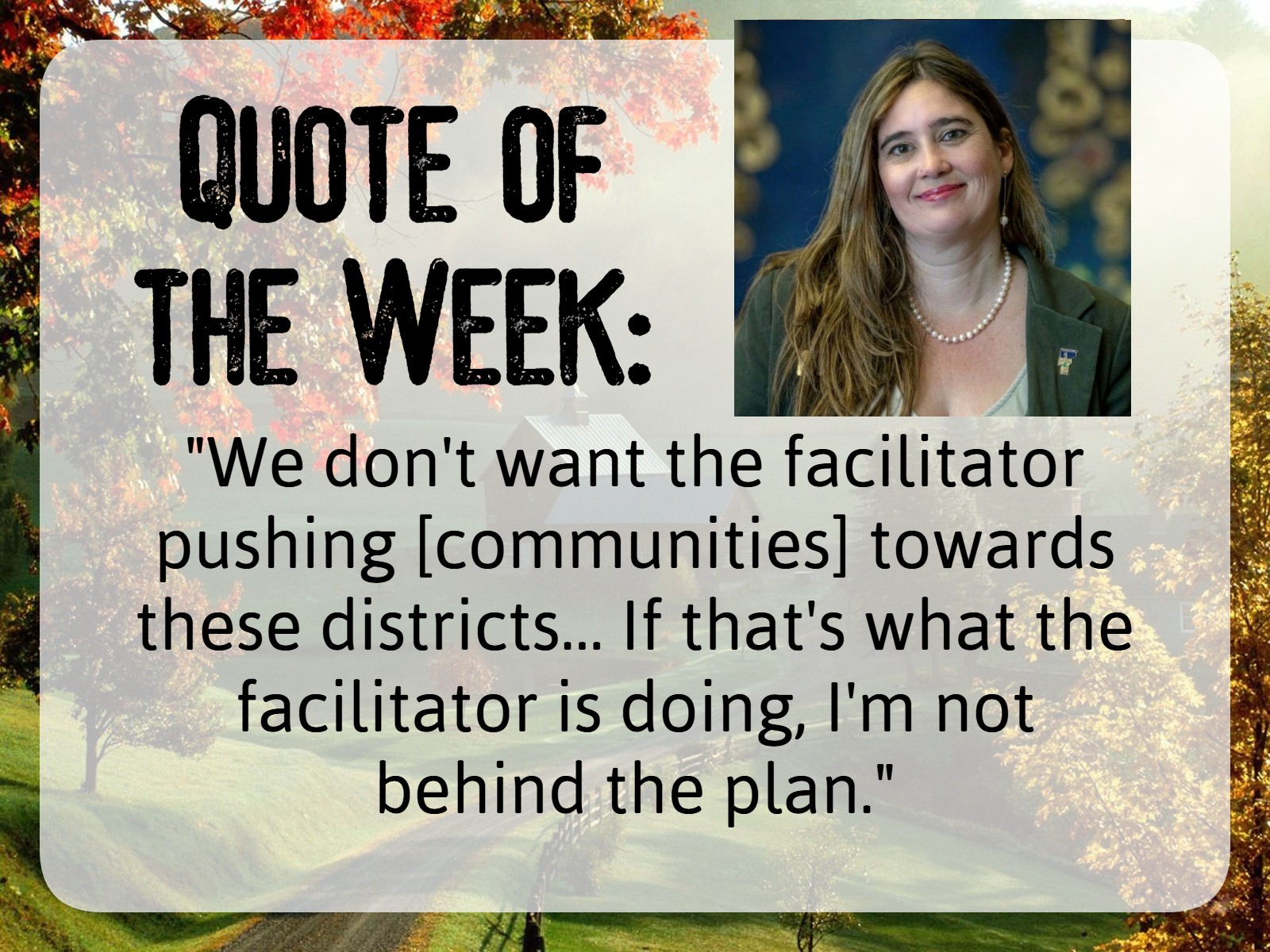
Quote of the Week:"We don't want the facilitator pushing [communities] towards these districts… If that's what the facilitator is doing, I'm not behind the plan." Comments make in regards to the roll merger study facilitators in H.955.
|
|

| Leanne Harple |
| State Representative, Orleans-4 |
NEW: Delaying Parts of Act 181's Rural Land Use Provisions (S.325)
The bill makes technical and transitional changes to Vermont’s land use and regional planning laws to align implementation of Act 181, while extending several housing-related exemptions and clarifying how Tier 1A, Tier 1B, and Tier 3 review will work under the new land use planning framework.
UPDATED: New Tools for Housing Production (H.775)
The bill gained approval from the House this week and will now move it's way over to the Senate after some changes to how capital can be deployed to support housing.
UPDATED: Reference-Based Pricing and Other Health Care Reforms (S.190)
The bill moved over to the House this week after several revisions by the Senate that added new studies were added related to public sector employee health benefits and Medicare outpatient costs.
| To continue reading, please sign up for our legislative updates (it's free!). |