


Vermonters understand the value of balance. We want to protect our forests, fields, rivers, and wildlife. We also want our children and grandchildren to be able to afford a home, find a job, and build a life here. Good public policy should recognize both realities. That is why the debate over Act 181 matters.
The law was intended to strike a grand bargain: encourage more housing and development in designated growth areas while tightening protections for ecologically sensitive parts of the state (conservation more or less). On paper, that sounds reasonable. Direct growth where infrastructure exists. Reduce sprawl. Protect natural resources. Streamline permitting where Vermont wants development to happen.
But as often happens in government, what sounds straight forward in theory can become much messier in practice.
As the implementation of Act 181 has unfolded, it has become increasingly clear that the law may impose significant unintended consequences on rural Vermont. And unless lawmakers intervene, those consequences could make our housing shortage worse, increase costs for rural families and landowners, and further strain communities already struggling to stay economically viable.
The central issue is this: Vermont should not be erecting new barriers to housing, regardless of geography.
We are already far behind where we need to be. Our current housing production is half of the market demand. That is creating scarcity and driving up prices. Employers cannot find enough workers. Young families struggle to buy homes. Older Vermonters looking to downsize often have nowhere to go. In many parts of the state, the lack of housing is now one of the biggest constraints on economic growth and community stability.
And yet Act 181, as currently being interpreted and implemented, threatens to place new hurdles in front of many projects outside of designated Tier 1 growth areas. Sure, these areas have infrastructure to support more housing and at a larger scale, but housing is housing and we need it everywhere. A substantial share of the housing we need will be built in smaller towns, on family land, along rural roads, and in the kinds of modest projects that have long sustained rural communities.
Why rural Vermont is alarmed:
Two provisions in particular have become flashpoints. The first is the so-called “road rule.” Under this provision, building a new road longer than 800 feet—or a combination of roads and driveways longer than 2,000 feet—outside Tier 1 areas could trigger Act 250 review.
That may sound technical. It's really not. In practical terms, it could affect ordinary rural landowners trying to do ordinary things: subdivide land for a child to build a home, create a small business, or improve access on property that has been in a family for generations. This new rule would apply to the vast majority of land in the state.
The second concern is Tier 3 designation, which could extend additional review and regulatory complexity over rural areas based on habitat and conservation mapping. Depending on how the rules are finalized, and what land is included, this may affect the allowable use of land that falls into these areas (which is often privately owned land) because ANY development would automatically trigger an Act 250 review. Further, this potential loss of use and impact on property values for rural landowners would not compensated for by the state. Typically when the state wants to conserve land, they buy it. That's not what is happening here.
The unintended impacts of Act 181 are becoming harder to ignore:
First, it risks worsening the housing shortage. If Vermont needs housing both inside and outside growth centers, then making rural development significantly harder is counterproductive. We cannot say we want more homes while simultaneously making it more expensive and uncertain to build them.
Second, it shifts the burden onto people least able to bear it. Large developers may be able to absorb engineering studies, permitting delays, and legal costs. A farm family, a retiree, or a homeowner trying to create a lot for a relative often cannot.
Third, it creates inequity between communities. Towns with infrastructure, planning capacity, and the ability to qualify for preferred designations may benefit. Smaller rural towns without those resources may be left behind.
Fourth, it undermines confidence in the system. When rules are broad, unsettled, and still evolving years after passage, people do not know what they can do with their own land. That uncertainty chills investment before a permit application is ever filed.
Why repeal is being discussed:
For many Vermonters, the issue is no longer whether Act 181 had good intentions (it did). The issue is whether those intentions are being translated into sound policy implementation. That is why calls for repeal (or at least major revision) have erupted in recent weeks.
Some want the road rule repealed outright, arguing that it is too blunt an instrument and sweeps in far too much ordinary rural activity.
Others want Tier 3 narrowed dramatically and defined much more clearly, so that truly sensitive areas can be protected without subjecting vast stretches of rural land to regulatory ambiguity.
Still others argue that if the framework cannot be fixed without continuing harm, then the most prudent course of action is to repeal the problematic sections (or the entire law) and replace them with something more targeted, more transparent, and more workable.
These concerns reflect a legitimate fear that Vermont is about to make a serious policy mistake at precisely the wrong moment. This debate is often framed too simply. It is not a choice between protecting the environment and allowing unchecked development. That is a false choice, and most Vermonters know it.
Vermont should protect high-value natural resources. It should also recognize that rural life depends on flexibility: the ability to build a home for a family member, support farm operations, expand a small business, or create modest new housing in places that are not traditional growth centers.
A policy that ignores that reality may be well-intentioned, but it will not be durable.
What should happen now?
At a minimum, lawmakers should act before the problematic rule-making related to Act 181 fully takes effect.
A sensible path forward would include:
- Repealing the road rule.
- Narrowing and better defining Tier 3 (or delaying implementation until this work can be done well).
- Exempting modest rural housing, family subdivisions, and low-impact projects from sweeping new review.
- Providing much clearer legislative direction rather than leaving core policy questions up to a prolonged rulemaking. This leaves too many Vermonters in limbo.
- Creating a true rural development framework that recognizes the realities of smaller towns and dispersed settlement patterns. Too many of these rural town centers are excluded from Tier 1 status.
Fortunately, a bill (S.325) passed by the Senate last week would do some of these things...
Act 181 was meant to support a better pattern of growth in Vermont. But if its implementation ends up discouraging housing, burdening rural families, and weakening local economic prospects, then lawmakers have a responsibility to fix it. We supported Act 181, but recognized that its impacts (both positive and negative) would rely heavily on the rulemaking process that followed the legislation itself.
We believe that public policy should be judged by results, not intentions. If the result of the Act 181 rulemaking process is to make it harder for Vermont to build homes, sustain rural communities, and remain affordable for the next generation, then repeal of the most harmful provisions—or substantial legislative correction—is not only justified. It is necessary.
On behalf of Vermonters,
Pat McDonald
Campaign for Vermont

|
|
CFV Announces the Addition of Elizabeth BrownLast month we announced the addition of Elizabeth Brown to our Advisory Council, expanding our capacity to advance data-driven, public policy solutions that strengthen Vermont’s economy and communities. |
|
CESAs and the Foundation FormulaVermont education spending has grown at nearly three times the rate of the national average since Act 60 passed. If our growth had kept pace with the nation as a whole, we would be spending over $9,000 less per student. |
 |
|
|
Statewide CTE May Exacerbate Some Issues We are Trying to SolveCareer and Technical Education should become the organizing backbone of a more coherent K–12 system rather than a parallel structure operating beside it. This is what we argued in a recent letter to the House Commerce Committee. |
|
FY2027 Property Tax 'Yield' Bill (H.949)This bill is best understood as both an annual yield bill and a short-term education finance management bill. It sets the yield amount needed to run the education financing system for FY27, but it also reflects a broader legislative effort to manage volatility in school taxes by using one-time funds over two years instead of all at once. |
 |
|
 |
Career and Technical Education Transformation (S.313)S.313 represents the opening act of what could be one of Vermont's most consequential education reforms in a generation. The bill correctly identifies the core problems: geographic disparities in CTE access, a tuition-based funding model that creates perverse disincentives for sending schools, fragmented governance across 17 centers operating under three different organizational models, and a growing disconnect between what schools offer and what Vermont's labor market demands. |
|
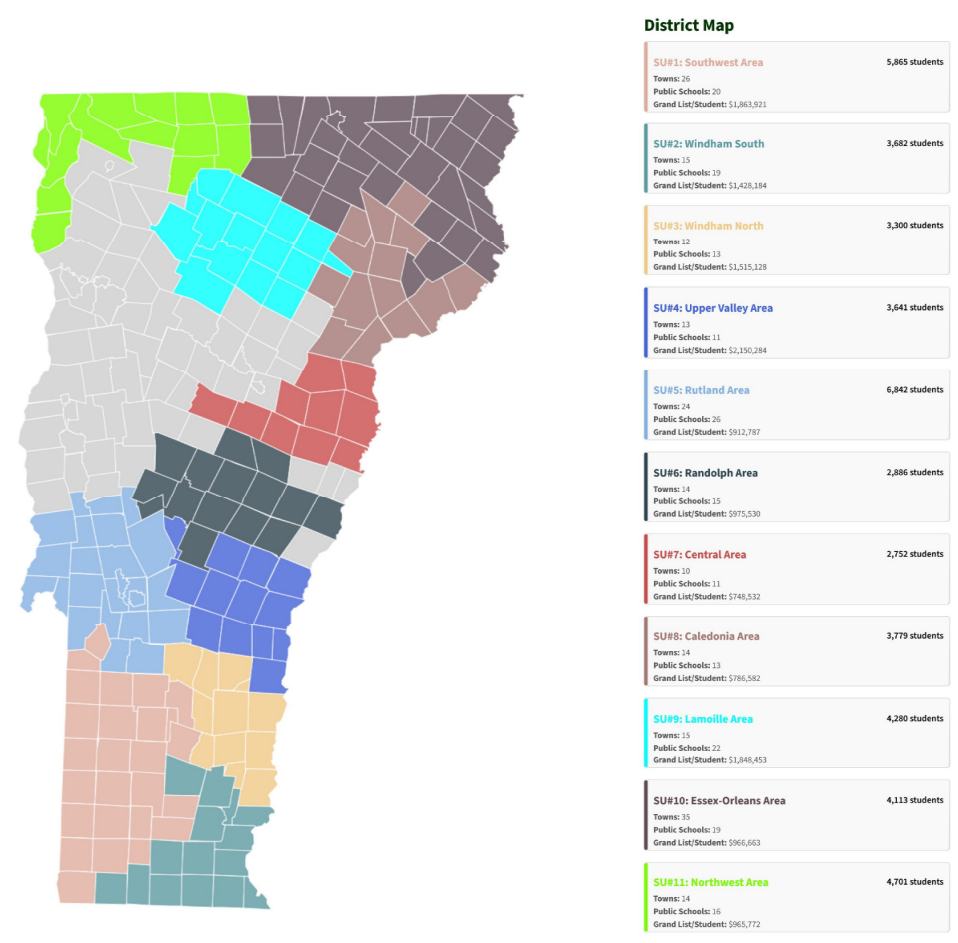
Senate School Governance PlanThis draft plan represents a hybrid governance reform bill: it sets a new statewide supervisory union map in statute, gives districts in 11 large supervisory unions a voluntary period to pursue mergers, and then creates a state backstop if that voluntary process does not achieve the bill’s consolidation goals. |
 |
|
 |
Delaying Parts of Act 181's Rural Land Use Provisions (S.325)S.325 delays the implementation of key provisions of Act 181, Vermont’s updated land use and regional planning laws, while extending several housing-related exemptions in an attempt to boost housing production. |
|
CESA's and 'Voluntary' Consolidation (H.955)The bill, creates regional cooperative educational service areas (CESAs), requires all districts to participate in structured merger studies, and delays major parts of the State’s broader education finance transition. |
 |
|
 |
Medal of Honor Day - March 25thPat leads a discussion about Medal of Honor Day its history, notable Vermont recipients, and how the Medal of Honor is awarded. The show also emphasis Vermont connections to submariners. |
|
Legislative UpdatesIf you're not subscribed already, you should be. Our weekly legislative updates give provide Montpelier insights you can't get anywhere else. |
|


News Worth Reading:
Our top picks of local must-read news this month.
- Vermont Just Hit Snooze on Your Property Tax Bill (Again) - Compass Vermont
- House Education advances reform bill, draws criticism from GOP caucus - Vermont Daily Chronicle
- Act 181 debate pokes at the heart of Vermont’s rural-urban dynamics - VT Digger
- Let’s Build Homes calls on Legislature to fix or repeal 'harmful' provisions of Act 181 - VermontBiz
- After Protest, Vermont Senate Postpones Some Act 250 Reforms - Seven Days
- In review: Rural land protest, property tax buydown, facility for mentally ill offenders - Vermont Public
- Vermont House approves $9.3 billion budget plan - Rutland Herald
- School Leaders Say Education Is Becoming Politicized - Seven Days
- Reporter roundtable: Vt. legislature's 'crossover day' - Vermont Public
- House Democrats revive push to tax the rich, despite their leadership's misgivings - Vermont Public
- Vermont's Tax-the-Rich Bill Would Miss Most of Vermont's Rich - Compass Vermont
- Senate Health Committee Favors Incremental Reforms This Year - Seven Days
- Some Vermont Doctors Embrace the New ‘Direct Primary Care’ Model - Seven Days
- Audit finds gaps in Vermont child care oversight pose risks to children, threaten federal dollars - VT Digger
- Vermont officials want to break with some new federal tax changes to avoid revenue shortfall - VT Digger
- Energy coaching program passes in the Senate - Rutland Herald
- Lawmakers want to strengthen data privacy protections by giving Vermonters 'the right to say no' - Vermont Public
- Vermont lawmakers narrowly advance bill increasing gun restrictions and crimes - VT Digger
- Vermont Senate leader Phil Baruth prepares for retirement - Vermont Public
- Beta Technologies Chosen for Next-Gen Aircraft Tests - Seven Days
Recently Completed Research & Policy Proposals:
- Wealth Migration Report - Published December 11, 2024
- Education Spending & Outcomes Report - Published December 30, 2024
- A Pathway to Viable Education Reform - Published March 7, 2025
- Letter to Education Reform Conference Committee - Sent June 6, 2025
- Review of Yale Report on Effectiveness of Act 46 - Published July 22, 2025
- Letter to Act 73 Task Force - Sent August 12, 2025
- Finding Savings Through Shared Services in Vermont - Published November 10, 2025
Campaign for Vermont's mission is to advocate for public policy changes by reconnecting middle-class Vermonters to their government.