


A bottleneck of bills hit the floor in both chambers this week. The House and Senate floors were busy passing major legislation on homelessness, health care, housing, and the FY27 budget. Meanwhile, the Agency of Education delivered pointed critique's of both chambers' approaches to education reform (color me shocked) and Ways and Means began inventorying the enormous technical to-do list that sits between Act 73 and anything resembling a workable foundation formula.
Let's walk through it.
| This is a truncated version of our weekly legislative update. To receive the full version, please sign up for our legislative updates (it's free!). |
House Education's Transformation Bill Builds Momentum — But AOE Isn't Sold
The House Education Committee walked through several drafts this week of their education reform bill. The approach: mandatory facilitated discussions about mergers, not mandatory mergers. Facilitators would lead local/regional study committees and encourage district mergers, potentially targeting consolidated districts of 2,000–4,000 students (this is still somewhat unresolved). Districts assigned to a study committee must participate, and the committees follow the existing statutory processes — the same framework Act 46 followed. If a study committee determines a merger is inadvisable, it must file a detailed report explaining why.
The draft includes a notable protection for communities with small schools: articles of agreement must prohibit school closures for three years without approval of the electorate in the town where the school sits. After three years, closure requires a union district-wide vote.
Study committee funding would come primarily through legislative appropriations rather than local school budgets, but that does not account for the leveling up of salaries as a result of re-negotiating collective bargaining agreements (this wiped out all the savings from Act 46). Education Secretary, Zoie Saunders, called this salary level-up a feature, not a bug. Because compensation varies widely across the state, she viewed this as an opportunity to level up our lowest paid teachers. That's great, but, um, where are the savings going to come from then?
Personally, I would prefer to level up salaries by adjusting our student/educator ratios. As the Secretary noted, we are 17th in compensation but we have the lowest student/teacher ratio in the country by a mile. The next closes state is nearly 25% higher. Instead of cutting administrators in order to pay teachers more, it seems prudent to give those administrative savings back to taxpayers (either through tax cuts or infrastructure investments) and then subsequently negotiate over staffing ratios versus compensation to create more equity for our educators.
Saunders and her team described a "three-legged stool" of education reform (quality, funding, and governance) and argued both chambers are pulling the legs apart. The Senate's maps (in their opinion) preserve too many existing structures; the House's voluntary approach risks producing no meaningful change. The Agency wants larger districts built around historic attendance and tuitioning patterns, with school advisory councils and equity-based budgeting in an attempt preserve local voice. Of course, we already know that bigger districts don't perform better on either a cost or an outcomes basis, but they are still stuck on this...
The thing I do agree with Saunders on? The shared services model that the House is advancing risks adding bureaucracy by layering new shared-service providers (CESAs) on top of the existing shared-service providers (Supervisory Unions). Both House and Senate versions also risk diverting educator time and school leadership energy into merger discussions instead of improving student outcomes. We saw student outcomes begin to decline right around the time that Act 46 demanded this same process from local districts. While a causal relationship has not been proven, it should give us pause to consider whether diverting attentions to merger discussions have significant impact on the support students are receiving.
Senate Education: The View from the Field
The Senate Education Committee heard from Tiffany Donza (Stowe School Board Chair) and Superintendent Ryan Heraty early in the week, who delivered a message that cuts against both chambers' instincts: the central problem isn't governance structure: it's lack of accountability. Donza recommended two priority changes: a comprehensive AOE data dashboard with comparable financial and outcome metrics, and a properly constructed foundation payment built through a professional-judgment panel. She warned that sweeping forced consolidation historically caused chaos and didn't deliver promised efficiencies. I agree, this IS what the data suggests.
Heraty reinforced that the cost realities he presented the prior week (salary leveling, pension implications, and transition costs) nullify the potential savings of mergers in many cases. He also cautioned that redrawing maps may simply reallocate money without reducing total statewide spending.
The Property Tax Bill: A Two-Year Compromise Moves Forward
The property tax 'yield' bill (H.949) gained approval on the House floor this week with a two-year tail for the Governor's proposed $105M General Fund transfer. Half (~$52.5M) plus the estimated FY26 Education Fund surplus (~$22.3M) will be applied to lower FY27 property taxes; the other half is reserved to offset potential FY28 spending increases. The result: an estimated average property tax bill increase of about 7%. This is better than the ~10% without intervention, worse than the ~4% if the full amount were spent in one year. But, it does prevent a cliff from being created next year which is what the Governor and Legislature have done the past couple years.
I will continue to note... the underlying math hasn't changed: education spending grew ~4.2% while non-property revenues grew more slowly, and property taxes keep picking up the difference. The two-year ramp buys time but doesn't solve the structural problem.
Senate Floor: Reference-Based Pricing Becomes Real
S.190 cleared the Senate floor, advancing what may be the session's most consequential health care policy. The bill caps hospital reimbursements for Qualified Health Plan enrollees at up to 250% of Medicare and requires hospitals and insurers to express prices as a percentage of Medicare payments. The Green Mountain Care Board (GMCB) must ensure savings are reflected in QHP premiums — a critical enforcement mechanism.
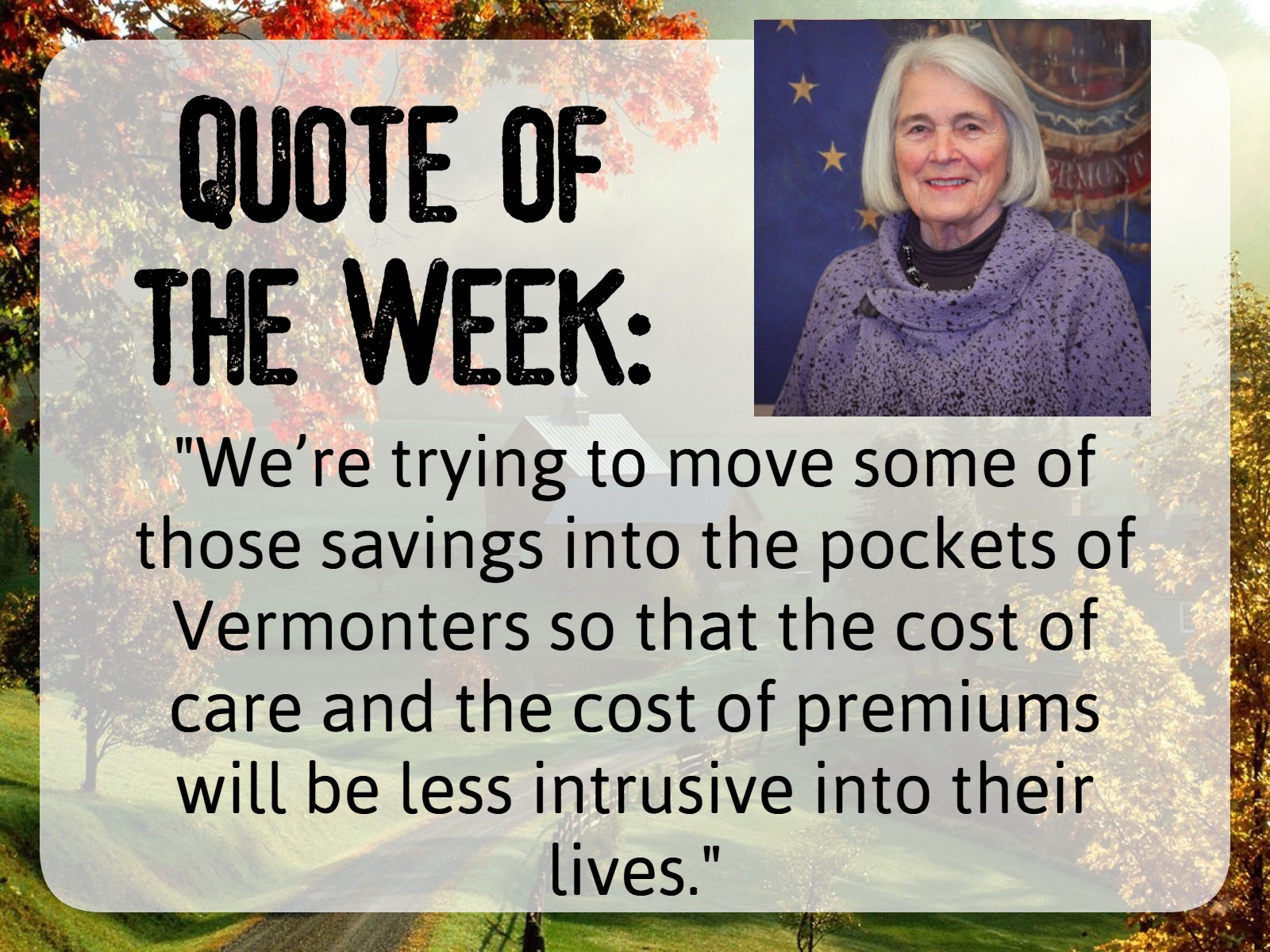
The Chair of the Senate Health and Welfare Committee framed it this way: "We're trying to move some of those savings into the pockets of Vermonters so that the cost of care and the cost of premiums will be less intrusive into their lives."
In a last-minute amendment, the bill also creates a working group to study a Medicare beneficiary cost-sharing problem at critical access hospitals — where patients can face 20% of the hospital's billed charge (not 20% of the Medicare payment rate). This potential creates an outsized out-of-pocket exposure in rural settings. This is a smart, targeted addition that addresses potential harm.
S.142 (internationally trained physician licensure) and S.197 (primary care payment reform) also advanced from the Senate this week.
House Floor: Budget, Homelessness, and Contested Housing Reforms
The House had a packed floor day Friday. Key actions:
H.951 (FY27 Budget) passed 97–40 after adding $23.4M in capital project appropriations. The floor debate reflected the familiar tension between fiscal restraint and investment in services — one member voted no "for 20 million reasons," while another called it "a fiscally responsible budget that invests in Vermonters in every corner of the state."
H.938 (Homelessness Response Continuum) advanced with its full $82.6 million FY27 appropriation, now allocated across specific categories: shelter operations, hotel/motel placements, case management, permanent supportive housing, a $3M rental assistance bridge program, municipal grants, and cold-weather shelters. The bill creates a five-level statutory continuum with definitions, time limits, fair-hearing protections, and performance metrics. As one member noted: "Over 4,000 Vermonters were experiencing homelessness as of December 2025, including 863 children…"
H.657 (Unaccompanied Homeless Youth) passed with reforms including eliminating asset limits for Reach Up, protecting foster youth Social Security benefits, creating certification pathways for 16–17-year-olds to access services without parental consent, and strengthening restraint/seclusion standards. The repeal of the Reach Up program asset limit is likely the most significant change here as it allows families to plan capital expenditures (like buying a house or a car) without jeopardizing program eligibility. As one member put it: "We can help, but only if you stay broke. That is not economic mobility."
H.772 (Landlord/Tenant Reform) survived a floor vote, but not before the House rejected amendments to delay effective dates by a year and to preserve municipal authority for just-cause eviction ordinances. Concerns about expedited timelines, affidavit-based hearings, and the scope of new trespass language dominated debate.
H.727 (Data Center Regulation) also drew extended debate. The bill creates a proactive regulatory framework for large data centers (although I'm not sure who would want to put one here with how high our energy costs are?).
PCB Testing: A Quiet but Consequential Update
The Senate Education Committee received a detailed briefing on H.542 and the bill repealing state's PCB testing program. The numbers tell the story: of ~328 schools built or renovated pre-1980, only 157 have completed testing, 46 of those exceeded state action levels, and 171 are yet to be tested. About $4.5 million remains in the remediation fund but is largely spoken for already. H.542 would pause the remaining testing mandate, preserve state funding for schools that already tested positive by shifting remaining funds to remediation, and require a health-risk assessment report to the le.
Looking Ahead
- House Education must resolve CESA boundaries, facilitator authority, and the district size targets before the bill can move forward.
- The AOE-vs-Legislature tension on scale and governance is now fully in the open — watch for whether it produces compromise or stalemate (i.e. a veto from the Governor)
- Ways and Means faces an enormous technical workload on tax classification, special education, school construction, and foundation formula mechanics. How they manage these priorities will be telling.
- S.190 heads to the House with reference-based pricing as the central health care policy of the session. What kind of reception will it receive?
- The yield bill numbers are set, but the underlying education spending dynamic remains unresolved. Will the Senate address this?
On behalf of Vermonters,
|
|
||
|

NOTE: The original version of this post incorrectly cited 115% as the final excess spending threshold in S.220. The wording around the Senate's draft governance bill was also updated for clarity.
| Sign Up for Legislative Updates |
Quote of the Week:"We’re trying to move some of those savings into the pockets of Vermonters so that the cost of care and the cost of premiums will be less intrusive into their lives." Comments make in regards to reference-based pricing during the floor debate on S.190.
|
|

| Virginia "Ginny" Lyons |
| Chair, Senate Health & Welfare Committee |

CFV Announces the Addition of Elizabeth Brown
This week we announced the addition of Elizabeth Brown to the Advisory Council, expanding our capacity to advance data-driven, public policy solutions that strengthen Vermont’s economy and communities.
NEW: FY2027 Property Tax 'Yield' Bill (H.949)
This bill is best understood as both an annual yield bill and a short-term education finance management bill. It sets the yield amount needed to run the education financing system for FY27, but it also reflects a broader legislative effort to manage volatility in school taxes by using one-time funds over two years instead of all at once.


NEW: Career and Technical Education Transformation (S.313)
S.313 represents the opening act of what could be one of Vermont's most consequential education reforms in a generation. The bill correctly identifies the core problems: geographic disparities in CTE access, a tuition-based funding model that creates perverse disincentives for sending schools, fragmented governance across 17 centers operating under three different organizational models, and a growing disconnect between what schools offer and what Vermont's labor market demands.
UPDATED: Legislative Operations and Government Accountability (H.67)
The bill passed the House floor this week with a minor amendment related to the makeup of the Government Accountability Committee.
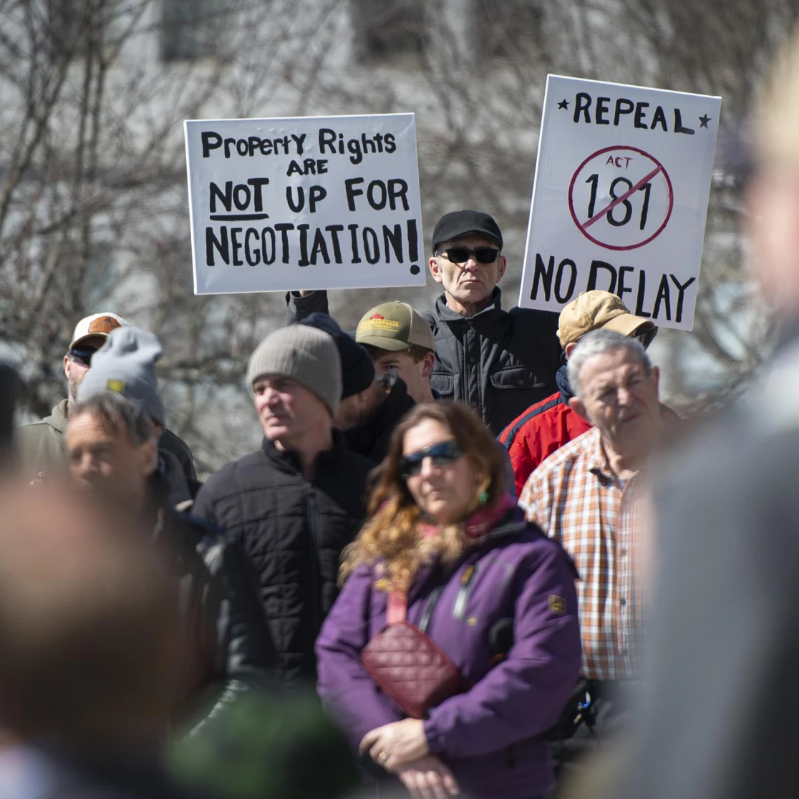
FEATURED NEWS: Hundreds protest Act 181 on Statehouse steps as new land-use rules come into focus (Vermont Public)
Clad in workwear and toting signs with slogans like “Hands off our land!,” several hundred protesters gathered on the Statehouse steps on Tuesday calling for lawmakers to repeal a major land-use reform law.
| To continue reading, please sign up for our legislative updates (it's free!). |