


This week the State Auditor's office delivered a sobering accountability check on Vermont's (former) flagship health care programs and the government accountability pilot moved to the Senate with fundamental questions about scope and institutional design still unresolved. Meanwhile, the climate policy infrastructure took a step forward with H.740's greenhouse gas registry advancing, though the familiar gap between policy ambition and funding commitment surfaced once again. The House's education reform bill also took another step closer to a floor vote.
Let's walk through it.
| This is a truncated version of our weekly legislative update. To receive the full version, please sign up for our legislative updates (it's free!). |
The State Auditor Dismantles the 'Accountable' Care Organization Model
This was arguably the most consequential hearing of the week for health care policy, and it has direct implications for S.197 and the primary care payment reform debate that's building in the House.
Deputy State Auditor Tim Ashe and Audit Manager Jonathan Kingston presented findings from audits of both the ACO/OneCare model and the Blueprint for Health program. The message was uncomfortable but necessary: Vermont's existing health care reform programs have not been rigorously evaluated for actual impact, and the data that has been presented publicly has the potential to mislead the public.
On OneCare, the auditors found that the Green Mountain Care Board lacked a methodology to determine whether OneCare's operating costs would be greater or less than the model's benefits. During the 2017–2019 period studied, Medicaid (DVHA) was the only payer actually funding OneCare's operating costs, and the model cost DVHA an estimated $26 million more than it saved.
On Blueprint for Health, the audit found that the program was not conducting evaluations to determine program impact (it was reporting data without causal analysis). The audit found that "Legislators and Vermonters therefore should not rely on the information in these reports that appears to indicate that Blueprint is achieving massive savings for program participants when an analysis has not been conducted to determine if Blueprint is the cause of the cost differences."
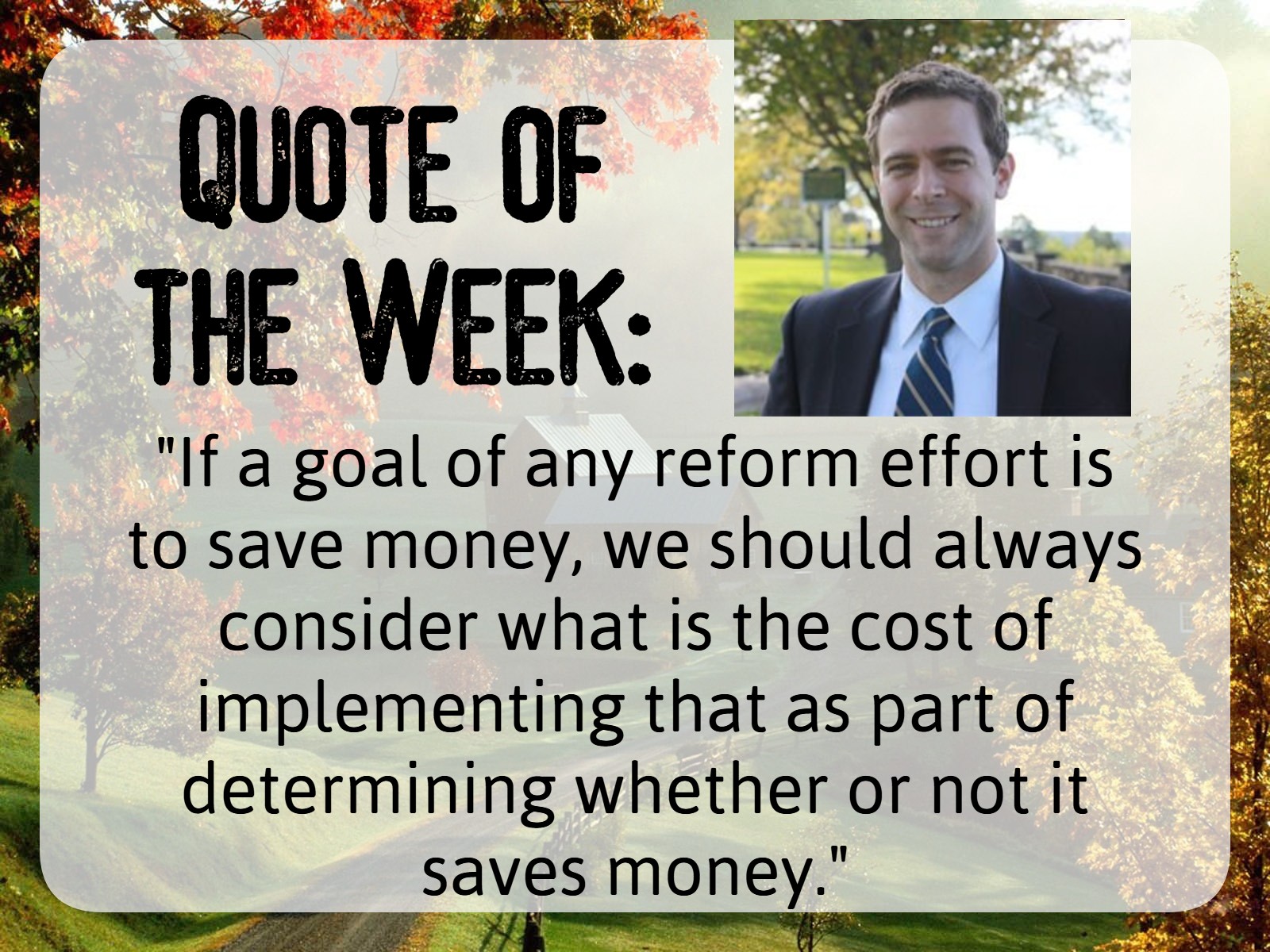
Tim Ashe framed the broader point with clarity: "If a goal of any reform effort is to save money, we should always consider what is the cost of implementing that as part of determining whether or not it saves money."
The timing here matters. The House Health Care Committee is actively reviewing S.197 (primary care payment reform) and H.680, both of which would expand capitated payment models and increase primary care spending from 10.2% to 15% of total health spending. Combined with S.197's reference-based pricing (now in the House), the Legislature is attempting a two-pronged approach: cap what hospitals charge and invest more in primary care. These are sound policy instincts. But the Auditor's findings are a flashing yellow light: when expanding or restructuring these models, the Legislature needs transparent, causal evaluations that include implementation costs and examine who is participating and who is not.
Approximately 25% of Vermont primary care providers are not participating in Blueprint, and the audit found no analysis of why. Blueprint doesn't survey providers (it surveys patients) which the auditors flagged as a gap. The good news: Blueprint has been responsive to the audit, implementing improved annual reporting, better methodological explanations, and a newly adopted strategic plan. A follow-up audit is underway. But the Legislature should take the Auditor's findings seriously as it designs the next generation of payment reforms, otherwise we risk building new programs on unverified assumptions about the old ones.
Base Education Funding, Striking the Right Balance
The Senate Education Committee is now actively considering inflating Act 73's base amount for the first two years of the foundation formula using the actual change in statewide education spending rather than the National Income and Product Accounts (NIPA) inflator that the statute currently prescribes. The JFO's modeling shows this would produce an FY2027 base of approximately $16,575 per student — roughly $600 higher (about 4%) than the $15,936 that the NIPA-only path yields. That may sound modest, but because all subsequent indexing builds on this base, the difference compounds permanently. Every downstream Educational Opportunity Payment would be higher, requiring additional property tax or other revenue to fund.
The Committee Chair was candid about the motivation: "There's a part of me that wants to raise the base because I think it will help smooth the transition." That instinct is understandable, districts facing a leap from the current system to a formula-based system may need some cushioning. But smoothing transitions by permanently inflating the base is an expensive form of comfort. The JFO was careful to flag that the net fiscal impact depends on a long list of unresolved policy choices: exact pupil weights, whether CTE and special education are funded inside or outside the base, the still-pending student weighting factors study, and the precise transition mechanics employed for the foundation formula.
The other problem? That 4% in extra growth does nothing to constrain education spending, which has been out of control since Act 60 passed in 1997. Vermont's 4.4 students per staff member (the lowest ratio in the nation, per fall 2022 NCES data) keeps showing up in every education funding conversation, and until the Legislature grapples directly with staffing ratios as a cost driver, the spending trajectory won't change regardless of which inflator is chosen. The current funding system has not created the correct incentives to address this fundamental problem and as a result our education spending has grown at more than twice the rate of the national average for the last 30 years. If we had kept pace with the rest of the country, we would be spending over $9,000 less per student.
The connection to the House's work is important here. Last week, H.955 pushed the foundation formula's effective date from July 1, 2028 to July 1, 2030. Now the Senate is considering making the base itself permanently higher before it even takes effect. If these threads aren't reconciled, the foundation formula risks becoming a policy vehicle that costs more and arrives later; Vermonters will bear the cost of that.
Government Accountability Pilot Moves to the Senate
H.67, the government accountability pilot arrived in Senate Government Operations this week. The bill's mechanics are straightforward: rather than creating a new standalone Government Accountability Committee, it charges the Joint Fiscal Committee (JFC) with pilot evaluation work, supported by the Joint Fiscal Office (JFO) via either a contracted consultant or a limited-service hire with a $300k appropriation. Projects would be selected by August 1, 2026, with reports due in December 2026 and November 2027.
Sponsor, Rep. Chea Waters Evans, framed it as a pragmatic compromise after years of attempts at reforms: "Instead of forming a whole new government accountability committee, we're just asking the joint fiscal committee to do that work." She was candid about the political constraints: "Many people were not excited about it… we don't want it to turn into a witch hunt… we don't want it to be political. We don't want it to cost a lot of money."
But the Senate committee pushed harder on scope than the House did. The central tension: the bill only evaluates legislative implementation, it does not empower review across the executive or judicial branches. Multiple Senators argued this is a fundamental limitation. Implementation of most laws happens in the executive branch; a accountability check that only applies to the legislature misses the place where programs actually succeed or fail. Several members noted that 34 states house this kind of evaluative capacity in the state auditor's office, with a legislatively appointed position reporting to a bipartisan committee.
The committee requested testimony from the State Auditor and the Chief Performance Officer at a future hearing to explore alternative homes for this accountability function.
Still, this is a bill worth supporting in concept. The idea that the Legislature should systematically evaluate whether the programs it creates, and whether or not they are actually working, is long overdue. But the Senate's instinct to push for cross-branch review is welcome.
Climate Data Infrastructure: H.740 Advances, Funding Lags
The Senate Natural Resources and Energy Committee heard from Agency of Natural Resources (ANR) Secretary Julie Moore and Climate Council member Jared Duval this week on H.740, the greenhouse gas inventory and registry bill. The policy case is straightforward: transportation and heating account for roughly 70% of Vermont's greenhouse gas emissions, and the state currently lacks facility- and supplier-level data to design, target, or evaluate emissions-reduction programs.
ANR recommends a standalone state-level reporting registry rather than trying to harmonize with existing Tax Department or DMV filings. The data those agencies collect isn't granular enough (fuel type, biofuel content, geographic specificity), and layering climate data requirements onto their systems raises access, privacy, and mission-creep concerns. ANR estimates the program needs roughly $500,000 in year-one funding to cover IT development and staffing. The problem: the House reportedly advanced the policy language but stripped the funding. This is a recurring pattern... authorizing data collection without funding compliance produces incomplete, unreliable data.
The committee was supportive of the issue but wants more precise cost estimates, statutory language options, and assurance that compliance will actually be funded. This is a foundational data tool (not a regulatory mandate, yet) and if the Legislature deeps it a priority, they should fund it accordingly.
Looking Ahead
- Senate Education will continue working through the foundation formula's technical questions. We will watch for whether the inflated base concept survives or whether JFO's follow-up data changes the calculus.
- House Health Care must now reconcile the Auditor's findings with its enthusiasm for S.197 and H.680. Expect stakeholder testimony from insurers and hospitals to sharpen the debate.
- Senate Government Operations will hear (hopefully) from the State Auditor and Chief Performance Officer on H.67. This feedback could fundamentally reshape the bill's design.
- S.190 (reference-based pricing) continues its journey through the House. This bill is still potentially the most consequential cost-of-living policy of the session.
- H.740 needs a funding commitment from the Senate to be meaningful; watch for whether Natural Resources can restore what the House stripped or if they will scrap the new reporting structure all-together.
- H.955 (education reform) may hit the House Floor next week. Passage is not assured, there is something for everyone to dislike in this bill and two narrow committee votes have kept it alive so far.
This was a week of reckoning with data (or the lack of it). The Legislature is starting to ask harder questions about what its programs actually accomplish, what its reform proposals actually cost, and whether the numbers it's been relying on actually mean what they appear to. That's progress. The challenge now is following through.
On behalf of Vermonters,
|
|
||
|

| Sign Up for Legislative Updates |



| To continue reading, please sign up for our legislative updates (it's free!). |