

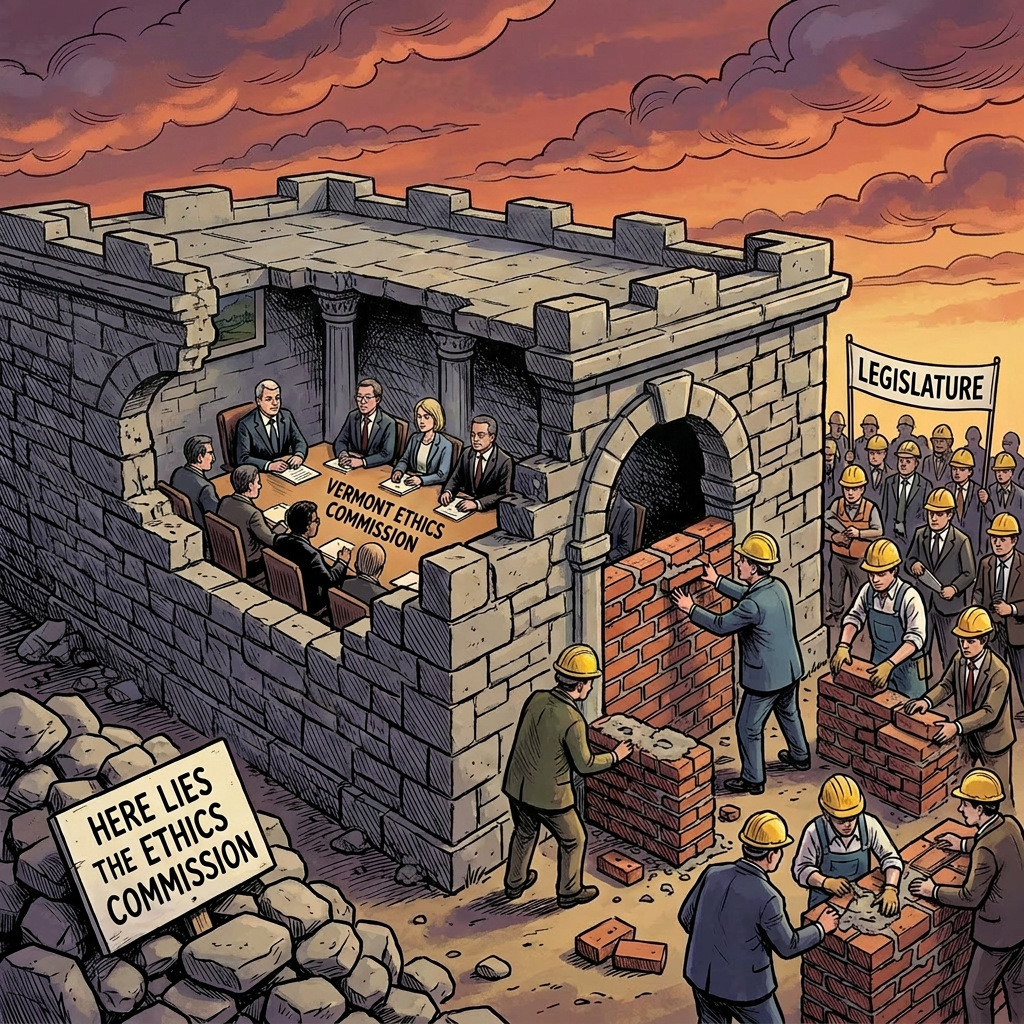
Campaign for Vermont fought hard to get ethics legislation passed in 2017 (Act 79). Not even a decade later it is feeling like the legislature is dismantling the ethics and transparency framework in the state... and it's coming from all sides.
In 2024, the legislature passed Act 171, which was intended to build on Act 79 by giving the Ethics Commission more oversight and (finally) enforcement powers. Unfortunately, Act 44 last year paused the enforcement powers (the House version of that bill would have scrapped them completely if we hadn't stepped in on the Senate side). More importantly, the Commission, overwhelmed with requests from the public, stressed the need for additional staff. State budget-writers denied that request last year — leaving the Commission under-resourced.
Fast-forward to this year and S.298 appears to be assigning new responsibilities to the Ethics Commission, just as... wait for it... the Senate is cutting the Commission's budget request, AGAIN.
Now, a little bit of history is required here. Act 79 (2017) required financial disclosures from candidates filing to run for public office. These report things like sources of income for the candidates themselves and are distinct from campaign finance filings which show income/expenditures for the campaign. For the past 8+ years, candidates have been provided these forms by the Secretary of State's office when they request their candidate application paperwork. Act 171 (2024) expanded some of the information required on these forms (to include assets instead of just income). The Ethics Commission, as the law directs, updated these forms in January and provided them to the Secretary of State's office.
Recently, the Secretary's office decided that they did not want to host these forms or administer them for candidates. Instead they wanted the Commission to host the forms and they would direct candidates to them, and (this is important) provide Q&A support for the forms when candidates had questions. The Commission objected to the change in practice, arguing that they did not have the resources to provide that type of support and it cut against the long-standing practice of the Secretary's office in supporting those forms. This dispute left candidates, who were allowed to start filing last week, in limbo.
The House Government Operations Committee stepped in, essentially siding with the Secretary of State, and requiring the Commission to provide this support via S.298. Of course the requirement does not come with any additional staff for the Commission (although the current draft of the state budget includes multiple new positions in the Secretary's office). And... this came a day after the Senate cut a position from the budget that was intended to help the Commission handle its current workload.
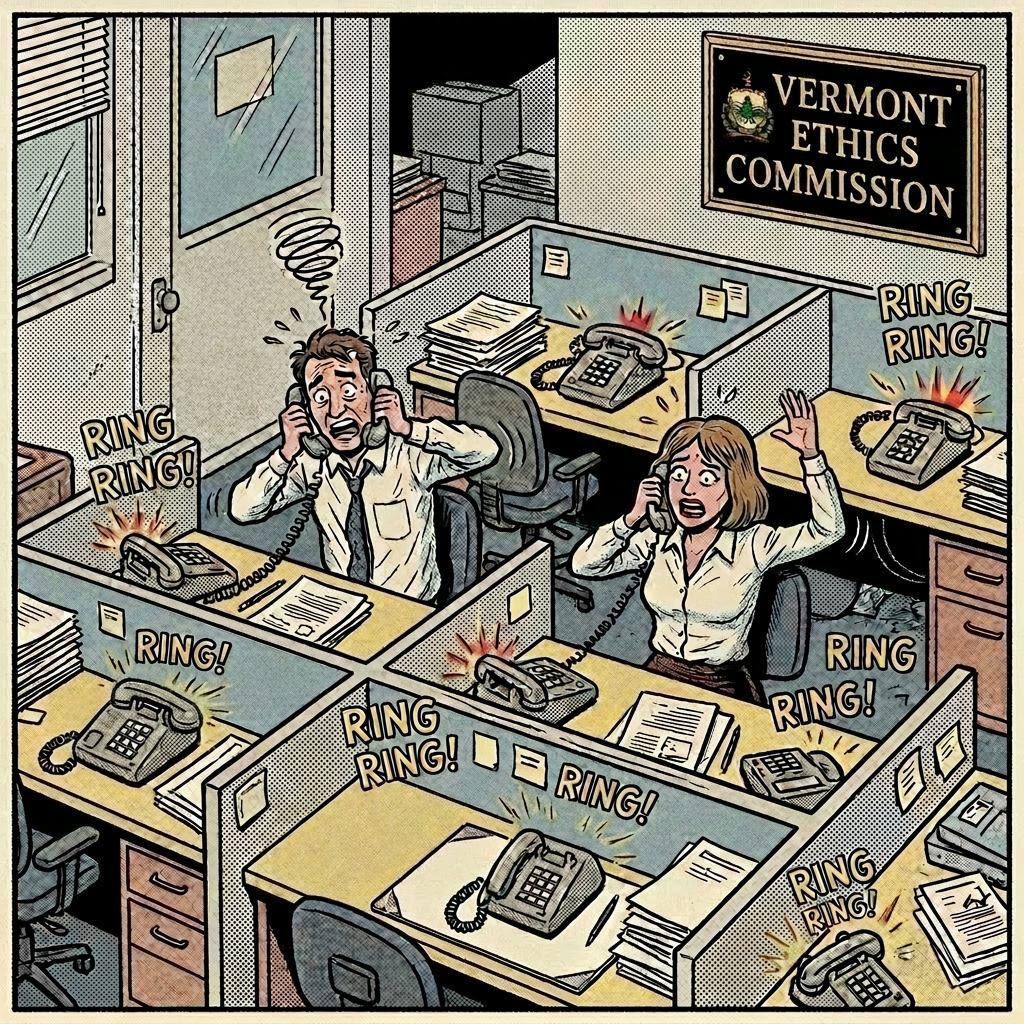
What does all of this amount to? It feels an awful lot like the legislature is setting our ethics system up to fail. The two part-time staffers the Ethics Commission has now cannot keep up with the hundreds of complaints they receive annually. Their requests for additional staff have repeatedly been rejected. Additional work keeps getting assigned, via Act 171 and now S.298, and public demand for their services continues to grow as faith and trust in state government faulters. How is this a recipe for success? Intentional or not, the effect is to under-resource the Commission to the point that it ceases to function. If that happens, the entire ethics framework in Vermont is at risk of being repealed. We've seen it elsewhere and we could see it here. Arguments like "it's become a bureaucratic mess, let's just get rid of it," or "it's not working anymore," or "they're not doing what they're supposed to be doing" could be used to get rid of the watchdogs.
The attacks have already started coming. The Chair of the Vermont Republican Party put out a press release recently that calls for the Executive Director of the Ethics Commission to step down. They also called it "alarming and irresponsible" that the Commission doesn't have the staffing to carry out the new requirements in S.298. Well... their staffing is determined by the legislature, so perhaps these words should be directed at them...
Speaking of the legislature, the Senate cut the Commission's new position from the budget. They originally asked for two, and the House provided one. Those positions were meant to support the requirements of Act 171 and didn't even contemplate the new candidate support requirements added in S.298. When asked why the Senate cut this position, the Chair of the Appropriations Committee responded that "it looked like the one new position was going to get bogged down with new assignments, so instead of a new Commission position the Legislature is talking about reducing the duties of the Commission." That should be concerning to you. What exactly does "reducing the duties of the Commission" mean? It sounds alarmingly like pulling back on ethics oversight (who wants to bet the legislature starts with rolling back oversight over themselves first?).
Now is the time to weigh in. The budget and S.298 have not received final stamps of approval yet and there is still time to course-correct. But that time is waning.
On behalf of Vermonters,
Pat McDonald
Campaign for Vermont

|
|
CFV Testimony in Senate EducationOn Friday we testified in the Senate Education Committee as they grapple with how to proceed on H.955 and education reform more generally. |
|
PRESS RELEASE: Fix Ethics System Capacity, Don’t Scapegoat StaffCFV waded into recent dispute involving the Secretary of State, the Ethics Commission, and the Chair of the VT-GOP erupted over how candidate financial disclosure forms are handled and when and where they would be available to candidates. |
 |
|
 |
Vermont Voting Rights Act (S.298)S.298 has become a more targeted and operational bill than its original title suggests. In its current draft, it builds a state voter-protection structure focused on intimidation, vote denial and dilution, and civil enforcement, while also folding in a set of election administration changes. Lawmakers were also responding to immediate confusion over candidate financial disclosure forms, agency responsibilities, and whether existing institutions have enough capacity to carry out new duties assigned in this bill and elsewhere. |
|
By-Right Housing and Other Policies (S.328)S.328 centers on aligning Vermont’s housing systems (planning, zoning, finance, and service delivery) around shared objectives while trying to preserve fiscal prudence and respect for local context. |
 |
|
 |
2026 Health Care Reforms (H.585)H.585 is a broad reform bill that combines stronger oversight with targeted market flexibility. Its most significant structural change is in nonprofit hospital service corporation and insurance governance, where the bill seeks to bring more public accountability to a corporation that plays a major role in Vermont’s health coverage system |
|
Primary Care Payment Reform (S.197)S.197 represents a significant step in Vermont’s ongoing attempt to strengthen primary care by reinvigorating the Blueprint for Health while keeping overall system costs in check. By moving toward more robust per-person, per-month payments and establishing explicit primary care spending targets, the bill signals a deliberate shift away from relying solely on fee-for-service payment toward a blended or alternative model that better supports prevention, coordination, and access. |
 |
|
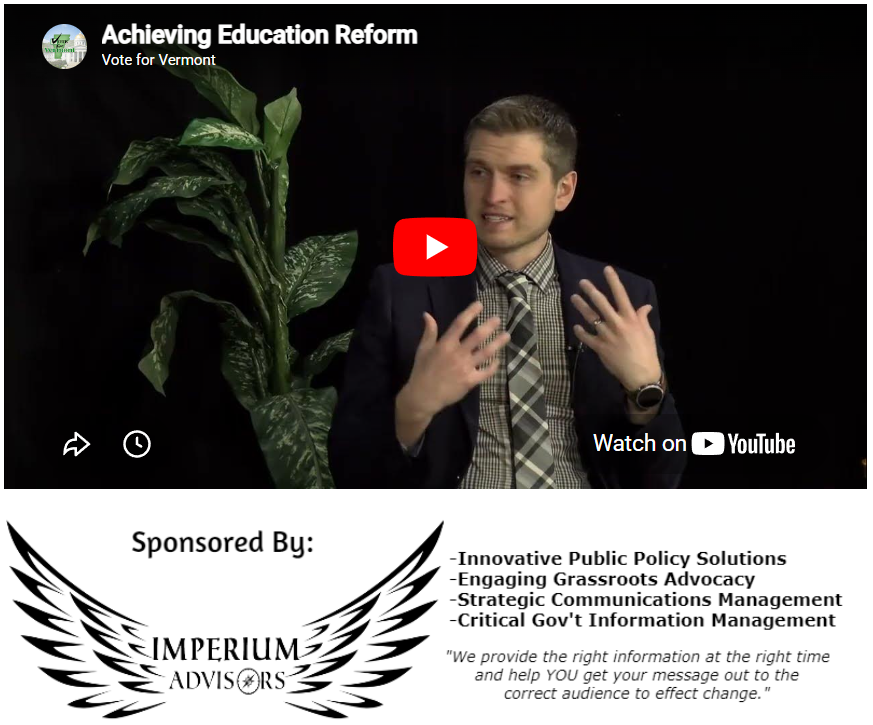 |
Featured Episode: Achieving Education ReformBen Kinsley joins Pat to discuss school governance reform, the Act 46 experience, Act 73 alternatives, and the potential of Education Service Agencies (ESAs) to achieve cost savings and improved services, including a foundation funding formula to control long-term costs and better align resources with student outcomes. |
|
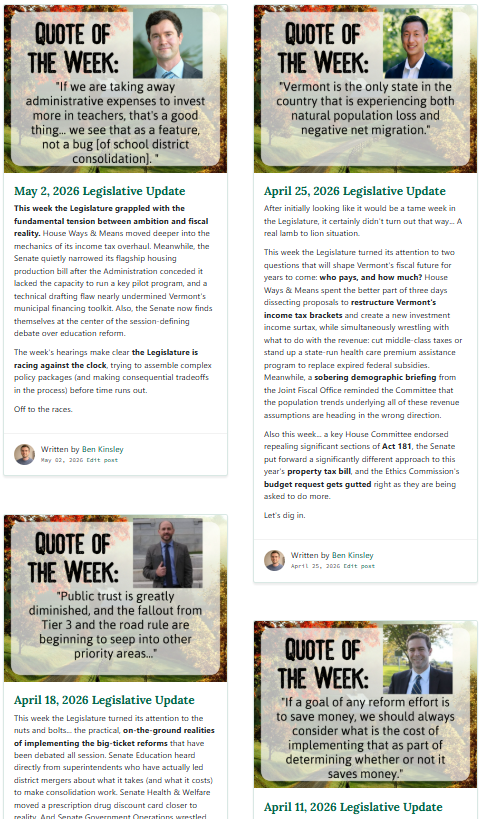
Legislative UpdatesIf you're not subscribed already, you should be. Our weekly legislative updates give provide Montpelier insights you can't get anywhere else. |
|
News Worth Reading:
Our top picks of local must-read news this month.
- Vermont's Housing Framework "Cannot Reasonably Meet Our Needs," Municipal League Tells Legislature - Compass Vermont
- After a Rural Revolt, Dems Favor Rolling Back Act 250 Reforms - Seven Days
- Vermont lawmakers divided over plan for property tax relief - Vermont Public
- Vermont lawmakers consider suspending new fines for candidates who don’t disclose their finances - VT Digger
- Why Does Vermont Have the Lowest Birth Rate in the Nation? - Seven Days
- Weinberger: Are we serious about addressing the housing shortage? - VermontBiz
- Democrats Try to Tee Up a Tax on the 1 Percent - Seven Days
- UVM Medical Center Is Losing $460,000 Every Day - Seven Days
- ANALYSIS - Vermont Raised DMV Fees to Match Inflation. Fewer Vermonters Showed Up to Pay Them. - Compass Vermont
- As gas tax revenues stagnate, Vermont Senate eyes mileage-based fee for all vehicles - Vermont Public
Campaign for Vermont's mission is to advocate for public policy changes by reconnecting middle-class Vermonters to their government.