

This week the Legislature turned its attention to the nuts and bolts... the practical, on-the-ground realities of implementing the big-ticket reforms that have been debated all session. Senate Education heard directly from superintendents who have actually led district mergers about what it takes (and what it costs) to make consolidation work. Senate Health & Welfare moved a prescription drug discount card closer to reality. And Senate Government Operations wrestled with how to modernize lobbying transparency without chilling free speech.
Of course the big happening this week was the passage of the House's education reform package, which the Governor promptly promised to veto. Why? Not because it doesn't save money (which it may or may not do) but because it doesn't force school district consolidation and the removal of local school boards.
Buckle up, here we go...
| This is a truncated version of our weekly legislative update. To receive the full version, please sign up for our legislative updates (it's free!). |
Education Reform: The Legislature's Next Move
The Legislature's next major move in Vermont's multi-year education transformation (H.955), passed the House this week after extended floor debate, clearing third reading on a 79–62 vote (not enough to sustain a veto).
The bill creates seven mandatory Cooperative Educational Service Areas (CESAs) to deliver shared services at regional scale (things like special education, back-office functions, professional development, grant writing, and transportation coordination) with modest startup grants ($15,000) and director-hiring grants ($50,000) to get them operational. Notably, the bill only mandates school districts and supervisory unions be members of a CESA, it does not require that they actually leverage shared services to gain efficiencies. A significant difference.
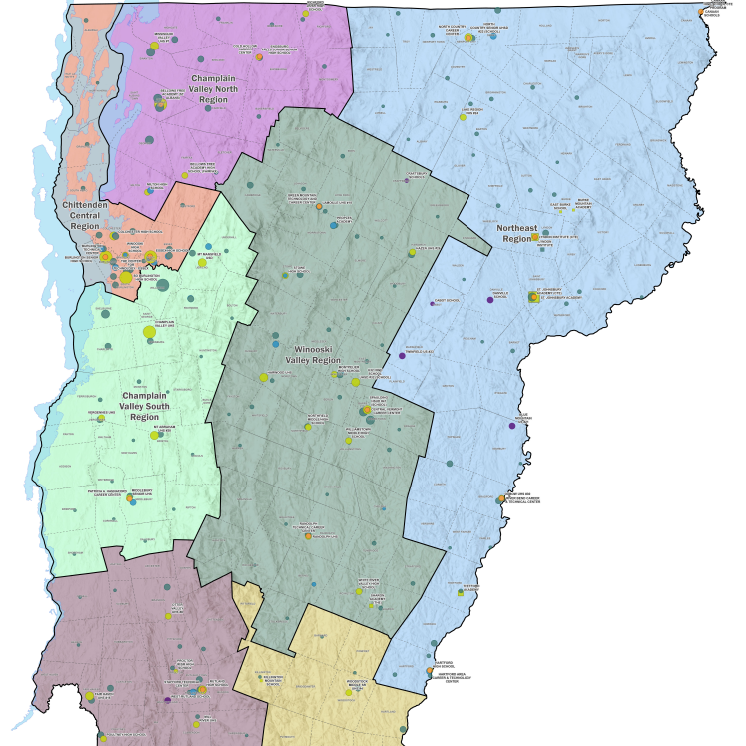
The second big requirement in the bill is that every school district in the state must participate in an assigned merger study committee to examine whether forming PreK–12 unified union school districts is advisable. Mergers themselves remain "voluntary" and subject to local voter approval, with a timeline targeting November 2028 for any merger votes that move forward.
The Ways and Means amendment added significant tax and finance architecture: a new second-home property tax classification, regional assessment districts to standardize property valuations statewide, and staged timelines to align the eventual foundation formula rollout with tax changes (designed to prevent the kind of year-over-year "tax whiplash" that has plagued prior transitions). The bill also restarts a state school construction program with prioritization criteria, potential state bonding (up to $50 million annually), and aid covering 50–95% of approved project costs. A legacy debt provision authorizes the state to cover 100% of debt service on school facility debt incurred before December 31, 2025 (removing a significant financial disincentive to voluntary mergers).
Notably, the bill delays the foundation formula's effective date from 2028 to 2030, a decision we have flagged as the bill's most significant shortcoming. Vermont's per-pupil education spending has grown at roughly twice the national average since the current funding system was established, and the foundation formula remains the most consequential tool available to arrest that trajectory. Pushing implementation further into the future extends uncertainty for districts, taxpayers, and families.
The floor debate crystallized the tensions running through the entire education reform conversation. Supporters framed H.955 as a pragmatic, community-driven path that delivers near-term savings through CESAs while respecting local voice on mergers. As House Education Chair Peter Conlon put it, the bill "can save money, provide more opportunity in a cost-effective way, and respect local voice." However, opponents questioned whether the approach is ambitious enough.
Multiple floor amendments were offered and defeated, including two to strengthen community-school closure protections, one to suspend the excess-spending penalty for two years, and one to require publicly funded independent schools to meet Education Quality Standards. All failed by decisive margins.
The bill's passage sends it to the Senate, where fresh perspectives may reshape its trajectory. Whether the Senate tightens timelines, adjusts CESA boundaries, changes the mandate around district consolidation, or revisits the foundation formula delay will be among the most consequential decisions of the session.
The People Who've Actually Done This Weigh In on Act 73
The most valuable testimony this week came not from policy analysts or agency officials, but from superintendents who lived through Act 46 mergers and can speak to what Act 73 will actually demand of communities.
Jackie Wilson, a retired superintendent who led one of Vermont's more complex voluntary consolidations, delivered a detailed, experience-driven briefing to Senate Education on Tuesday. Her core message: successful mergers are political and relational processes, not just technical ones, and the front end of the process and communication is where they are won or lost.
Wilson described a roughly one-year pre-vote timeline dominated by community outreach, financial modeling, and drafting articles of agreement. The state provided a modest $20,000 planning grant per merging unit and a $150,000 post-approval supervisory grant for integration costs (software, contract alignment, legal work). Wilson noted that while $20,000 was adequate nine years ago, inflation and larger consolidation footprints today would likely require more generous front-end funding. She also hired a communications consultant at roughly $20,000, a cost the district couldn't absorb internally.
Voluntary consolidation, she argued, produced more durable, community-owned outcomes than a top-down mandate would have.
A retired superintendent from the Champlain Valley echoed this sentiment:
"Our merger was easy…because we started establishing the picture of 'we are one' years ahead: unified contracts, unified curriculum, common budgeting practices. By the time of the vote, the culture was ready."
The emerging pattern here is important. Over the past several weeks, we have heard from the Agency of Education (which wants larger districts, top-down maps, and forced consolidation), the House Education Committee (which advanced a "voluntary" but structured approach with CESAs and facilitators in H.955), and now from the people who have actually led these mergers. The practitioners are telling the Legislature something the policy designers have been slow to internalize: the process is the product. Front-end investment in trust, communication, and community engagement is not a nice-to-have — it is the single biggest predictor of whether a merger succeeds or fails. Act 73's funding levels and timelines need to reflect that reality.
Of course, Senate Education is the same committee that just received H.955 from the House on Friday, so they will be digging into these questions in detail over the next couple weeks.
Prescription Drug Discount Gains Diverse Backing
Senate Health & Welfare took up H.577, the Vermont Prescription Drug Discount Card Program, on Thursday. The bill would authorize Vermont to join ARx, a multi-state prescription drug discount program that provides negotiated prices at the point of sale for both insured and uninsured Vermonters.
The testimony was uniformly supportive, with rare alignment of the Office of the Health Care Advocate (HCA), the Department of Financial Regulation (DFR), Blue Cross Blue Shield of Vermont, and AARP Vermont. The reason was made clear by Charles Becker of the Health Care Advocate's office:
"I take a generic medication for a chronic condition. Under my high-deductible insurance plan, I would pay about $1,800 per month for that medication until I got through my deductible. Yet pharmacies can acquire that same drug for roughly $50. Through ARx, the price appears to range from roughly $73 to $110 depending on the pharmacy."
That kind of spread (between what consumers pay and what drugs actually cost) is exactly the problem the bill targets. The Green Mountain Care Board has estimated that a cost-plus model could save Vermonters $23.6 million on generics alone. ARx isn't a full cost-plus system, but it moves consumer prices significantly closer to acquisition cost.
A critical House amendment requires that when insured Vermonters use the discount card for a covered drug, that spending must count toward their deductible and annual out-of-pocket maximum. Every witness urged the Senate to retain this language. Without it, consumers face an impossible choice: save money now but forfeit deductible credit, which discourages program use. Blue Cross confirmed it is operationally prepared to process these claims through an online submission process similar to COVID-test reimbursements.
The one legitimate concern: pharmacy viability. The Vermont Pharmacists Association flagged that ARx reimbursement rates could produce low or negative margins for some participating pharmacies (a real risk for independent rural pharmacies). The HCA proposed a targeted monitoring provision directing the state treasurer to track pharmacy impacts and to end participation only if program-caused losses are demonstrated. DFR favored a softer approach: monitor first, pursue remedial solutions before pulling the plug.
Connecticut's experience offers a cautionary note on a different front, uptake. Initial enrollment in Connecticut's similar program was low, partly because the state initially lacked deductible-counting language and didn't invest adequately in consumer education. Vermont has the advantage of learning from that mistake. AARP and other organizations have offered to partner on outreach.
This bill represents the kind of targeted, pragmatic cost-of-living relief that can make a material difference for Vermonters (particularly those on high-deductible plans or without insurance). Combined with S.190's reference-based pricing (now in the House) and S.197's primary care payment reform, the Legislature is assembling a multi-pronged health care affordability strategy.
Lobbying Transparency: Modernizing Disclosure Without Chilling Speech
Senate Government Operations took up H.686 on Friday. That bill aims to close gaps in Vermont's lobbying-advertisement disclosure law. The policy case is straightforward: the current statute was drafted for a pre-app, pre-social media, pre-robocall world. It defines communications as "orally or in writing," references "internet websites" that don't account for apps or in-app advertising, and contains a time-window limitation that excludes advertising activity that occurs after the legislature has adjourned.
Vermont Public Interest Research Group (VPIRG) presented the bill as a transparency repair, not an expansion of regulatory reach. They want to require that advertisement filings list the specific bills or issues targeted and indicate whether the ad expresses support, opposition, or neutrality. He demonstrated the need by citing real filings from the last biennium with descriptions as unhelpful as "ad in support renewable energy standards" or simply "advertising with VT Digger." That level of vagueness defeats the purpose of disclosure.
The harder question (and the one that consumed most of the committee's time) is where to draw the line between a reportable "advertisement" and ordinary advocacy. Veteran lobbyist Matt Cota supported the bill's intent but raised sharp concerns about definitional overreach: would segmented newsletters, targeted emails, or advocacy communications be swept in? His bright-line test: "An advertisement would be paid money." Paid placements are reportable; everyday advocacy emails are not.
Deputy Secretary of State Lauren Hibbert largely agreed, noting the bill already includes paid elements, and suggested the committee give the Secretary of State limited rulemaking authority to resolve ambiguous edges (such as whether paying for Mailchimp or Office 365 constitutes a reportable expenditure). This approach avoids overbroad statutory language while enabling practical implementation.
The balance here matters. Vermont has a legitimate interest in knowing who is paying to influence legislative outcomes. But if the definitions sweep too broadly, they risk chilling the kind of grassroots advocacy and constituent communication that is essential to a functioning democracy. The committee appears to be navigating this carefully, and the rulemaking suggestion offers a pragmatic path forward.
Looking Ahead
- Senate Education will continue refining Act 73 implementation details via H.955 (which they now have possession of). The big question is whether or not they will work with the House's framework or scrap it in favor of their own.
- H.577 (prescription drug discount card) moves through Senate Health & Welfare. The deductible-counting language and pharmacy-monitoring provisions are the two issues to watch.
- S.190 (reference-based pricing) continues its journey through the House. Combined with H.577 and S.197, this remains potentially the most consequential cost-of-living policy cluster of the session.
- H.686 (lobbying transparency) needs definitional precision before it can advance. The rulemaking authority suggestion may be the key to resolving the paid-versus-unpaid reporting threshold issue.
- S.325 (Act 181 fixes) is continuing to evolve, but there seems to be alignment between the House and Senate that the road rule needs to be repealed and that Tier 3 mapped areas need more work.
This was a week where the Legislature listened to the people who do the work. The superintendents, pharmacists, and administrators who testified this week were offering hard-won operational knowledge. The challenge for lawmakers is the same one it always is: translating that knowledge into statute without losing the nuance that makes it valuable.
On behalf of Vermonters,
|
|
||
|

| Sign Up for Legislative Updates |




| To continue reading, please sign up for our legislative updates (it's free!). |