

This week the Legislature continued its race against the clock, but the action shifted noticeably from the high level policy debates of recent weeks toward implementation details, technical fixes, and the quieter but consequential decisions that determine whether ambitious legislation actually works on the ground. The Senate pumped the brakes on proposed changes to its new housing finance tool (CHIP), the House heard about a promising geothermal pilot program that could reshape how Vermont delivers clean and affordable energy, and Senate Education weighed in on whether to terminate or fund the state's school PCB testing program.
Meanwhile, the education reform debate continues to simmer in Senate Education as the clock ticks toward adjournment. What appears to be taking shape is a more coherent, democratic, and data-informed bill than what emerged from the House. If it doesn't fall apart at the 10-yard line...
Let's dig in.
| This is a truncated version of our weekly legislative update. To receive the full version, please sign up for our legislative updates (it's free!). |
Housing Production: The Senate Hits Pause on CHIP Changes
The Senate Economic Development Committee devoted a lengthy Thursday hearing to proposed statutory amendments to the Community Housing Infrastructure Program (CHIP). This is the same tax-increment financing tool created last session to help municipalities (especially smaller ones) finance housing-supporting infrastructure. The hearing featured a revealing split between developers eager to loosen statutory guardrails and oversight officials urging patience.
Four proposed changes were on the table:
- Clarifying the "public good" test so that privately-owned infrastructure serving housing could qualify
- Broadening eligible costs to reimburse developer/sponsor expenses (attorneys, consultants, pre-development work) rather than requiring municipalities to front those costs
- Relaxing the primary-residence requirement for subsequent purchasers while CHIP debt is outstanding
- Converting tax increment from a rebate to a tax credit to ease developer cash flow
Consultants argued these changes would smooth "rough edges" that create financing friction. But the the State Auditor's office warned, bluntly, that the proposals "largely remove statutory guardrails," thereby weakening the public-good test, creating audit risks, and potentially allowing taxpayer support to flow toward second homes or short-term rentals. The Joint Fiscal Office confirmed that expanding allowable uses of tax increment would reduce revenue otherwise flowing to the Education Fund and complicate municipal tax operations.
Most notably, Vermont Economic Progress Council (VEPC) board members (who wrote the program guidelines) urged the Committee to wait at least a year before making statutory changes. The committee agreed. The proposed amendments will not be folded into H.775 for this session. Instead, the program will continue to operate under current law and guidelines, with statutory revisions to be considered next session after real operational data is available.
Community-Scale Geothermal: A Promising Model Emerges
The House Energy Committee heard a genuinely interesting briefing Thursday on a community-scale geothermal pilot at Windy Ridge in Hinesburg. The pilot is a partnership between Vermont Gas Systems (VGS), Champlain Housing Trust (CHT), Evernorth, and Green Mountain Habitat for Humanity. Advancing technology has rapidly expanding the number of locations where geothermal heating and cooling are viable. The US Department of Energy now identifies this technology as a valuable component of America's future energy needs.
The model is worth understanding because it addresses persistent barriers to clean energy adoption in affordable housing: upfront capital cost, ongoing costs, and operational complexity.
Here's how the pilot works: VGS installs, owns, and maintains the in-ground geothermal loop infrastructure (closed-loop boreholes drilled roughly 400–500 feet deep). Building owners pay an access fee and ongoing maintenance fee (similar to how they currently pay for a gas connection). CHT, as the landlord in this case, absorbs electricity costs (included in rent), so the model only works if total operating costs are competitive with conventional alternatives.
Why this matters beyond the pilot: If the economics work (VGS estimates roughly 7–10 year payback, though that's preliminary), the utility-ownership model removes the upfront capital barrier that has stalled ground-source heat pump adoption in affordable housing. In-ground loop assets have expected lifespans of 50–100 years, indoor heat pump equipment lasts 20–30 years, and the centralized maintenance model through an established utility addresses the reliability and workforce concerns that plague distributed systems (i.e. systems serving only one home).
Committee members were engaged and supportive, probing with questions on payback timing, regulatory treatment, property tax implications, and whether the model could expand beyond VGS's current service territory (which would require regulatory approval). VGS and CHT committed to provide more detailed financial modeling and host site visits during construction this summer.
This is the kind of pragmatic, cross-sector partnership that can actually move the needle on housing production, energy costs, and decarbonization. These are policy goals that too often exist in separate policy silos; the key question going forward is whether the current regulatory framework can accommodate expansion if the pilot succeeds.
PCB Testing: Senate Education Refuses to Walk Away
Senate Finance received H.542 from the Senate Education Committee this week. The House-passed version of the bill bill that would have terminated Vermont's organized PCB testing program for schools. Senate Education's message was unambiguous: they reject the House's approach.
Rather than ending the program, Senate Education endorsed continuing testing for schools already in the queue and finding state funding to complete the work. The committee converged on a figure of roughly $10 million over four years (~$2.5M/year) to finish testing the approximately 160+ pre-1980 school buildings that haven't yet been assessed.
The arguments for continued state support include:
- Equity: Wealthier districts can self-fund testing and remediation; lower-resource districts cannot. Terminating state support creates a two-tier system where children's exposure to a known carcinogen depends on their community's property tax base or willingness to incur debt.
- Litigation coordination: The Attorney General has pending litigation against manufacturers historically responsible for PCB contamination. Costs incurred under the state umbrella are far easier to recover through settlement or judgment.
- Integration with school construction: The committee recommended folding PCB testing and remediation into the broader school facilities planning process. This is a logical connection given H.955's school construction provisions.
The state created this testing program because the problem requires coordinated, equitable action. Walking away now (when roughly half the at-risk buildings remain untested) could be seen as a public health failure despite the cost burden remediation places on local communities. The key questions are whether the Appropriations Committee can find the $10 million, and whether the final bill integrates testing into the school construction framework that's being built through H.955.
Education Reform: The Clock Is Ticking
While this week's education hearings were less dramatic than last week's four-vision collision in the Senate, the underlying dynamics haven't changed, and the timeline pressure is intensifying. The Senate Education Committee must produce its version of H.955 in the coming days, and the fundamental design choices we flagged last week are still sticking points:
- Mandatory vs. voluntary CESA service use (membership alone vs. requiring districts to actually leverage shared services)
- Foundation formula timing (every year of delay extends the spending incentive structure that has produced twice-national-average per-pupil cost growth over the last 30 years)
- Legacy debt provisions (the Senate removed the House's uncapped version but hasn't settled on an alternative)
The Committee is making progress, with new drafts introduced nearly daily this week that include a clearer vision for regional coordination for k-12 education that includes community elementary schools, local middle schools, regional high schools, and accessible (and integrated) career and technical education. This is a positive development, as is the proclivity of the committee to avoid top-down mergers that have proven to be ineffective in previous efforts. Another positive addition to the bill is the addition of full cost-benefit analysis for each merger that takes a full view of all costs and the readiness of the district for the upcoming foundation formula implementation. Of course, even after all this progress, some committee members brought a whole new set of priorities to the table on Friday that threaten to derail the bill...
The Governor's veto promise continues to loom over the entire process. The House's 79–62 vote is not veto-proof, meaning the Senate's version needs to either attract significantly broader support or the two chambers must find a compromise the Governor can sign. Neither path is easy, and time is running short.
Looking Ahead:
-
Senate Education must finalize its version of H.955 imminently. Positive progress is being made but the final version will be dependent upon the parties at the bargaining table.
-
H.775 (housing production) moves forward in its current form after the committee declined to fold in CHIP amendments. The bill assembles a wide array of housing tools, though it remains less ambitious than earlier iterations following the Administration's removal of the off-site construction pilot.
-
H.542 (PCB testing) needs a funding path. The $10 million ask will test Appropriations' willingness to invest in public health infrastructure during a tight budget year.
-
House Ways & Means is seeking finalize its income tax/health care package. Although it is unclear what vehicle this might be attached to and the Governor has made clear that he believes this effort is misguided.
-
H.949 (yield bill) heads toward conference committee. The 3.8% vs. 6.7% property tax increase gap remains the central negotiating point. The House Ways & Means Committee has asked us to weigh in this coming week about our recommendations for stabilizing the state's property tax system over the short-term.
-
S.325 (Act 250/land use) passed the House floor following last week's strike-all that repealed the road rule and Tier 3. The Senate will now review changes and determine whether or not to concur or negotiate.
- S.298 (Elections/Ethics) is now being reviewed by the Senate Government Operations Committee. We pushed them this week to ensure funding for the Ethics Commission given the new candidate support requirements included in the bill. The legislature has chronically underfunded the Commission and this is just the latest example.
There are a lot of positives this week, but the harder decisions (on taxes, education governance, and fiscal sustainability) still await. The quality of deliberation offers some reason to believe those decisions, when they come, will be better for the care taken now.
On behalf of Vermonters,
|
|
||
|

| Sign Up for Legislative Updates |
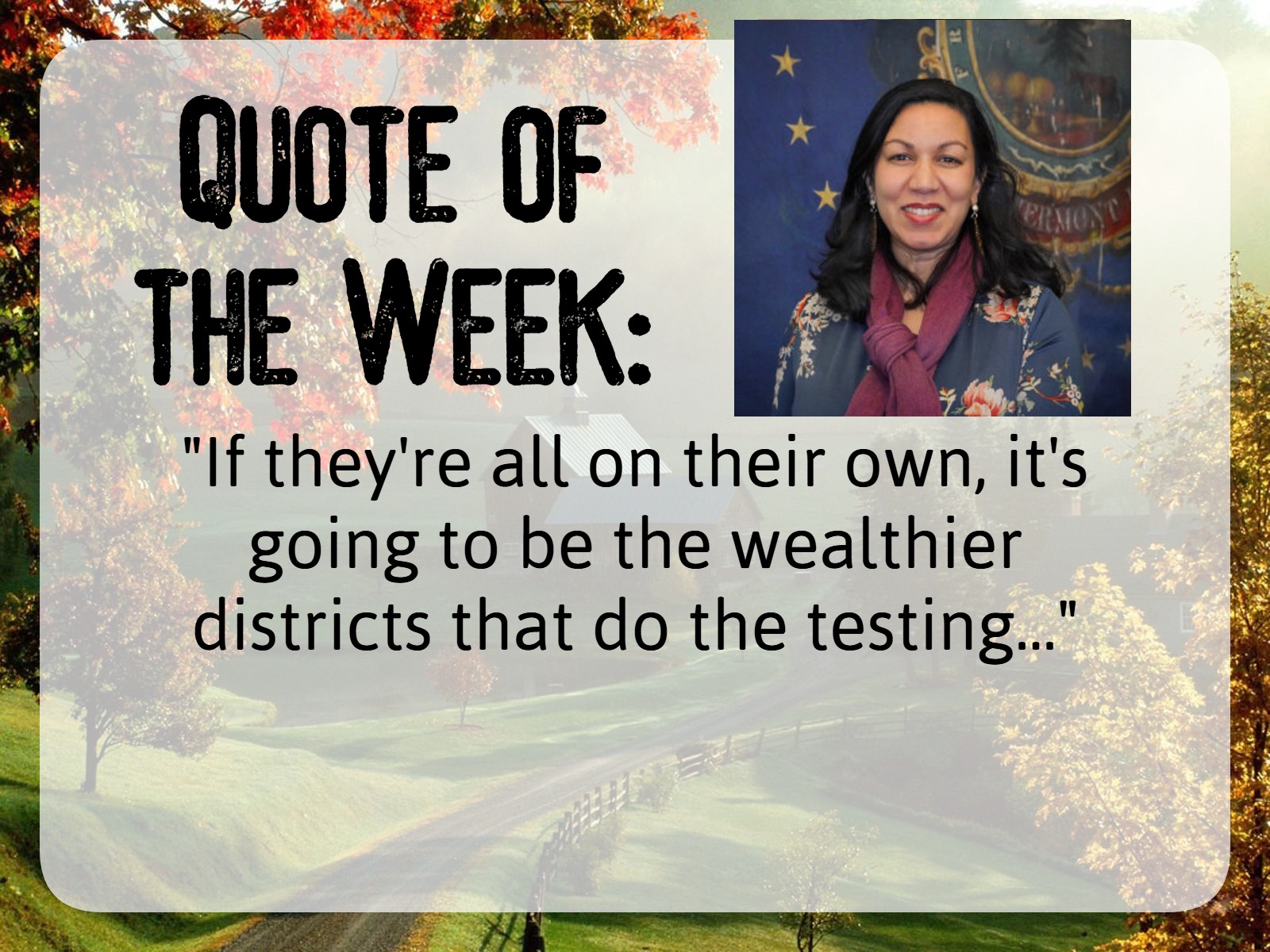
Quote of the Week:"If they're all on their own, it's going to be the wealthier districts that do the testing..." Comments in regards to school PCB testing and remediation requirements.
|
|

| Kesha Ram Hinsdale |
| Senator, Chittenden-Southeast |

LETTER: End the Cycle of One-Time Funds
The use of one-time funds creates funding cliffs in the following years that require further expenditure of one-time funds to fill... This is a cruel game of musical chairs. We sent a letter to the House Ways & Means Committee this week asking them not to perpetuate this situation.
LETTER: Fund Our Ethics System
A strong ethics framework builds public confidence in the work of public officials and protects said public officials from unfounded accusations. We called on the Senate Government Operations Committee this week to fund the state's ethics and oversight system.
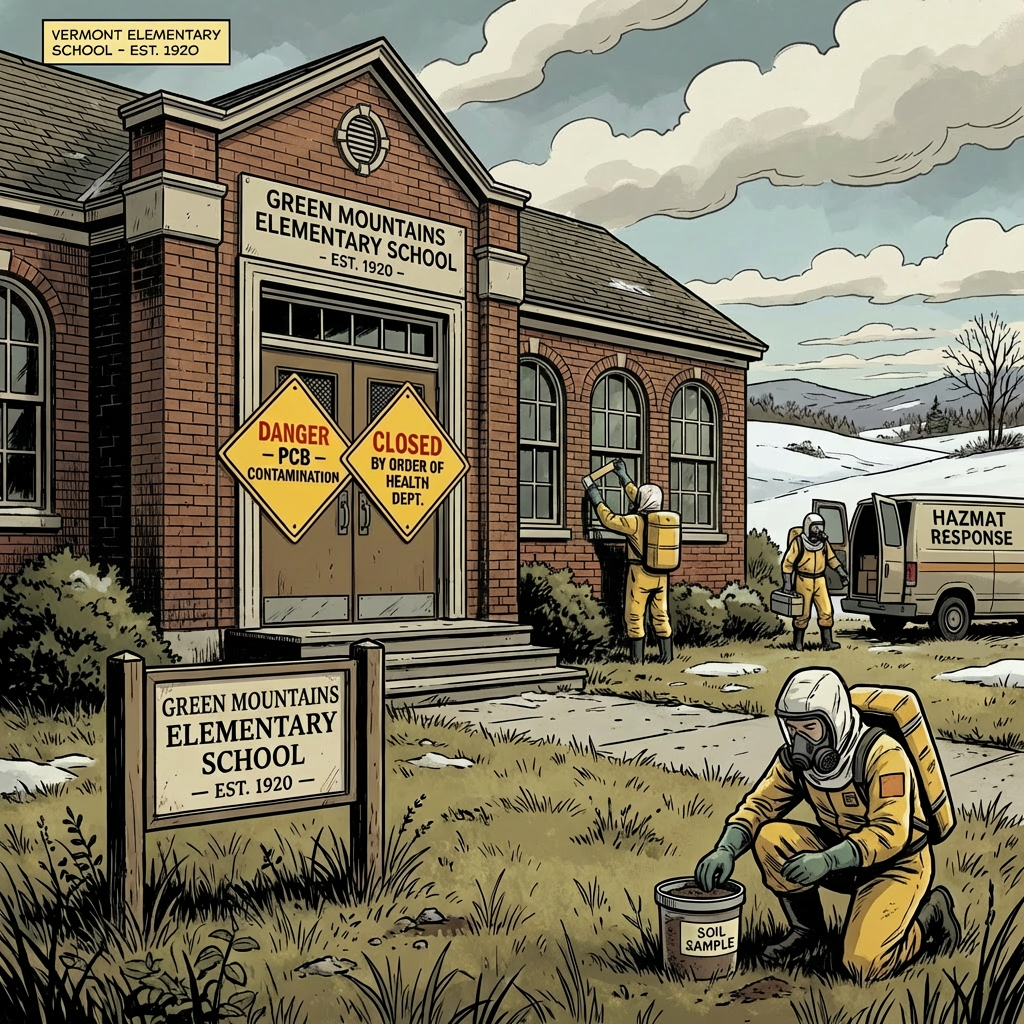
UPDATED: Terminating the School PCB Testing Program (H.542)
Instead of terminating the statewide school PCB testing mandate, the Senate version of H.542 now extends the testing deadline to 2031 and creates a dedicated Program Fund and grant structure to support investigation and cleanup. The new approach attempts to manage PCB risks over a longer timeline, with a clearer (though still limited) financing framework.
UPDATED: FY2027 Property Tax 'Yield' Bill (H.949)
The Senate passed a much different version of the annual property tax bill than the House. The House has now called for a conference committee to work out the differences.


Media Appearance: WCAX
Ben was interviewed this week by WCAX's Calvin Cutler about the dispute between the Secretary of State and the Ethics Commission that is holding up candidate disclosure forms.
| To continue reading, please sign up for our legislative updates (it's free!). |